
Editor’s Note: This article is produced in collaboration with the Chongqing Institute of Foreign Studies as part of a series of ongoing reports exploring the city’s abundant resources in intangible cultural heritage.
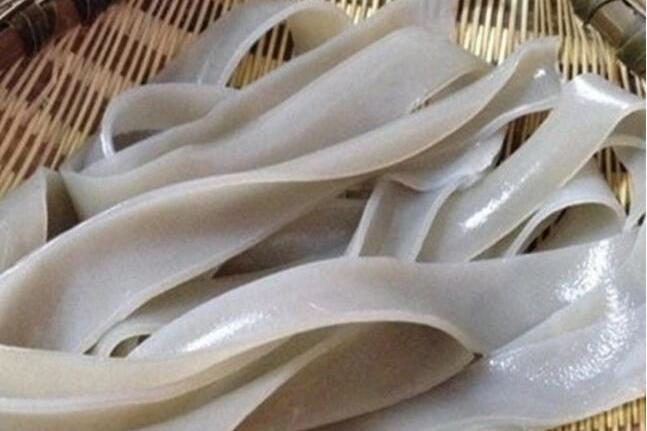
Tukan Sweet Potato Noodles in Wulong District, Chongqing.
You’ve surely heard of the renowned Fairy Mountain in Wulong. But do you know about Tukan Sweet Potato Noodles, a specialty crafted through a unique traditional technique? Made from stone-ground sweet potatoes, these noodles preserve an ancient manual grinding method, making them a treasure among Wulong’s sweet potato products and earning recognition as a celebrated Chinese dish.
Wulong enjoys a distinctive combination of climate, soil, evening sunshine, river breeze, and spring water—conditions that give rise to the red-skinned, crisp, sweet, and fragrant “Ruby” sweet potatoes. These potatoes are the ideal ingredient for producing Tukan Sweet Potato Noodles. According to local legend, during the Kangxi Emperor’s reign in the Qing Dynasty, a boatman along the Wujiang River used these sweet potatoes and, through sixteen traditional stone-milling steps, created noodles that were “fresh, glutinous, and crystal-clear.” Thus, Tukan Sweet Potato Noodles came into being.
The production process is rigorous and meticulous, embodying the essence of craftsmanship. It begins with the careful selection of high-quality sweet potatoes, which determines both flavor and texture. Large, plump potatoes with high starch content are thoroughly washed to remove impurities. Then, under the roar of grinding machines, they are milled into fine powder. The settling process further purifies the starch, filtering out impurities and yielding clean, refined starch ready to be shaped into smooth, tender noodles.
The most visually striking step is the noodle-extruding process. Experienced masters hold a sieve and gently filter the prepared starch slurry into boiling water. Long, thin strands fall like silk, swirling lightly as they cook—a scene that never fails to evoke admiration for the magic of traditional craftsmanship. After cooling and sun-drying, Tukan Sweet Potato Noodles become white and glossy like jade, with a texture that is soft yet resilient. Whether served in a steaming soup, stir-fried into a fragrant dish, or prepared as a refreshing cold salad, they offer pure satisfaction with every bite.
Wulong Sweet Potato Noodles, known for their distinctive flavor and artisanal technique, have gained popularity not only in Chongqing, Wuhan, and Shanghai, but also abroad. They are now exported to more than ten countries and regions, including the United States and Australia. Their production technique reflects the wisdom and diligence of the Wulong people and showcases the enduring appeal of traditional Chinese food culture. Today, this craft stands as a vital cultural heritage worthy of continued preservation and transmission.
Chinese script: Chen Dan
Tutored by: Chen Fangyi
Translation: Su Yi
Tutored by: Tu Qingqing, Jiang Jun
Voice-over: Luo Ying
By continuing to browse our site you agree to our use of cookies, revised Privacy Policy and Terms of Use. You can change your cookie settings through your browser.
For any inquiries, please email service@ichongqing.info