
Chongqing - On the afternoon of December 9, visitors flowed steadily across the E'ling Cliffside Walkway, another “skyline landmark” in Chongqing. Near E'ling Park, a small teahouse run by Chen, a local business owner of five years, was packed with customers. Since the walkway opened, the once-quiet shop has rarely had an empty seat.
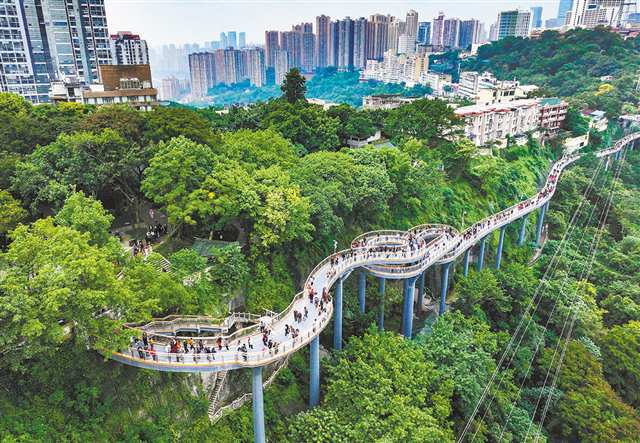
On November 12, the E'ling Cliffside Walkway along Chongqing’s mid-mountain cliffside route officially opened to the public, drawing large numbers of residents who stopped to take in the views. (Photo/Zheng Yu, Visual Chongqing)
Chen’s experience reflects a broader transformation underway in Chongqing: the city’s mountain walkways are no longer just pedestrian infrastructure but have become vibrant corridors driving urban consumption.
Since 2019, Chongqing has accelerated the construction of an integrated Mountain City Walkway network that connects neighborhood alleys, riverside paths, and forest trails. To date, the city has completed 871 kilometers of walkways. Winding through hillsides and along riverbanks, these routes act as the city’s “urban capillaries,” linking neighborhoods with scenic areas and channeling foot traffic into commercial activity. Increasingly, they are helping create new consumption scenarios and revitalize local businesses.
Opened in mid-November, the 460-meter E'ling Cliffside Walkway quickly became a popular destination for residents and tourists alike. Suspended along a ridgeline, the elevated walkway links Fotuguan, E’ling Park, and other scenic spots into a continuous loop, allowing visitors to move seamlessly from one attraction to another without retracing their steps.
“The increase in foot traffic is on a completely different scale,” Chen said. He has noticed that visitors now move more slowly along the route, with more young people choosing to stop for tea, enjoy the scenery, and linger for one or two hours rather than simply passing through.
The surge in visitors has translated directly into stronger local spending. A neighborhood tofu shop nearby reported nearly triple year-on-year revenue growth in November, while a handicraft store saw brisk sales after launching walkway-themed cultural products.
According to Wan Ziyu, a member of the walkway planning team, the route was designed with area revitalization in mind. By linking community nodes between E’ling and Fotuguan parks, the project aimed to stimulate local commerce and unlock underused resources through a linear urban renewal approach.
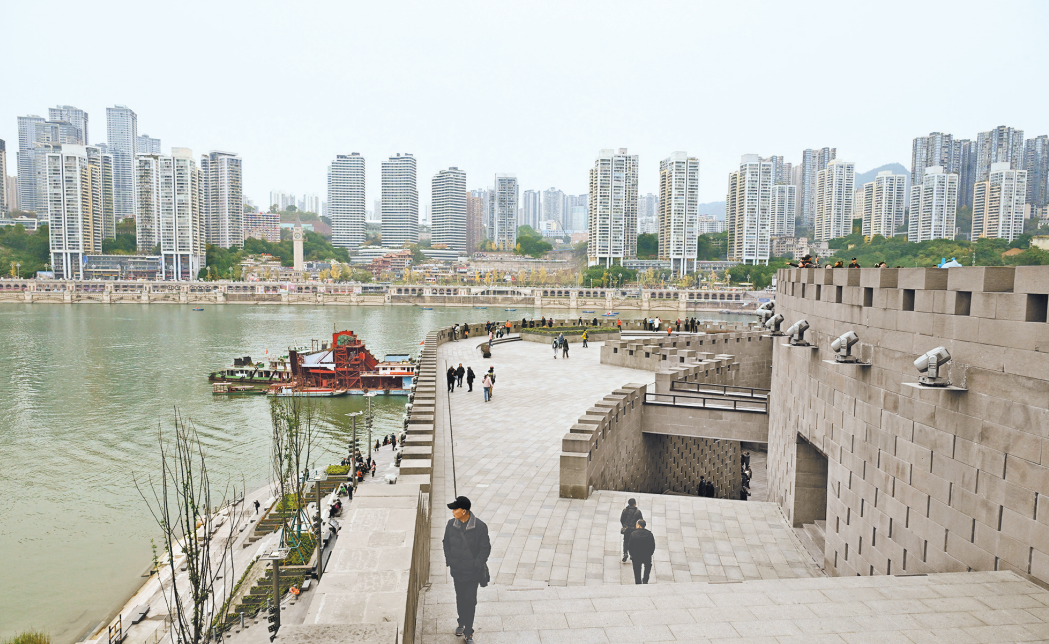
On December 4, residents stroll along the riverside walkway between Chaotianmen and Hongyadong in Chongqing. (Photo/Luo Bin, Visual Chongqing)
Similar effects can be seen elsewhere. In the Chaotianmen area, a 2.4-kilometer riverside walkway connects Hongyadong, Chaotianmen Square, and the Huguang Guild Hall. The route offers a convenient “walk-and-explore” experience while doubling as a prime viewing corridor for the confluence of the Yangtze and Jialing rivers and the city’s night skyline. As visitors linger, consumption naturally extends to nearby dining, retail, and cultural venues.
Municipal authorities estimate that Chongqing’s walkway network now attracts about three million visits per day, forming a multifunctional, efficient, and all-age-friendly slow-mobility system.
Beyond attracting crowds, Chongqing’s walkways have evolved into distinctive consumption spaces in their own right. Planners have leveraged the city’s dramatic vertical terrain to transform walkways into experience-oriented commercial environments.
Along the Jialing River, Daijia Alley—once a dense and disorderly cliffside residential area—has been revitalized through the construction of a suspended walkway with an elevation change of about 60 meters. The project opened new river-view corridors and encouraged ground-floor residences to gradually transform into cafés, craft shops, and creative studios, achieving organic community renewal.
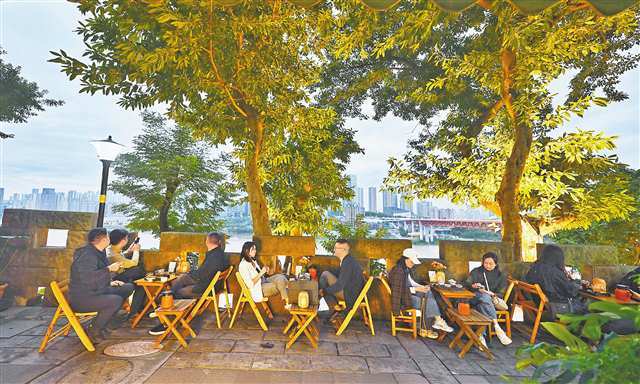
On October 21, visitors enjoy tea and conversation along the Daijia Alley cliffside walkway in Yuzhong District, Chongqing. (Photo/Long Fan, Visual Chongqing)
“Cliffside locations used to be impossible for business,” said Lin Yue, who runs a café beside the walkway. “Now they’ve become prime spots.” Her café, overlooking the river, often attracts visitors who stop for coffee, sunset views, and extended breaks.
Today, more than 40 small businesses line Daijia Alley, forming a themed commercial street that blends Chongqing’s mountain-city character with contemporary lifestyle appeal. According to local officials, light renovations covering 7,200 square meters of aging buildings, along with the addition of 1,100 meters of cliffside walkways and viewing platforms, have contributed to a 15 to 20 percent rise in commercial rents. Similar models are emerging across the city. In Shangqingsi’s Zengjiayan area, cliffside paths and aerial walkways link multiple cultural heritage sites. In Dadukou District, a 22-kilometer cliffside route along the Yangtze River connects former industrial sites, museums, and riverside parks into an integrated walking and cycling corridor. From an urban renewal perspective, Wan noted that walkways can consolidate scattered urban resources into public assets that are walkable, experiential, and commercially viable, generating sustainable momentum for community vitality.
Chongqing’s walkway network is far from uniform. Different types of routes—riverside, forest, and neighborhood walkways—are developing along distinct paths based on local resources and user demand.
City officials emphasize a planning approach that prioritizes classification and local adaptation. Riverside walkways along the Yangtze and Jialing rivers have naturally fostered a vibrant waterfront economy, with activities such as kayaking and paddleboarding driving demand for outdoor equipment rentals and light dining.
Forest walkways focus on ecological and cultural value. On Nanshan’s Huangge Ancient Trail, heritage protection is paired with nature education stations and scenic teahouses, turning hiking into an immersive cultural experience. In Shapingba District, the Gele Mountain walkway integrates research, wellness, and recreational facilities, attracting families and nature enthusiasts and forming a green consumption chain centered on hiking, education, and health.
A single walkway can serve as a scenic route, a commercial strip, or a cultural corridor. In Chongqing, this growing pattern of diverse, experience-driven pathways is steadily injecting new momentum into the city’s consumption-led urban development.
By continuing to browse our site you agree to our use of cookies, revised Privacy Policy and Terms of Use. You can change your cookie settings through your browser.
For any inquiries, please email service@ichongqing.info