
Chongqing — On Dec 18, China launched island-wide special customs operations at the Hainan Free Trade Port (FTP), easing entry for overseas goods, expanding zero-tariff coverage, and improving the business environment. Experts and business leaders told Bridging News the move could significantly boost trade and investment.
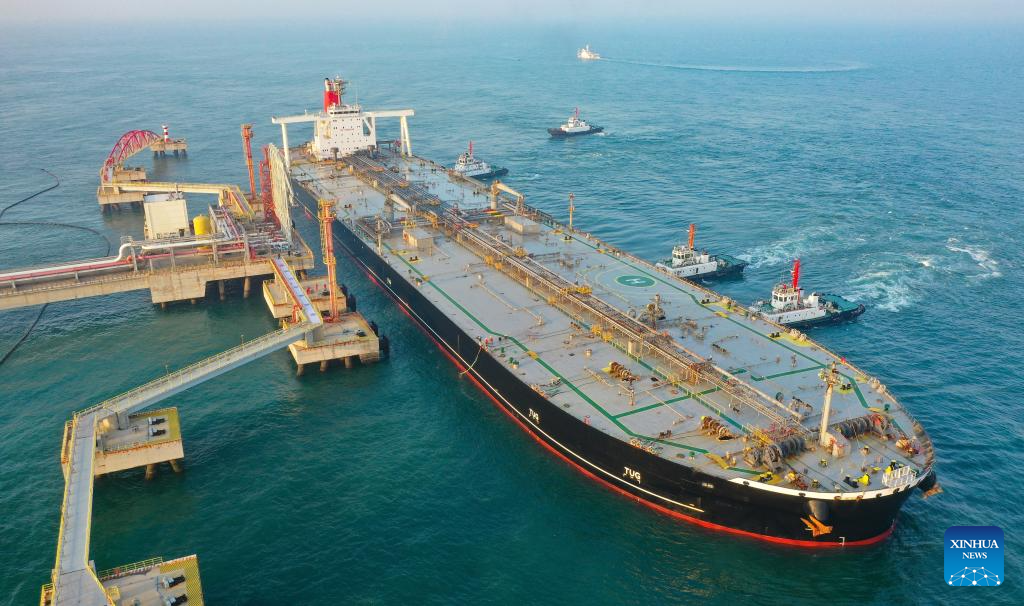
An aerial drone photo shows a foreign vessel carrying petrochemical raw materials berthing at Yangpu Port in Danzhou, south China’s Hainan Province, December 18, 2025. (Xinhua/Guo Cheng)
Under the new arrangements, the 30,000-sq-km tropical island is now a special customs supervision zone, marking a new stage for the Hainan FTP that enables freer flows of goods, capital, people, and data under zero tariffs, low taxes, and a simplified tax system.
Located on China’s southernmost island, the Hainan FTP is the country’s largest special economic zone and a key reform test bed. Under the new customs regime, it follows a model of “freer access at the first line, regulated access at the second line, and free flows within the island”.
The “first line”, linking Hainan with overseas markets, will allow most imported goods to enter tariff-free with faster customs clearance. The “second line”, referring to the customs boundary between Hainan and the mainland, will apply standard customs oversight to ensure fairness and prevent smuggling.
Yang Yong, a professor at the School of Economics at Southwest University of Political Science & Law, said the term “closed customs operations” associated with the Hainan FTP is often misunderstood by international observers.
In customs terms, “closed operations” mean the entire island functions as a special customs-supervised zone under the principle of “opening the first line and managing the second line”. Goods, capital, and people can move freely between Hainan and overseas markets, while flows between Hainan and the rest of China remain subject to standard customs controls and taxes.
“The ‘closed’ aspect mainly refers to the ‘second line’ with 30% value-added processing and duty-free policy,” Yang said. Under this arrangement, companies in Hainan that fall within the encouraged industries list and whose products achieve more than 30% value added after processing imported raw materials can sell those products to the mainland without paying import duties.
Rather than signalling restriction, Yang said the move reflects China’s broader efforts to promote free trade and expand high-standard opening-up during the 15th Five-Year Period, serving as a “stress test” for China’s institutional opening-up.
Unlike traditional free trade zones, the Hainan FTP represents one of the highest degrees of openness, as the entire island enjoys free trade rather than limited, designated areas. The impact is most evident in tariff and mobility policies: about 74% of goods will enjoy zero import tariffs, with the number of covered tariff items expanding sharply from more than 1,900 to over 6,600. Travel is also becoming more convenient, with visa-free entry now available to citizens of 86 countries.
In this sense, Yang said, Hainan will serve as a bridgehead for China’s opening-up. Following the implementation of island-wide customs operations, exchanges between Hainan, the international community, and the mainland are expected to become smoother and more efficient. Policy benefits will continue to be released, including more relaxed trade management measures. Some goods prohibited or restricted on the mainland can be imported into Hainan, and the list of zero-tariff goods is set to expand further.
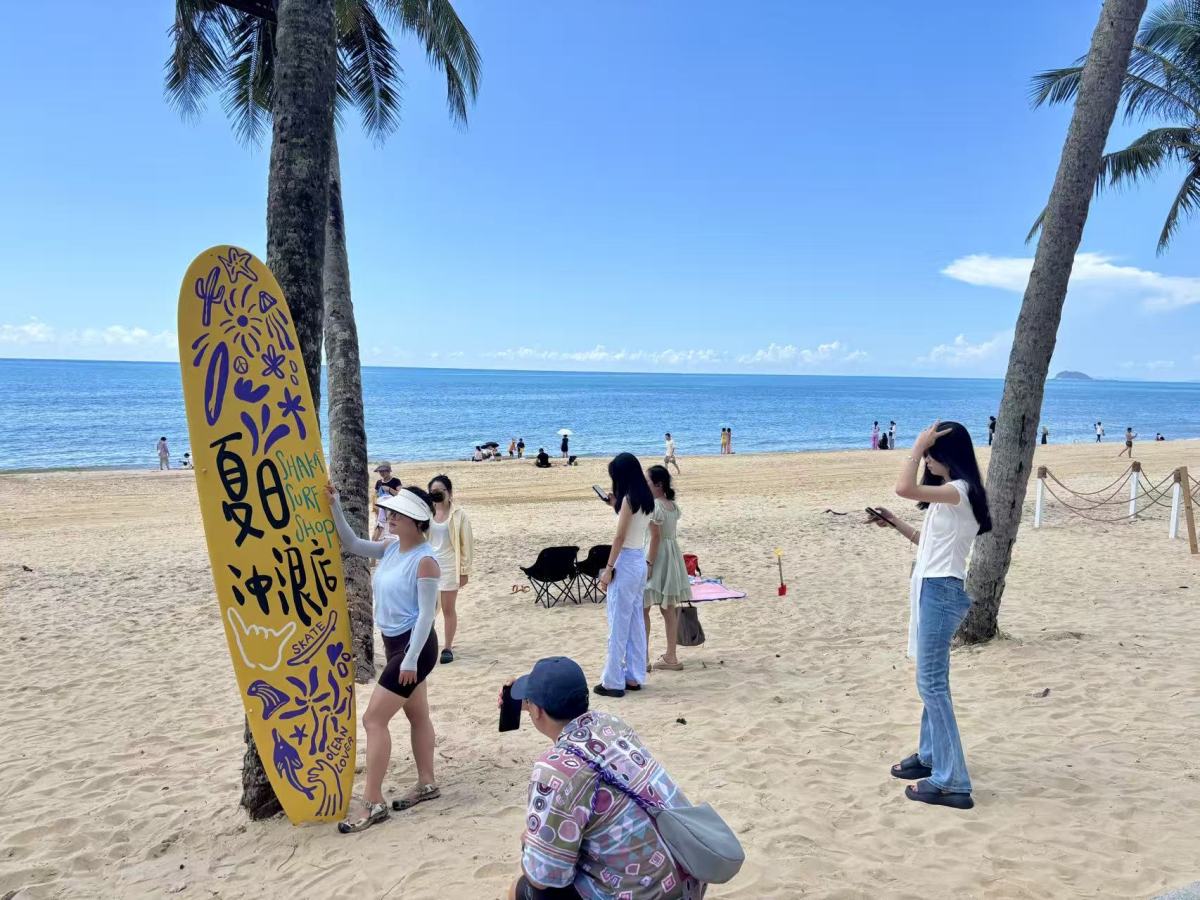
Hainan’s stunning beaches draw visitors from all over. (Photo/Chen Zhan)
Yang noted that Hainan’s past development model, which relied heavily on agriculture and tourism, has struggled to sustain growth and build industrial depth. To function as a true free trade port, Hainan must move beyond a consumption-driven island economy and build a production- and service-oriented system anchored in shipping and finance.
Yang believed shipping would be central to Hainan’s development, as the free trade port’s institutional advantages can only be fully realised through efficient logistics and global connectivity. For instance, Yangpu Port is well positioned to play that role, given its status as China’s closest container port to ASEAN by sea and its natural deep-water conditions, which allow it to accommodate large vessels and support international shipping routes.
“Managing the port is a key issue for Hainan,” he said. “Shipping determines whether goods can move efficiently, at low cost, and on a large scale. Without a strong shipping sector, the advantages of zero tariffs and freer trade cannot be fully translated into real economic activity.”
Yang said shipping acts as the backbone of the FTP, directly supporting trade in goods while also anchoring related industries such as logistics, warehousing, ship leasing, maritime services, and cross-border e-commerce. As cargo volumes increase and trade flows become more frequent, demand for insurance, settlement, financing, and risk management rises, creating natural spillover effects into the financial sector.
Finance, in turn, plays a critical enabling role. Yang said a developed financial system is essential to support shipping operations, trade financing, and investment flows, particularly under a model that encourages cross-border capital movement and offshore trade. “Shipping and finance need to grow together,” he remarked. “Only with sufficient financial support can shipping drive other industries such as tourism, consumption, and modern services.”
Lin Xueping, a visiting researcher at the China Institute for Quality Research at Shanghai Jiao Tong University, also identified finance as the most decisive factor in determining whether Hainan can differentiate itself from other free trade zones. He said that if the Hainan FTP develops strong financial attributes, it could become attractive to Chinese companies seeking to expand overseas.
Such a role would allow enterprises to use Hainan as a base for outward investment, international trade, and regional headquarters. However, he cautioned that the port will face direct competition from established financial centres like Hong Kong and that its policy effects will need time to be thoroughly tested.

Hainan is home to a wide range of duty-free shopping malls, featuring an array of top brands. (Photo/Chen Zhan)
For enterprises, Yang noted that some of the biggest opportunities will emerge in sectors closely tied to port operations and related industries, where faster clearance, streamlined procedures, and lower friction at the border can quickly translate into real savings and new market access.
This matters not only to coastal firms but also to inland manufacturing hubs. Chongqing, with its strong auto and motorcycle industries, could use Hainan as a transfer hub—linking logistics, warehousing, and customs services—to shorten delivery times and reach overseas markets more efficiently. In this way, Hainan can complement inland regions by acting as a cost-effective coastal gateway for global exports.
At the same time, island-wide special customs operations are expected to benefit both domestic and international enterprises that want to invest in China. Many companies have already moved early to establish a presence in Hainan ahead of the policy rollout. Ms Chen, a business owner from Chengdu in Sichuan province, is one of them.
“I had a consulting firm in Chengdu and have now established a wholly owned subsidiary in Sanya,” she told the reporter. Chen explained that the decision was not only about following the policy, but also about being physically close to where new trade rules will be implemented. Setting up in Hainan allows her team to stay near the front line of regulatory updates and to connect with government service windows and industry partners more easily.
Chen said the customs changes are expected to bring broader free trade opportunities across a wide range of products—from consumer goods and cosmetics to electronics and machinery—because the core advantage is improved circulation and efficiency. “Tax incentives are the biggest benefit, as they reduce costs and allow goods to move more quickly and smoothly,” she noted.
Official data show that since 2020, more than 9,600 foreign-invested enterprises have been newly established in Hainan, with investors from 176 countries and regions. With the launch of island-wide special customs operations, the province is expected to further strengthen its role as a headquarters base for overseas companies entering the Chinese market, while also serving as a springboard for Chinese firms to build the capabilities and connections needed to expand internationally.
By continuing to browse our site you agree to our use of cookies, revised Privacy Policy and Terms of Use. You can change your cookie settings through your browser.
For any inquiries, please email service@ichongqing.info