
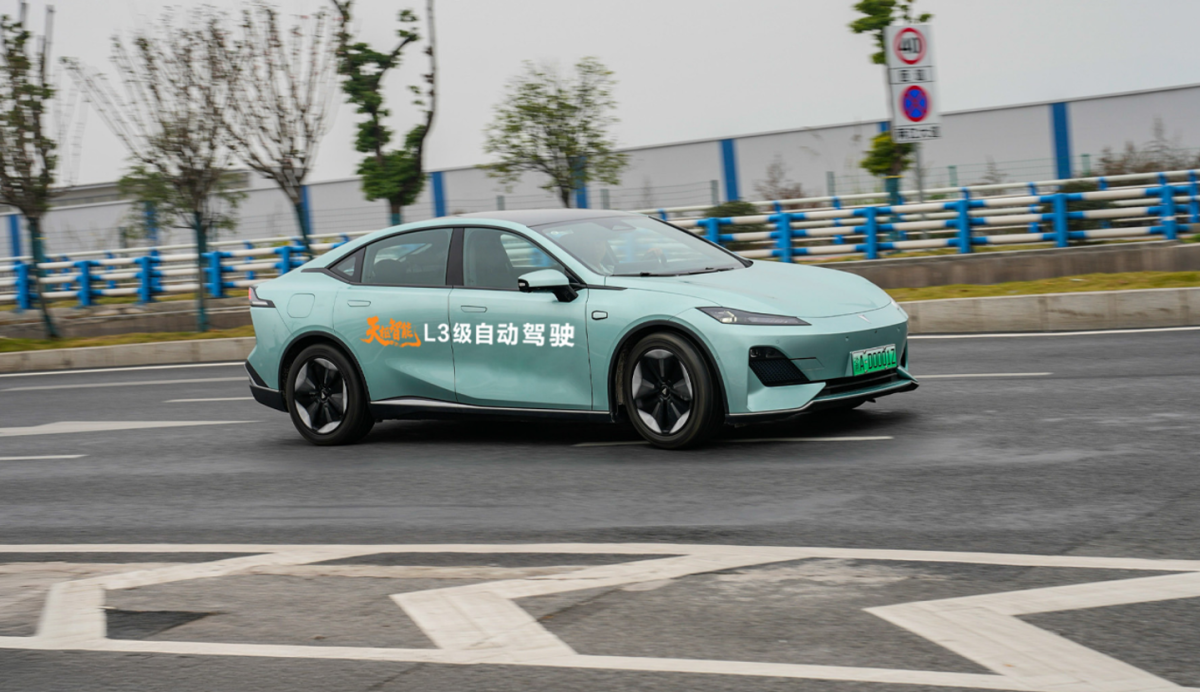
The Deepal SL03, one of China's road-legal L3 autonomous driving models, speeds down the road. (Photo/Deepal)
Chongqing - China, recently approved two Level 3 (L3) conditional automated driving models for road use, marking the official launch of L3 automated driving in China. However, although the systems allow hands-off and eyes-off operation, legal requirements and safety risks still require drivers to remain ready to take control at all times.
The transition from Level 2 (L2) to L3 represents a shift from assisted driving to conditional automated driving. Under China’s Taxonomy of Driving Automation for Vehicles, L2 is partial driving assistance, in which the system controls acceleration, braking, and steering, while the driver bears full responsibility, monitors the driving environment, and is ready to intervene.
L3 is conditional automated driving: under specified conditions, such as designated road sections, the vehicle assumes complete control of the driving task, and the driver does not need to operate continuously, with limited hands-off and eyes-off permitted.
However, users do not gain full autonomy when using L3. Their role is a “dynamic driving task fallback user.” Technical standards require that when the system issues a takeover request, the user must immediately resume driving. This means that the L3 automated driving currently deployed in China is essentially a hybrid “human–machine co-driving” model.
China’s existing regulations indirectly require users to be ready to take control at all times. Intelligent driving traffic rules currently under pilot programs—primarily referencing regulations in Shenzhen—establish a “driver-priority liability system.”
As long as a driver is present in the vehicle, if an accident causes damage and is deemed the vehicle’s responsibility, the driver bears compensation liability. If a vehicle defect causes the accident, the driver may seek reimbursement from the manufacturer or seller after compensation.
For ordinary consumers, this rule means that using L3 functions does not reduce legal risk. Users must compensate victims upfront, then pursue complex technical assessments and legal action against automakers to prove that the accident resulted from automated-driving algorithms.
At present, there is a pronounced information asymmetry between users and automakers. After an accident, automakers are both system developers and controllers of the data. Users often cannot directly access key data and must rely on analyses provided by the automaker. If an automaker refuses to accept liability because “backend data is normal” and raw perception data is not disclosed, users’ rights claims can easily reach an impasse.
By contrast, Germany adopts a dual-track system in which both vehicle owners and manufacturers bear responsibility, with manufacturers assuming greater direct liability when the system is operating. China’s current approach facilitates rapid industry pilot programs, but for users, it entails a degree of “liability shifting,” indirectly preventing truly hands-off and eyes-off use and requiring continued attention to driving conditions.
In addition, the inherent safety risks of L3 systems themselves require users to remain vigilant. The first is the “takeover paradox.” Scientific studies show that when a person is in a relaxed state—such as using a phone or daydreaming—it typically takes five to ten seconds to regain situational awareness and fully control a vehicle.
Yet current L3 systems provide takeover warnings of only a few seconds. In such moments, a user may quickly grasp the steering wheel while the brain remains relaxed. This gap, where physical takeover is faster than cognitive takeover, is a high-risk window for traffic accidents.
The second risk is “phantom braking,” in which perception systems mistakenly identify road shadows, overpasses, or traffic signs as obstacles, triggering sudden and severe braking without warning. In L2 mode, a driver holding the steering wheel can manually correct such behavior. In L3 mode, however, if the user is relaxed, abrupt emergency braking may cause serious cervical spine injuries or even trigger rear-end collisions.
By continuing to browse our site you agree to our use of cookies, revised Privacy Policy and Terms of Use. You can change your cookie settings through your browser.
For any inquiries, please email service@ichongqing.info