
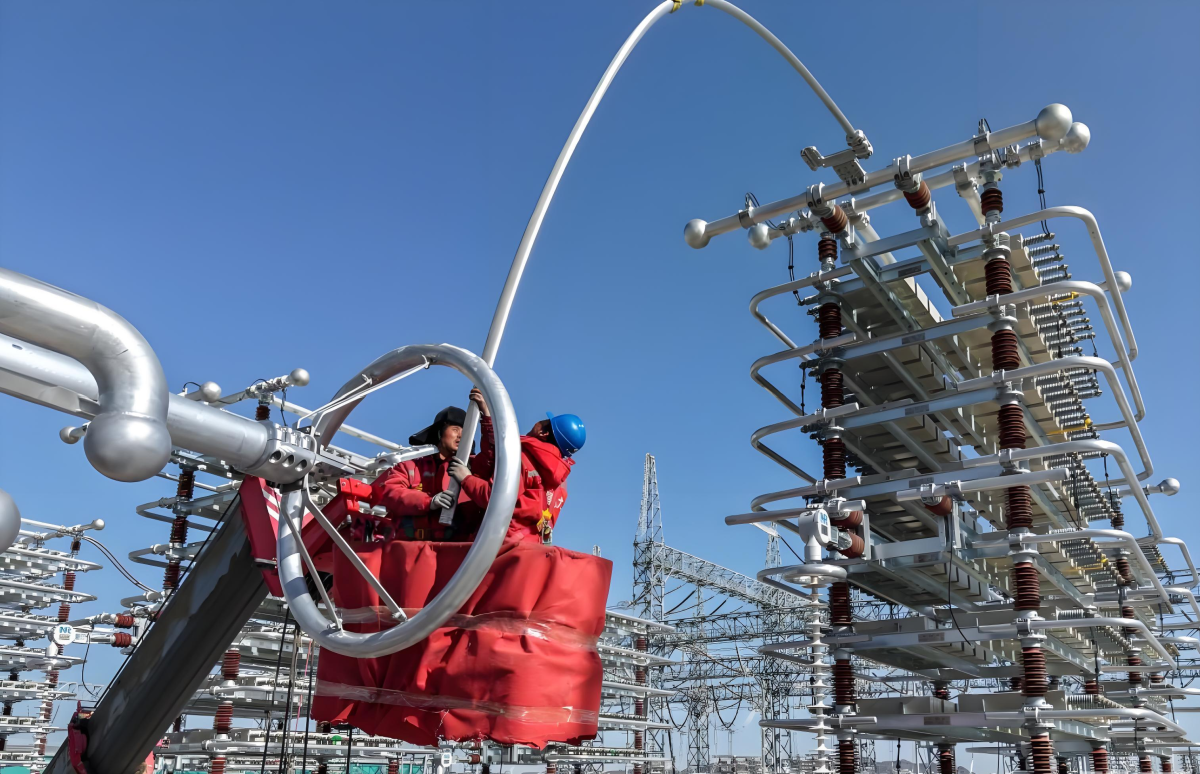
In Xinjiang, workers installed lead wires for the capacitor bank equipment of the "Xinjiang Power to Chongqing" project. (Photo/Li Song)
Chongqing - The “Xinjiang Power to Chongqing” project has recently hit a key milestone, with real-time monitoring data showing that Chongqing has now received more than 10 billion kilowatt-hours of electricity from Xinjiang.
As China’s first ultra-high-voltage direct current (UHVDC) line directly connecting the Northwest and Southwest regions, the project was launched in June 2025. The line, which spans 2,260 kilometers from Hami in Xinjiang to Liangjiang New Area in Chongqing, represents an investment of about 28.6 billion yuan (4.09 billion U.S. dollars), functioning as a "highway" for electricity.
Leveraging the core advantages of UHV technology, electricity generated from Xinjiang's abundant renewable energy sources—such as wind and solar power—reaches Chongqing in just seven milliseconds. The project's maximum daily transmission capacity is nearly 100 million kilowatt-hours, with its maximum power output exceeding 10% of Chongqing’s grid’s peak load. It has become a central pillar of Chongqing’s energy supply system, ensuring robust support for the region’s energy security.
This project holds strategic value for bridging Chongqing’s electricity shortfall and optimizing its energy structure. Wang Zuxun, Director of the Chongqing Energy Administration, explained that due to limited energy resources, Chongqing is the only electricity-deficient province in western China. According to statistics, total electricity consumption in Chongqing will reach 161.26 billion kilowatt-hours in 2024, with 29.21 billion kilowatt-hours, or 20.8%, sourced from external sources, making the city highly dependent on external power.
As a major population hub in western China, Chongqing’s population exceeds 30 million and is experiencing an ongoing surge in residential electricity demand. Additionally, Chongqing is an important automotive industry base. According to the National Bureau of Statistics, from January to November 2025, the city produced 2.4981 million vehicles, ranking third in the country behind Anhui and Guangdong, resulting in growing industrial electricity demand.
The successful integration of electricity from Xinjiang has eased pressure on Chongqing's power supply. During this year’s summer peak demand period, the scale of external electricity supply to Chongqing surpassed 10 million kilowatts, with Xinjiang’s power playing a key role in helping Chongqing first achieve a balanced electricity supply and demand during the summer peak.
As Chongqing enters the critical winter period, the demand for residential heating and industrial electricity continues to rise, placing higher demands on the stability of the electricity supply. Shuai Hong, Deputy Chief Engineer at the Chongqing Power Dispatch Center, said that through intelligent joint inspections and other technological measures, the center will focus on the maintenance and operation of key equipment, continuing to strengthen the fine management and control of the “Xinjiang Power to Chongqing” project, ensuring a stable power supply for residents and businesses during the winter.
From a national energy distribution perspective, 80% of China’s energy resources are concentrated in the western and northern regions, while around 70% of energy demand is in the eastern and central regions. Against this backdrop, the west-east power transmission has become the optimal solution for resource allocation and a key part of the country’s energy strategy.
Wang emphasized that Chongqing, located at the crossroads between Eastern and Western China, has the geographic advantage of serving as a transmission ‘relay station’ for electricity from the West to the East. Currently, six UHVDC lines pass through Chongqing to deliver power to eastern regions. At the same time, Chongqing is building itself into an energy distribution hub for west-east power transmission, strengthening its strategic position in China’s national energy layout.
By continuing to browse our site you agree to our use of cookies, revised Privacy Policy and Terms of Use. You can change your cookie settings through your browser.
For any inquiries, please email service@ichongqing.info