
Chongqing - As China marks ten years of development along the Yangtze River Economic Belt, the southwestern municipality of Chongqing says it has built a green, low-carbon industrial pathway that decouples economic growth from energy consumption, according to local officials on January 6.
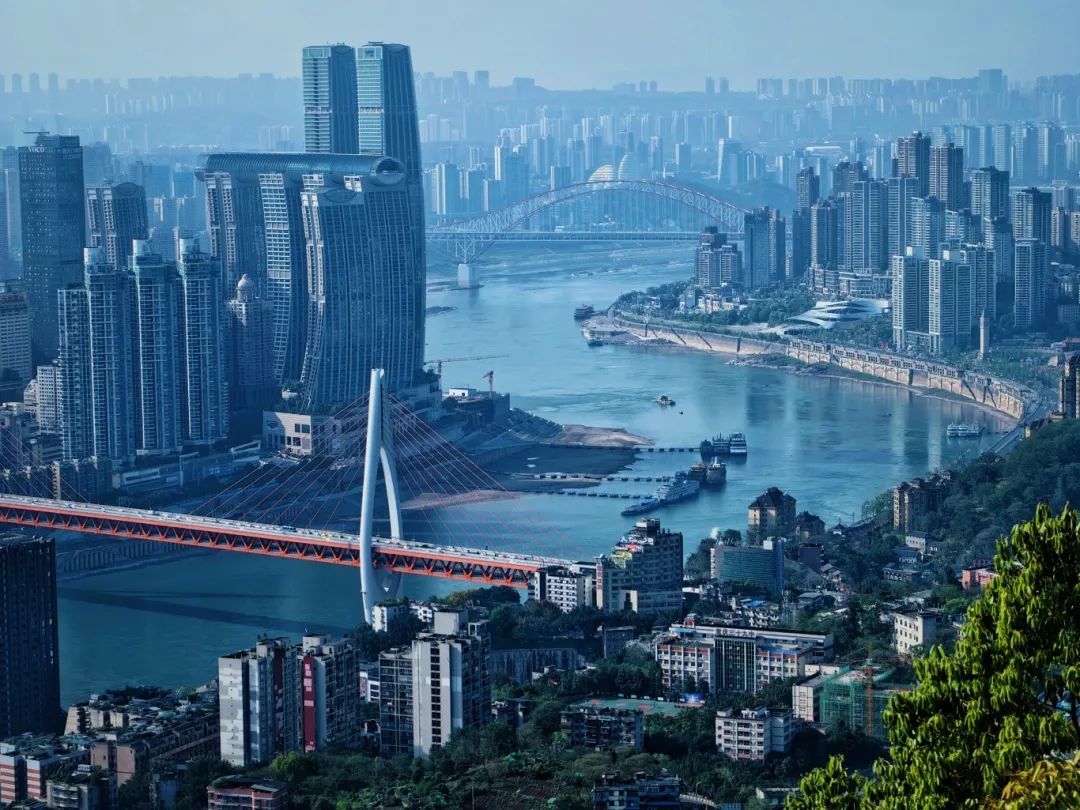
A view of Chongqing's urban landscape. (Photo/Chen Xin)
Since 2016, Chongqing's industrial sector has recorded average annual energy consumption growth of about 3.8%, while supporting roughly 6.6% industrial output growth. Zhong Xi, deputy director of Chongqing Municipal Commission of Economy and Information Technology, said Chongqing's approach focused on restructuring its industrial base while expanding emerging industries.
Chongqing has emerged as a national center for intelligent connected new-energy vehicles, with annual output nearing 1.3 million units in the past year. China Changan Automobile Group is now headquartered in the city, while SERES has become China's first luxury new-energy vehicle maker listed both on the Chinese mainland and Hong Kong stock exchanges.
The city is also a global manufacturing base for electronics. laptop production ranks first worldwide, while output of power semiconductors and smartphones ranks third and fifth nationally, according to official data. In materials manufacturing, Chongqing hosts the world's largest adipic acid production base- a chemical used in nylon - and has developed products such as aluminum alloy body panels and titanium alloy seamless tubes that officials say previously relied on imports.
Emerging industries now account for about 36% of Chongqing's industrial value added, up from 16% in 2016, placing the city among China's leading regions in strategic emerging industry development.
Zhong said the city has also upgraded traditional high-energy-consumption sectors such as steel, building materials, and chemicals through equipment renewal and technical retrofits. Chongqing Liangjiang New Area has been designated among China's first batch of pilot zero-carbon industrial parks.
In parallel, Chongqing has pursued technology-driven emission reduction. Zhong cited examples including lower-emission adipic acid production at Huafon Chemical, lightweight electric motor systems developed by Tsingshan Industrial Corporation, and high-pressure carbon-fiber hydrogen storage tanks produced by local firms.
Digitalization is another focus. Through platforms known as "industrial brains," manufacturers integrate supply chains and monitor energy use. SERES, Zhong said, linked more than 300 suppliers through its platform, reducing per-unit carbon emissions by 16.9%. Changan's digital factory has implemented 198 process optimizations, cutting nearly 50,000 tons of carbon dioxide emissions.
Chongqing officials also highlighted improvements in transportation and river management. The Yangtze River shipping channel from Chongqing to Wuhan now maintains a 4.5-meter navigable depth year-round, allowing 5,000-ton vessels to reach the city center. Cargo throughput at Chongqing ports reached 240 million tons, while the city's airport passenger capacity has grown more than fivefold over the past ten years.
On ecological restoration, Chongqing has strengthened river management through a system assigning responsibility to local officials. Since 2018, authorities have cleared over 2.2 million tons of waste from waterways and restored riverbanks along 190 kilometers of shoreline.

The Chongqing section of the Youshui River, a tributary of the Yangtze River. (Photo/Chongqing Municipal Water Resources Bureau)
Over the past decade, Chongqing has treated 14,700 square kilometers of soil erosion, reducing affected areas by 20.6%, while water conservation rates rose more than seven percentage points, leading the Yangtze River Economic Belt during the current planning period.
Officials said these measures aim to align industrial growth, transport efficiency, and ecological protection as Chongqing positions itself as an inland hub within China’s Yangtze-centered development strategy.
By continuing to browse our site you agree to our use of cookies, revised Privacy Policy and Terms of Use. You can change your cookie settings through your browser.
For any inquiries, please email service@ichongqing.info