
Chongqing - More than a month after China’s new national standards for electric bicycles took effect, debate continues nationwide. In Chongqing, however, the impact has been relatively limited, as the city’s mature motorcycle market has reduced reliance on electric bikes.
Much of the criticism centers on the 25 km/h speed cap and the ban on speed modifications, which many riders say reduces commuting efficiency.
Compliance-driven design changes have led to smaller storage capacity and reduced passenger space, limiting practicality. Higher prices linked to upgraded safety requirements have further weakened perceived value, prompting many consumers to delay purchases.
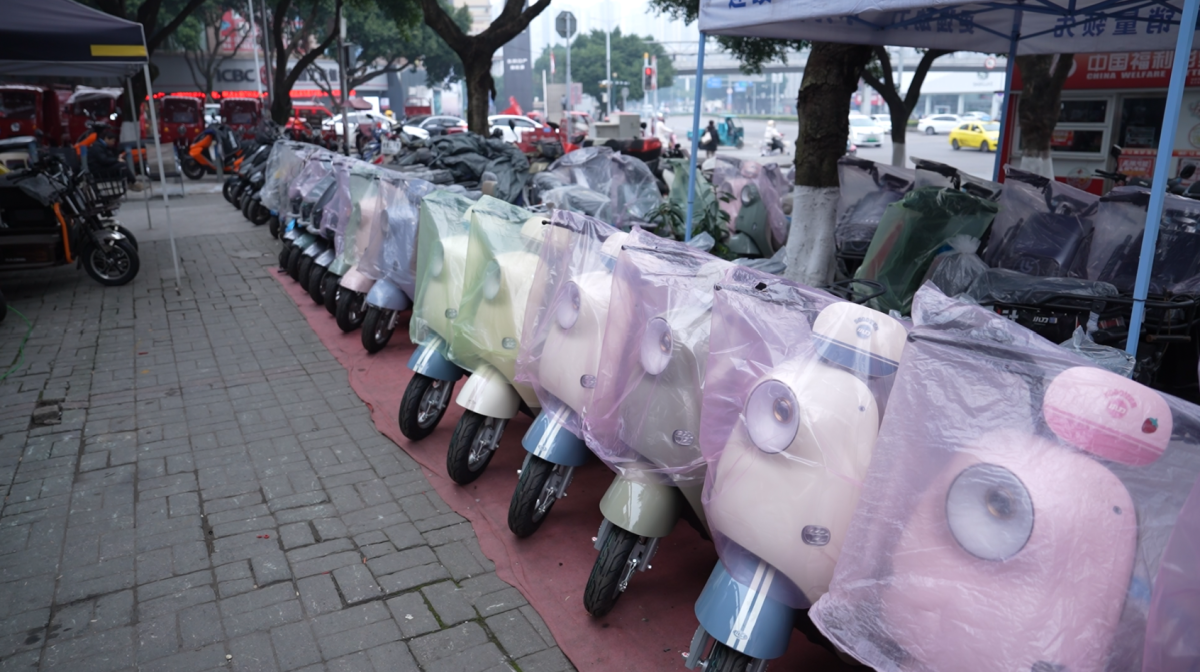
In Chongqing’s electric mobility market, electric bicycles that meet the new national standards remain uncommon, while electric motorcycles are far more prevalent. (Photo/Sun Wangpeng)
As a major motorcycle hub, Chongqing’s well-established markets for motorcycles and electric motorcycles have shielded local businesses from the challenges facing new electric bicycles, further strengthening the dominance of alternative models.
According to data from the Chongqing Bureau of Statistics, the city produced 6.47 million motorcycles from January to November 2025. Meanwhile, data from the China Chamber of Commerce for Motorcycles shows that the national production during the same period was 20.11 million, with Chongqing accounting for 32% of the total.
Ms. Fu, the owner of an electric motorcycle store, shared that her business has long focused on selling electric motorcycles, so the new regulations have had a limited impact on her operations. She observed that as the new standards enter the transitional sales period in the first half of 2025, the electric bicycle market would likely continue to decline, further driving the growth of electric motorcycles.
A visit to Chongqing’s key electric bicycle and motorcycle markets revealed that the stock of new national standard electric bicycles is minimal, with the market primarily focused on electric motorcycles and gasoline-powered motorcycles.
Mr. Wang, the owner of a Yadea electric motorcycle store, said he was aware of the negative market feedback surrounding the new national standards and decided not to stock these bikes to avoid financial losses. He added that the brand does not require dealers to sell these models, allowing them to make decisions based on market conditions.
Ms. Zhong, another motorcycle store owner, said she carries only a small number of electric bicycles that meet the new standards, and sales have been weak. She noted that consumers typically prioritize power and price, and that the new models—despite their higher costs—often lack sufficient power to handle Chongqing’s hilly terrain. As a result, most sales have gone to students in flatter areas or to riders with fixed, short commuting routes.
Bridging News also spoke with three delivery riders—Mr. Yang, Mr. Wu, and Mr. Li—at shopping malls in Chongqing. All three said they were aware of the controversy surrounding the new electric bicycles through online channels and expressed concern that the models’ limited power could slow deliveries and reduce their income.
Despite these concerns, the new standards have not affected their daily work. The riders said they do not need to switch vehicles, as electric motorcycles and gasoline-powered motorcycles remain viable options.
Mr. Yang added that while electric motorcycles cost more than electric bicycles, they remain affordable. He noted that obtaining a license would require additional time, and that the monthly insurance cost of about 100 yuan fits within his budget without creating significant financial pressure.

In Chongqing’s shopping districts, delivery riders rely on electric motorcycles and electric bicycles for their daily deliveries. (Photo/Sun Wangpeng)
In China, electric two-wheelers fall into two main categories: electric bicycles and electric motorcycles. The key difference is their classification as motorized vehicles. Electric bicycles are non-motorized and require only registration, while electric motorcycles are classified as motor vehicles and require a driver’s license and mandatory insurance before they can be registered and used on public roads.
With a total of 380 million electric bicycles in China—roughly one for every four people—the new regulations focus on key safety issues such as fire prevention and modifications. Released on December 31, 2024, the new standards will have an 11-month transition period, coming into full effect on December 1, 2025.
To address concerns regarding poor flame resistance and toxic smoke in case of fire, the new rules require enhanced fire-resistance standards for key components. A new high-temperature vehicle identification tag will also be introduced to improve accident traceability and prevent vehicle identity loss.
Code system will link vehicles, batteries, and chargers, providing full traceability of the supply chain and addressing road safety hazards like illegal modifications.
(Sun Wangpeng, as an intern, also contributed to the report)
By continuing to browse our site you agree to our use of cookies, revised Privacy Policy and Terms of Use. You can change your cookie settings through your browser.
For any inquiries, please email service@ichongqing.info