
Chongqing - Southwest China’s Chongqing on January 9 released an implementation plan to accelerate construction of the Air Silk Road, setting out measures to expand its international air routes and strengthen the city’s role as an inland gateway for trade and connectivity under the Belt and Road framework.
Under the plan, Chongqing aims to operate more than 70 international and regional air routes by 2030. Annual international passenger traffic is expected to exceed 5 million trips, while cross-border cargo throughput is projected to reach 300,000 tonnes.
Officials said the plan focuses on five key areas and includes 14 policy measures, outlining a clear roadmap to advance Chongqing’s Air Silk Road initiative.
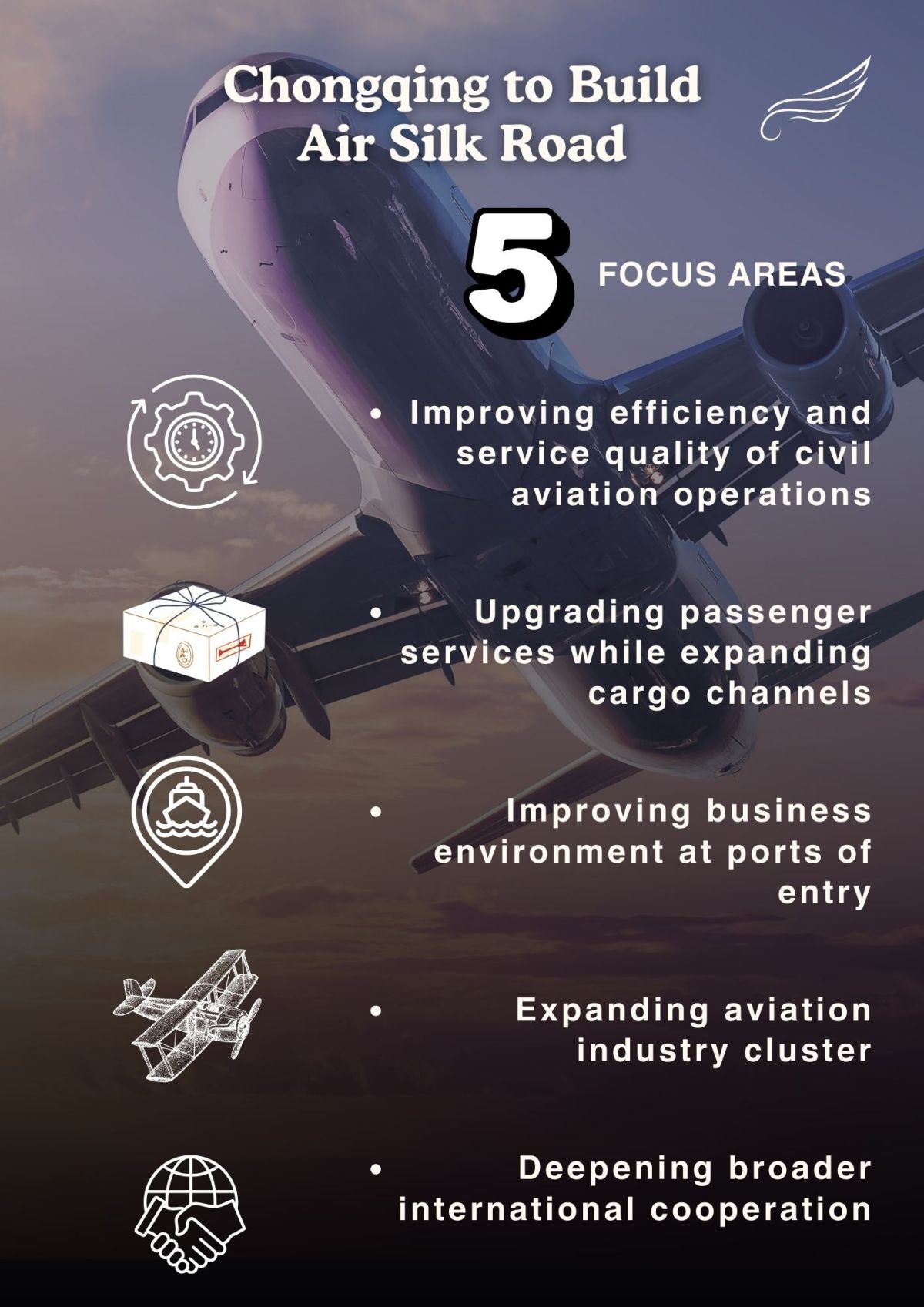
Chongqing has identified five focus areas for the expansion of the Air Silk Road. (Graphics/Chen Zhan)
A key priority is improving the efficiency and service quality of civil aviation operations through stronger resource support. For instance, Chongqing plans to carry out renovations and capacity upgrades in the western area of Jiangbei International Airport, applying digital technologies to streamline operations and raise service standards.
Another central task is upgrading passenger services while expanding cargo channels to build an integrated, multimodal transportation system. Based on national planning guidance and existing cargo flows, Chongqing will prioritize route development toward Europe and Southeast Asia by opening new routes and increasing flight frequencies. The city also plans to explore air links with emerging markets in the Middle East and North Africa.
At the same time, Chongqing aims to strengthen its role as a regional transit hub. Passenger transfer efforts will focus on three major international corridors: Southeast Asia–Chongqing–Europe, East China–Chongqing–Europe, and North China–Chongqing–Southeast Asia. For cargo, the city plans to develop a transit network centered on Southeast Asia–Chongqing–Europe and North America to enhance its role in global logistics chains.
The plan also emphasizes improving the business environment at ports of entry. Measures include strengthening around-the-clock customs clearance services and establishing green channels for special imports such as fresh food products, with the aim of speeding up inspection and release for time-sensitive international trade.
Chongqing will also move to expand its aviation industry cluster, with a focus on aviation logistics, aircraft equipment manufacturing and the upgrading of airport-based economic zones.
In the logistics sector, the city plans to build an international aviation logistics hub covering air express services, cross-border e-commerce, bonded logistics and high-end cold-chain transport. Capacity will be expanded for handling specialized cargo such as high-tech equipment, raw materials, specific medicines, biological products and oversized shipments, while branch airports are expected to play a larger role in cargo consolidation and distribution.
Beyond transport and industry, the Air Silk Road is intended to serve as a platform for broader international cooperation. The plan calls for the expansion of overseas warehouse networks, closer integration between cross-border e-commerce and domestic manufacturing clusters, and deeper coordination across international industrial and supply chains.
By continuing to browse our site you agree to our use of cookies, revised Privacy Policy and Terms of Use. You can change your cookie settings through your browser.
For any inquiries, please email service@ichongqing.info