Chongqing - As China marks a decade since the launch of the Yangtze River Economic Belt development strategy, the southwestern municipality of Chongqing has reported major progress in environmental protection, with all township-level sewage treatment facilities now operating at full capacity.
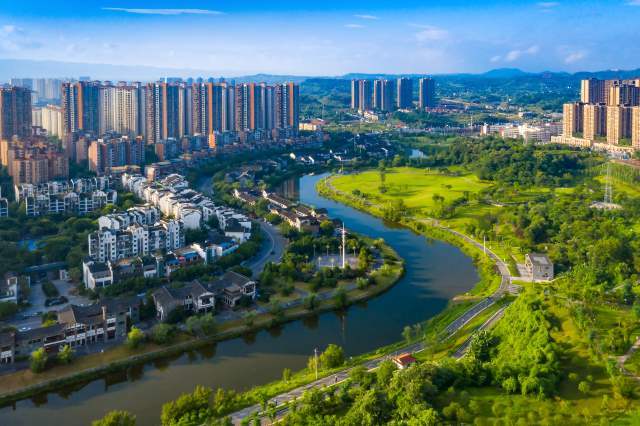
Taohua Creek in Chongqing's Changshou District is recognized as a national "Happy River". (Photo/Chongqing Ecology and Environment Bureau)
According to information released by Chongqing Environmental Protection Investment Group, the normal operation rate of township sewage treatment facilities has risen from less than 50% a decade ago to 100% today. Compliance with national wastewater discharge standards has remained above 98 percent. Over the past decade, the city has treated a cumulative 1.18 billion tonnes of wastewater, resulting in a reduction of 174,300 tonnes in chemical oxygen demand and 26,300 tonnes in ammonia nitrogen.
Direct discharge of untreated sewage was once a major source of pollution in tributaries of the Yangtze River. The Linjiang River, a tributary of the upper reaches of the Yangtze River, in Yongchuan District, offers a clear example. A locally circulated rhyme recalling daily life from the 1970s through the early 2000s describes a steady ecological decline that eventually left the river black and foul-smelling.
In 2017, Chongqing launched a comprehensive river basin restoration program, addressing more than 30,000 pollution sources, expanding and upgrading over 450 kilometers of sewage pipelines, and building large-scale ecological water purification systems. Water quality has since improved fundamentally, with monitoring stations now consistently meeting Class III national standards.
In 2023, the Linjiang River was included in China's first group of "Happy Rivers", a national designation recognizing waterways restored for ecological health and public benefit.
Similar efforts have been carried out across the municipality. More than 20 river restoration projects, including those in Pengshui County, have together improved over 500 kilometers of rivers, reflecting Chongqing's systematic, basin-wide approach to environmental protection.
A key foundation of these improvements has been the full coverage and stable operation of township sewage treatment networks. Since 2015, Chongqing has promoted an integrated model combining investment, construction, management, and operation. Early efforts focused on addressing challenges posed by small, dispersed facilities, with hundreds of treatment plants built or upgraded to ensure comprehensive coverage. By the end of the last decade, Chongqing became one of the first regions nationwide to achieve both full facility coverage and full compliance with discharge standards.
Technology and digital tools have further strengthened environmental management. To adapt to mountainous terrain and complex sewage collection conditions, Chongqing has promoted small-scale integrated treatment equipment alongside smart monitoring systems. Drone patrols, artificial intelligence-assisted inspections, and remote visual monitoring are now widely used.
Looking ahead, Chongqing will continue strengthening environmental protection, expand cooperation with neighboring Sichuan Province and support the integrated development of the Chengdu–Chongqing economic circle, aligning local river protection efforts with the broader goals of the Yangtze River Economic Belt.
By continuing to browse our site you agree to our use of cookies, revised Privacy Policy and Terms of Use. You can change your cookie settings through your browser.
For any inquiries, please email service@ichongqing.info