
Editor’s Note: This article is produced in collaboration with the Chongqing Institute of Foreign Studies as part of a series of ongoing reports exploring the city’s abundant resources in intangible cultural heritage.
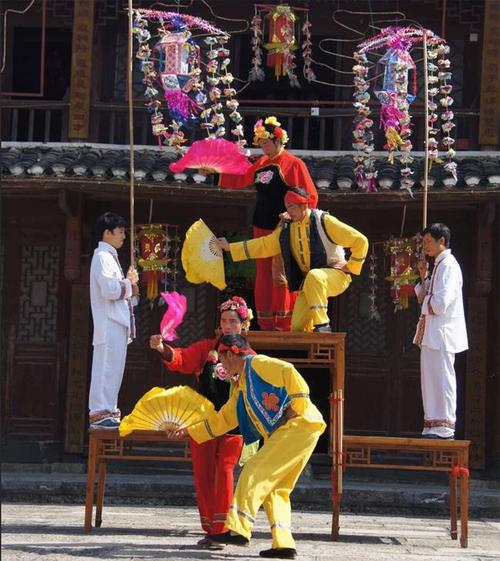
Xiushan Huadeng, or the Xiushan Flower Lantern Dance, is a vibrant folk custom prevalent in Xiushan Tujia and Miao Autonomous County, Chongqing.
"Hey, my little sweetheart, time for the Flower Lantern Dance! Here we go!" With calls and responses echoing back and forth, the Flower Lantern Festival in Xiushan Tujia and Miao Autonomous County, located in southeastern Chongqing, kicks off in this lively manner.
Designated as a national intangible cultural heritage, Xiushan Huadeng, or the Xiushan Flower Lantern Dance, is a vibrant folk custom prevalent in Xiushan Tujia and Miao Autonomous County, Chongqing. It integrates singing, dancing, short plays, quyi (a traditional Chinese form of storytelling and singing), acrobatics, wind and percussion music, and ritual practices into a cohesive whole. This rich blend is presented to audiences through various performance forms, including Huadeng duet, double Huadeng performances, Huadeng group dances, and Huadeng dramas.
"On the Lantern Festival, Pingkai was illuminated by magnificent lanterns and lively acrobatic displays, making it the most splendid celebration in the region." This is how ancient Xiushan Huadeng is described in the Xiushan County Annals. Tracing its development through historical records, Xiushan Huadeng originated in the Tang Dynasty, flourished in the Song Dynasty, expanded and spread to neighboring regions during the Ming Dynasty, and ultimately matured in the Qing Dynasty. During this period, it absorbed musical elements from outside influences and gradually formed its distinctive Huadeng culture, which has been passed down to this day.
Xiushan Huadeng performances begin on the second day of the Chinese Lunar New Year and conclude on the fifteenth day of the first lunar month. During this period, the tradition follows a complete and well-defined set of procedures. A Huadeng hall is first set up, where the divine figures of Jinhua Xiaojie (literally "Golden Flower Lady") and Yinhua Erniang ("Silver Flower Second Lady") are reverently enshrined. The Huadeng master lights incense and candles and burns paper money as offerings to the lantern deities, praying for blessings upon the performers and wishing them smooth, safe, and auspicious performances throughout the year.
Following the worship ceremony comes the ritual of "Inviting the Lantern." The Huadeng master leads the singing, after which the performers join in to sing the "Huadeng Raising Tune." Once the ceremony concludes, the Huadeng troupe sets out to perform. They dance in the host family's main hall and courtyard, spreading joy and happiness while conveying New Year blessings. In return, the host prepares a hearty meal or offers monetary gifts as a token of gratitude.
The climax of the Xiushan Huadeng tradition is the farewell lantern ceremony held on the riverbank on the evening of the fifteenth day of the first lunar month. During this ritual, the troupe pays homage to the deities, with the Huadeng master leading the singing of all the lantern melodies performed throughout the Spring Festival. The ceremony concludes with the burning of the lanterns and deity effigies, while the performers' costumes are passed over the flames—symbolizing the casting away of misfortune from the past year and the welcoming of a new beginning.
"A lantern is a lantern—but where does Huadeng come from? Where does it rise and flourish? In the Tang Dynasty, an imperial decree established the Lantern Festival, which has been celebrated annually on the Yuanxiao Festival ever since. Once dazzling with thousands of lights, only a few remain today." Indeed, now that we know the origins of Xiushan Huadeng, the question arises: where will it be in the future?
Perhaps its future lies in the Huadeng-themed calisthenics practiced on the playgrounds of local primary and secondary schools, and in the specialized Huadeng courses offered at vocational schools. There, generation after generation of young people sow the seeds of Huadeng heritage in their hearts, nurturing them over time—until they bloom anew on this ancient land.
Chinese script: Zhang Qiong
Tutored by: Yuan Jingyi
Translation: Yan Jingyi
Tutored by: Jiang Jun, Wang Jing
Voice-over: Luo Ying
By continuing to browse our site you agree to our use of cookies, revised Privacy Policy and Terms of Use. You can change your cookie settings through your browser.
For any inquiries, please email service@ichongqing.info