
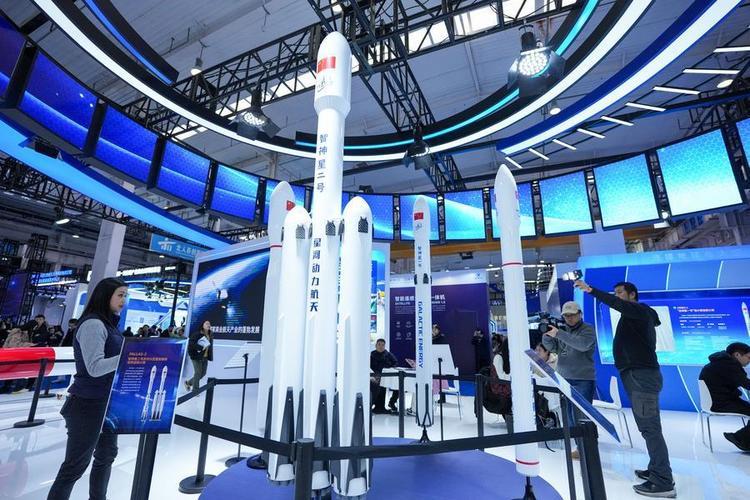
People visit the 2026 Beijing International Commercial Space Exhibition in Beijing, capital of China, Jan. 23, 2026. (Xinhua/Ju Huanzong)
Beijing - A Beijing-based commercial space company, InterstellOr, has captured nationwide attention recently with plans to start suborbital rides by 2028, offering tickets priced at 3 million yuan (about 429,534 U.S. dollars) per passenger.
Meanwhile, several Chinese commercial space companies like Galactic Energy and Deep Blue Aerospace have announced maiden flights of their newly developed launch vehicles scheduled this year, many involving the high-thrust and reusable ones.
Industry experts say exploring profitable, mass-market applications is crucial for China's commercial space companies to expand businesses and achieve sustainable growth.
Once dominated by state-backed programs, China's space industry was opened to private investment in 2015, with numerous commercial rocket and satellite startups founded shortly afterward.
In 2024, the commercial space industry was highlighted in the country's government work report as a "new engine of economic growth," and more than 20 provincial-level regions have rolled out supportive policies. In Beijing's Yizhuang district alone, "Rocket Street" hosts over 75 percent of China's commercial rocket firms.
China now has more than 600 commercial space companies, with annual financing reaching 18.6 billion yuan in 2025, up 32 percent year on year, according to a recent industry report. At least five private rocket makers are eyeing initial public offerings.
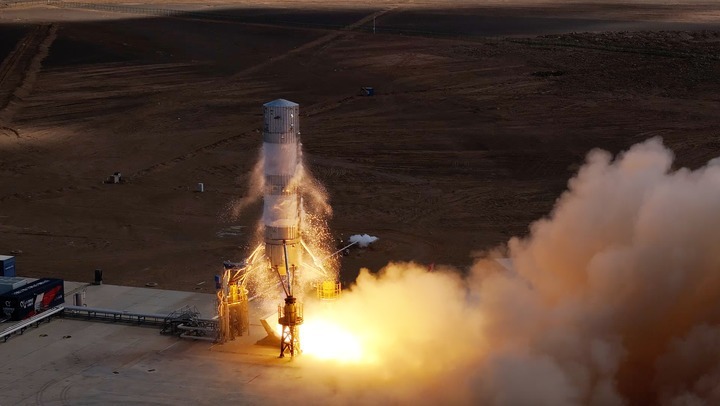
This undated photo shows the Zhuque-3 reusable test rocket developed by a Chinese private rocket company LandSpace. (Xinhua)
Commercial launches made up 54 percent of the country's total space launches in 2025, with 311 commercial satellites reaching orbit, accounting for 84 percent of all satellites launched that year, according to the China National Space Administration.
Looking ahead, the industry's evolution is stretching into longer and more complex value chains.
Satellite manufacturing is entering mass production. Beijing-based satellite maker GalaxySpace, for example, operates a smart factory that can cut development cycles by 80 percent and produce hundreds of satellites weighing 1,000 kilograms annually.
Meanwhile, companies like Orienspace are pursuing high-capacity, low-cost solutions. Its "Gravity-1" rocket is designed to carry up to 30 satellites per mission, aiming for weekly sea launches to meet growing constellation deployment demands.
Beyond rocket launch and satellite manufacturing, new business models are emerging, including in-orbit services, such as space travel and mining.
Before InterstellOr's tourism plan, a spacecraft made by commercial company CAS Space, targeting space travel, also completed its suborbital flight test on Jan. 12.
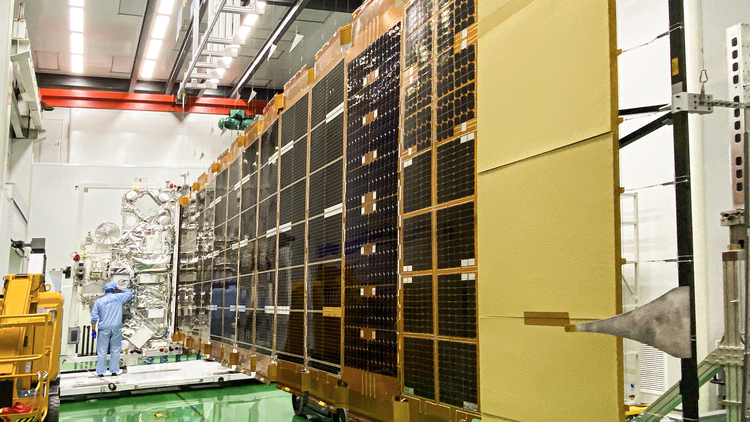
This photo taken on May 29, 2023 shows the unfolded flexible solar wing of Lingxi-03 satellite. (GalaxySpace/Handout via Xinhua)
Long compared the sector to the early days of new energy vehicles, where manufacturing was tough but spurred wider industrial value. "Satellite makers face pressure to cut costs while figuring out how to monetize their assets in orbit," he said.
Long pointed to SpaceX's model, which combines launches, satellite production and constellation operations, as a blueprint for Chinese counterparts, noting that closed-loop, demand-driven development is a key factor.
The surge in satellites is creating new needs, such as space traffic management and debris management, opening commercial opportunities in monitoring and cleanup technologies, said Liu Jing, a researcher at the National Astronomical Observatories.
The potential applications also extend to civilian uses, such as satellite-supported precision agriculture, microgravity pharmaceutical research, and reliable remote communications for healthcare.
Long advocated for "commercial space for all," suggesting that open data, lower barriers and consumer-grade services could allow broader public participation in using, innovating and investing in the space sector.
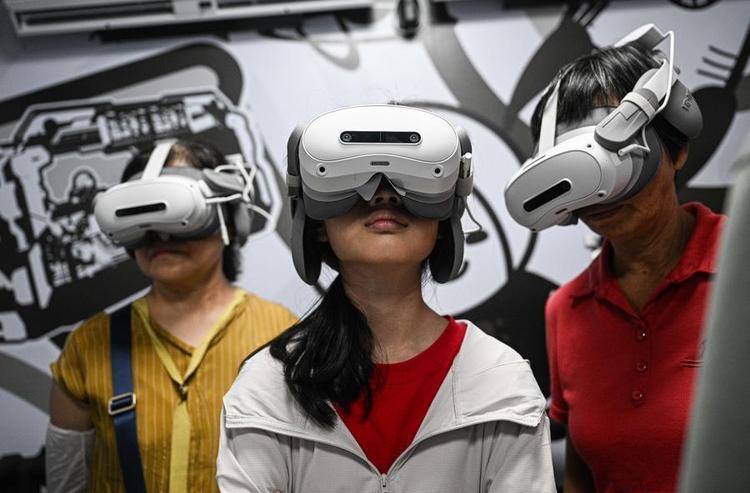
People experience MR technologies at the Wenchang Aerospace Science and Education Center in Wenchang, south China's Hainan Province, Oct. 7, 2025. The upgrade project of the Wenchang Aerospace Science and Education Center is nearing completion. (Xinhua/Pu Xiaoxu)
"A human-robot society will be needed not only on Earth but also on other planets with hostile environments," Qiu said.
Interestingly, the passenger list also includes a humanoid robot from Shenzhen-based Zhongqing Robot Technology Co., Ltd. The integration of humanoid robotics and commercial space could chart a new path for the future.
By continuing to browse our site you agree to our use of cookies, revised Privacy Policy and Terms of Use. You can change your cookie settings through your browser.
For any inquiries, please email service@ichongqing.info