
Chongqing - China's Chongqing recorded transport investment of 533.36 billion yuan (about 74 billion U.S. dollars) during China's 14th Five-Year Plan period (2021–2025), exceeding its original target by 6.7%, according to the Chongqing Municipal Commission of Transport.
The sustained investment has driven the rapid expansion of rail and road infrastructure, significantly improving regional connectivity across the southwestern municipality. High-speed rail operating mileage rose from 840 kilometres at the end of the previous five-year plan to 1,356 kilometres by the end of 2025, an increase of 61.6%.
Expressway development has kept pace. Total expressway mileage expanded from 3,400 kilometres to 4,771 kilometres, marking a growth of 40.2%. Expressway density per land area now ranks first in western China, and all districts and counties now have expressway access.
The expanded network has enabled most parts of Chongqing to be reached from the central urban area within two hours. At the regional level, one-hour connectivity has been achieved between the Chengdu and Chongqing metropolitan areas, reinforcing the twin cities' role as growth engines in western China.
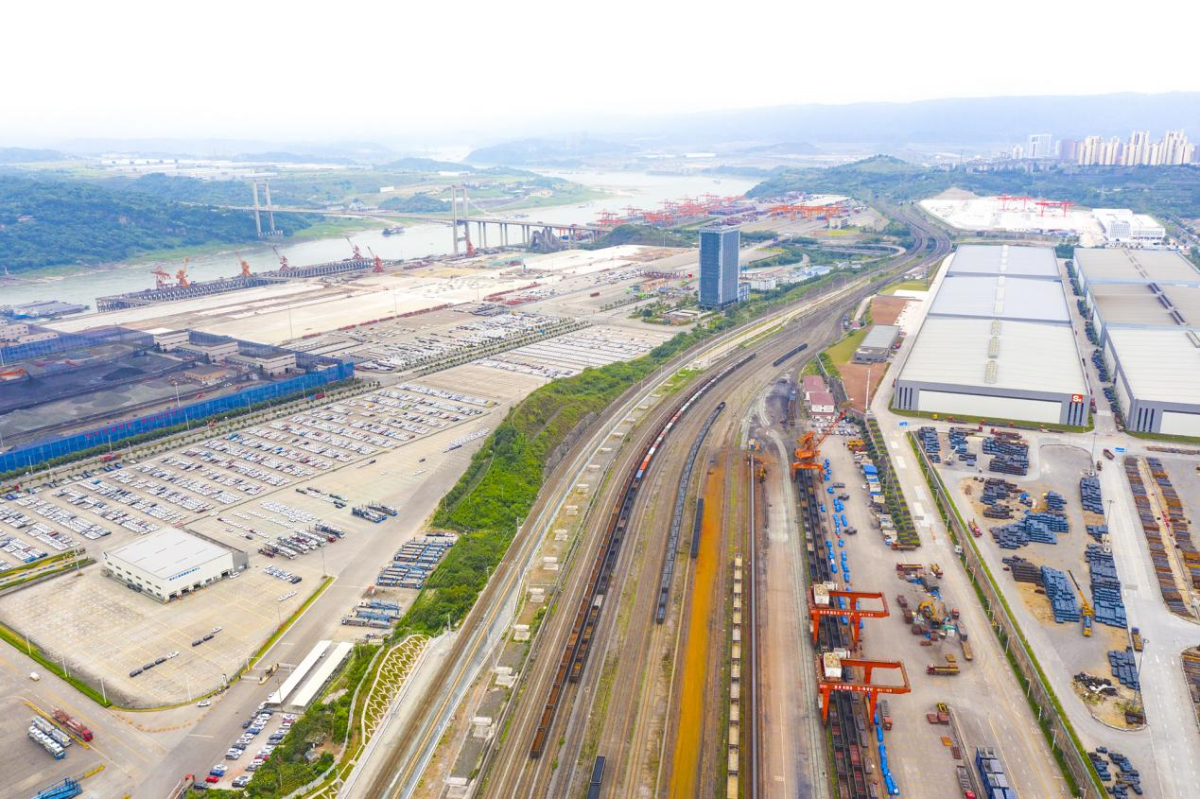
Guoyuan Port, located in Liangjiang New Area, is the largest port on the upper reaches of the Yangtze River and features a multimodal transportation network. (Photo/Lan Tian)
Beyond passenger travel, Chongqing's transport buildout has strengthened its role in national and international logistics. Backed by an integrated system combining river ports, railways, highways, and air transport, the city has accelerated its transition from an inland hinterland into a key gateway for opening up.
Over the past five years, port cargo throughput has climbed to 240 million tonnes, ranking first in western China. More than half of cargo from neighbouring provinces is now transshipped through Chongqing, while over 90% of container traffic from Sichuan, Yunnan, and Guizhou passes through its ports, consolidating Chongqing's position as the main shipping hub in the upper reaches of the Yangtze River.
In particular, the New International Land–Sea Trade Corridor (ILSTC) now links Chongqing to 584 ports across 127 countries and regions. The China Railway Express (Chengdu–Chongqing) has maintained the highest cumulative number of trips nationwide, positioning Chongqing as a key logistics node connecting European, Chinese, and ASEAN markets.
Moreover, transport upgrades have also supported rural revitalization. The rollout of the post and transport integration model has improved first- and last-mile logistics in rural areas, cutting agricultural input logistics costs by more than 20%. As a result, local specialty products such as Fengjie navel oranges and Wushan crisp plums have gained wider access to national markets and overseas buyers.
Across the municipality, total social logistics costs have declined to 13.3% of GDP, staying below the national average for four consecutive years. Differentiated expressway toll policies have generated cumulative savings of 17 billion yuan, benefiting 1.4 billion vehicle trips and easing costs for both businesses and the public.
By continuing to browse our site you agree to our use of cookies, revised Privacy Policy and Terms of Use. You can change your cookie settings through your browser.
For any inquiries, please email service@ichongqing.info