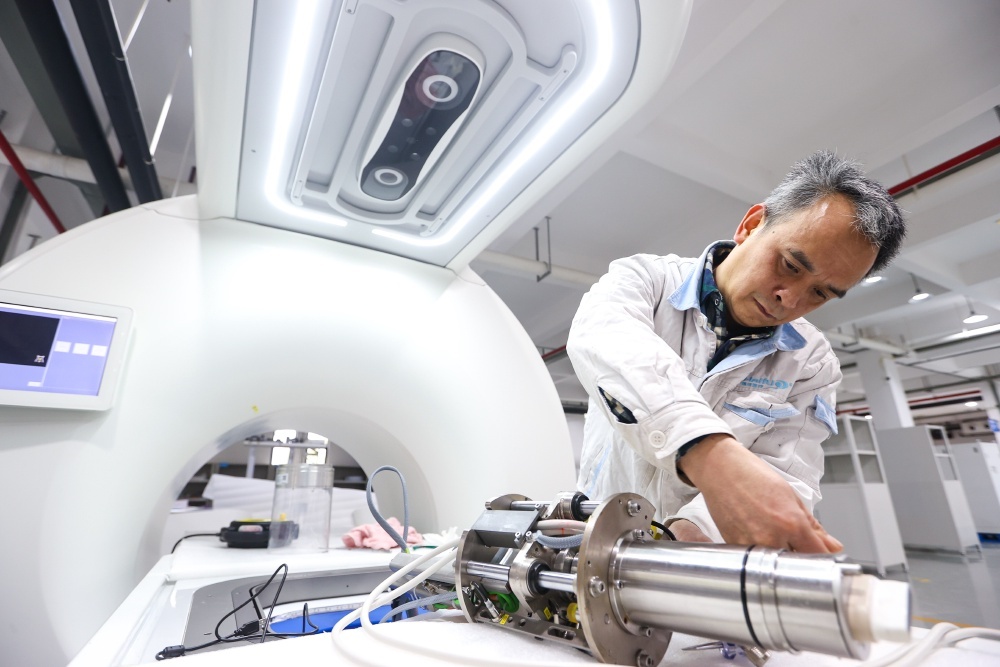
An industrial worker hurries to fulfill the first batch of orders following the New Year holiday on January 4, in Liangjiang New Area, Chongqing. (Photo/Chongqing Daily)
In 2025, Chongqing's industrial enterprises above a designated size grew by 5.9%, and on February 5, the city presented its top ten industrial achievements, reflecting progress in manufacturing, innovation, and digitalization.
In terms of automobile production, Chongqing remained a national leader, with 2.788 million vehicles manufactured, including 1.296 million new energy vehicles. China Changan Automobile Group established its headquarters in Chongqing, becoming the fastest company to reach 30 million cumulative domestic‑brand vehicles and one of the first to receive conditional Level 3 autonomous driving approval in China.
Seres became the first new energy vehicle company listed on both domestic A shares and Hong Kong's H shares, with its AITO brand reaching 1 million units faster than any other emerging automaker. Intelligent driving systems from Chongqing Afari Technology Co., Ltd. were installed in over 300,000 vehicles. By year‑end, the average value of a “Chongqing‑made” new energy vehicle reached 240,000 yuan (about 33,000 U.S. dollars).
Chongqing's manufacturing high‑quality development index of 78.4 is 3.9 points above the national average. Chongqing was selected as one of the first pilot cities for large‑scale vehicle‑grid interaction applications.
Meanwhile, in coordination with Sichuan Province, the region built four industrial clusters, each exceeding one trillion yuan, and five national advanced manufacturing clusters. Together, they accounted for 6.6 percent of China’s industrial output, with laptop production exceeding one‑third of the global total. One in nine vehicles made in China came from the Chengdu‑Chongqing area.
Innovation and smart manufacturing also advanced quickly. Thirty industrial innovation complexes linked more than 850 enterprises to carry out 220 industrial chain projects. R&D intensity among major enterprises reached 1.92 percent, ranking fourth nationally.
At the same time, digital and intelligent production expanded further, with 135 new digital workshops and 28 smart factories added, bringing cumulative totals to 1,231 and 211. A total of 1,513 technological transformation projects began, boosting industrial equipment investment by 21.5 percent, improving production efficiency by 57.6 percent, and reducing operating costs by 22.7 percent.
Chongqing also became a national leader in embodied intelligence, establishing an open community with over 100 industry partners. Forty‑seven industrial research institutes transferred 558 innovations and incubated 359 enterprises. Thirteen local enterprises were selected as national typical cases in future industry innovation, ranking third nationally and first in western China.
Notably, the software and information services sector employed 503,000 people and generated 501.78 billion yuan in revenue, making it the first of the “33618” Modern Manufacturing Cluster System’s pillar industries to exceed 500 billion yuan in revenue.
Notably, Chongqing's biomedicine achieved multiple firsts. Pugi Ornese CAR‑T therapy became the first domestic and second global drug approved for treating children and adolescents with refractory or relapsed B‑cell acute lymphoblastic leukemia. The bispecific antibody GR1803 injection was approved and became Chongqing’s first biopharmaceutical export‑licensing breakthrough.
Yaopharma’s small‑molecule weight‑control and glucose-regulating drug secured overseas licensing deals exceeding 2 billion USD, setting a new domestic record. The city’s first Class‑1 innovative drug, Sairiqi monoclonal antibody injection, was included in the Ministry of Industry and Information Technology’s first batch of landmark biomanufacturing products. Chongqing was also named the first national pilot for the open utilization of tumor tissue data resources.
The achievements also include the fact that Chongqing's AI‑Powered enterprise QR Code service platform now covers 1.31 million enterprises, addressing 79 categories of common issues and resolving over 26,000 cases. The city nurtured 1,977 innovative small and medium‑sized enterprises, 1,381 specialized SMEs.
Finally, Chongqing hosted 14 major national industrial events in 2025, including the 2025 World Smart Industry Expo, a national forum on scientific and technological innovation, the conference on specialized SME development, and the 2025 China Industrial Transfer and Development Matchmaking Event.
By continuing to browse our site you agree to our use of cookies, revised Privacy Policy and Terms of Use. You can change your cookie settings through your browser.
For any inquiries, please email service@ichongqing.info