
Chongqing - A modern megacity runs on electricity. Assembly lines operate around the clock, data centers process massive volumes of information, and essential public services must remain uninterrupted. In southwest China's Chongqing municipality, electricity has become a critical foundation for economic expansion and urban governance.
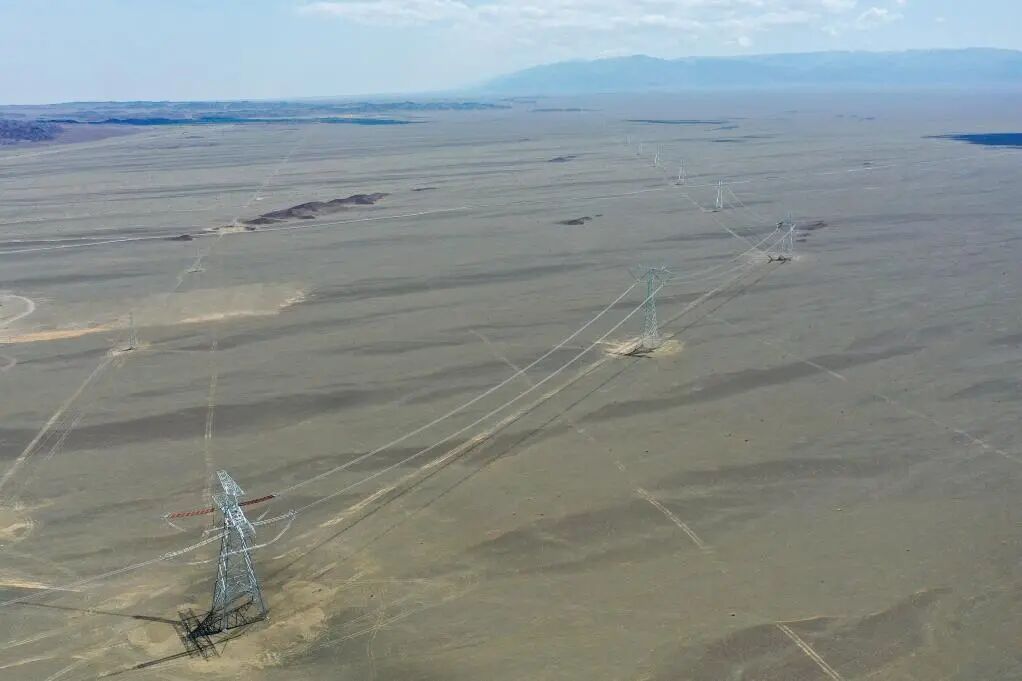
The Hami-Chongqing ±800 kV ultra-high-voltage direct current (UHVDC) transmission line. (Photo/Ding Lei)
Between 2021 and 2024, Chongqing's economy grew at an average annual rate of 5.7%. Electricity demand rose in tandem, reflecting the city's industrial and technological development. As the city approaches China's 15th Five-Year Plan period (2026–2030)- a national planning cycle that sets development priorities- ensuring a reliable power supply has become increasingly important.
The challenge became particularly clear in the summer of 2025. During that period, electricity demand on Chongqing's power grid hit record highs four times, surpassing 30 million kilowatts for the first time. The peak load eventually reached 30.28 million kilowatts. Despite the surge, authorities maintained supply stability, describing the system as capable of withstanding the peak and securing the baseline.
Chongqing also faces structural constraints in energy resources. Compared with other regions, the city has limited coal reserves, moderate natural gas resources and relatively less potential for large-scale hydropower or wind and solar generation. These factors historically made it difficult to meet the needs of a rapidly expanding economy through local power generation alone.
To address these limits, Chongqing has increasingly relied on cross-regional electricity transmission.
Major national projects completed during China's 14th Five-Year Plan period (2021–2025) have increased the city's ability to import electricity from other provinces. These include the Xinjiang-to-Chongqing power transmission project and the Sichuan–Chongqing ultra-high-voltage alternating current (UHVAC) line. UHV technology, widely used in China, enables long-distance power delivery with lower losses.
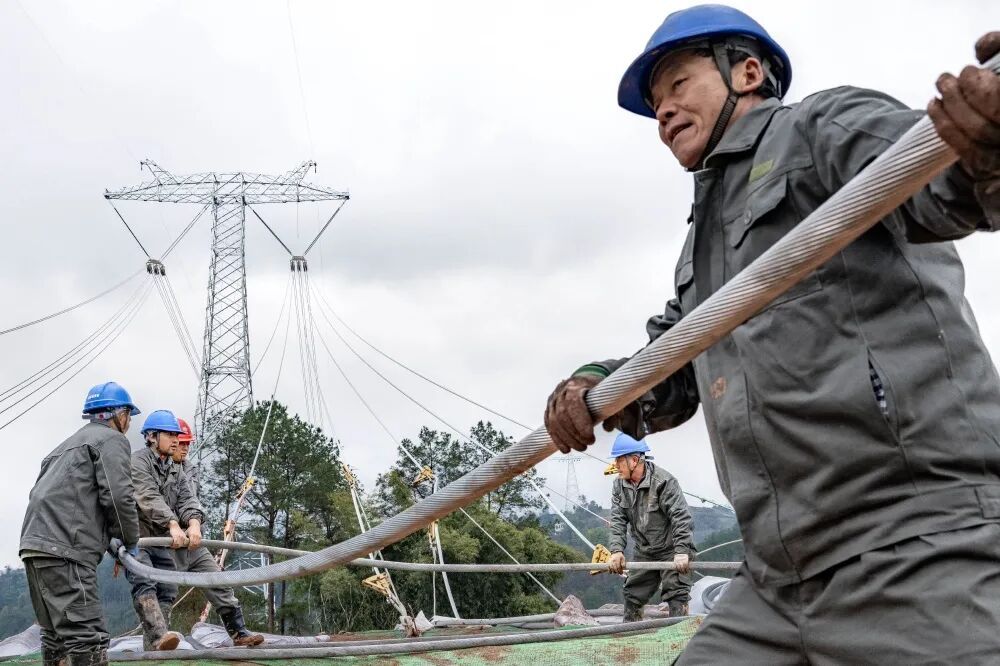
On January 8, 2025, workers from Chongqing Electric Power Transmission and Transformation Company install the final section of conductor for the Chongqing segment of the Hami–Chongqing ±800 kV UHVDC transmission project, part of the Xinjiang–Chongqing power transmission project. (Photo/Zhang Jinhui)
With these projects in operation, Chongqing's external power intake capacity increased from 8.2 million kilowatts at the end of the previous five-year plan period to 18.2 million kilowatts. In 2025, imported electricity exceeded 10 million kilowatts for the first time, accounting for roughly one-third of the city's peak power load.
At the same time, Chongqing expanded renewable energy capacity. Installed wind and solar power capacity during the 14th Five-Year Plan period grew to 5.4 times the level recorded at the end of the prior planning cycle.
Infrastructure upgrades have also supported reliability. By 2025, the total length of 10-kilovolt distribution lines exceeded 126,500 kilometers, about 30% longer than at the end of the previous five-year plan period.
System flexibility has become another priority. The Panlong pumped-storage power station- southwest China's first facility of its kind with capacity exceeding one million kilowatts- has entered full operation. Pumped storage acts like a large-scale battery, storing energy during low-demand periods and generating electricity during peaks.
Chongqing has also launched the region's first provincial-level virtual power plant platform, using digital control systems to coordinate dispersed power sources, the grid, electricity demand, and storage, improving dispatch efficiency.
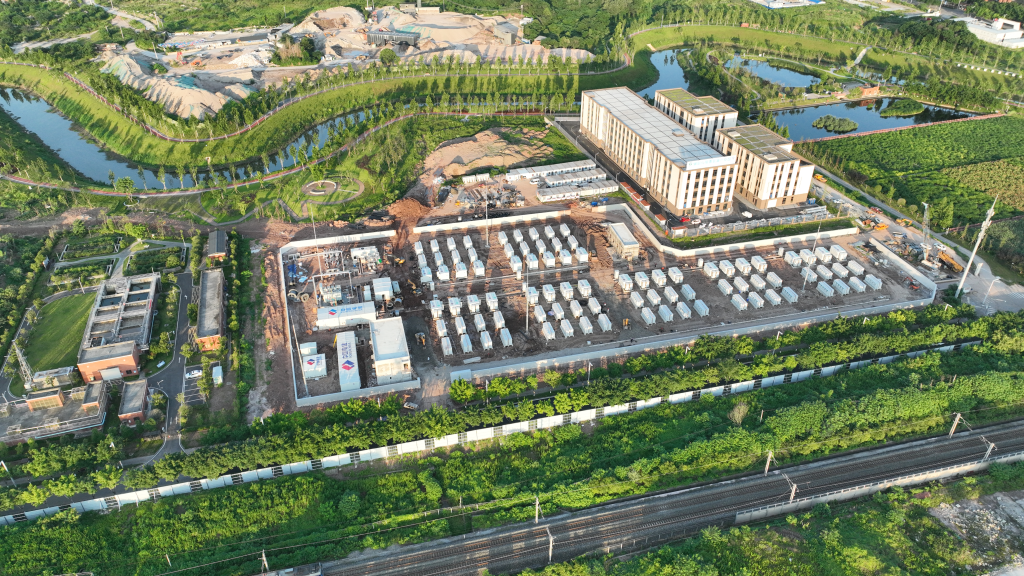
An aerial view of the Gaoxin Hangu energy storage power station. (Photo/Chongqing Municipal Development and Reform Commission)
In 2025, Chongqing's total electricity consumption reached 166.8 billion kilowatt-hours, with a five-year average growth rate of 7%. The city's GDP surpassed 3 trillion yuan (about 435 billion U.S. dollars) in 2024 and reached 3.38 trillion yuan in 2025, up 5.3% year-on-year. Per-capita GDP exceeded 100,000 yuan.
Manufacturing remains a major driver of demand, particularly autos. In 2025, Chongqing regained its position as China's largest automobile production center. The output of new-energy vehicles (NEVs) reached 1.296 million units, up 36%. Electricity consumption in the NEV industry was 16.7 billion kilowatt-hours, accounting for nearly a quarter of manufacturing power use. The city supported the sector with more than 2,050 ultra-fast charging stations and nearly 480,000 charging points across urban areas, highways, and rural communities.
Electricity demand is also rising in services and the digital economy. In 2025, the tertiary sector consumed 42.4 billion kilowatt-hours, up 5.4%, while software and information technology services used 3.44 billion kilowatt-hours.
As Chongqing plans for the 15th Five-Year Plan period, priorities include expanding cross-regional transmission channels, accelerating smart grid and microgrid construction, and improving digital coordination among power generation, transmission, consumption, and storage- aiming to keep the energy system aligned with the needs of a fast-growing megacity.
By continuing to browse our site you agree to our use of cookies, revised Privacy Policy and Terms of Use. You can change your cookie settings through your browser.
For any inquiries, please email service@ichongqing.info