
Chongqing - China’s Chongqing delegation to the National People’s Congress (NPC) filed a group suggestion with the country’s top legislature on March 7, calling for stronger national-level support to accelerate the implementation of rules on transferable cargo documents and advance higher-quality development of land-based trade.
The Chongqing delegation urged state-level support in three areas—legislation, policy coordination and judicial safeguards—to help the southwestern municipality explore land-trade rules and strengthen its role as a strategic hub in western China’s development and inland opening-up.
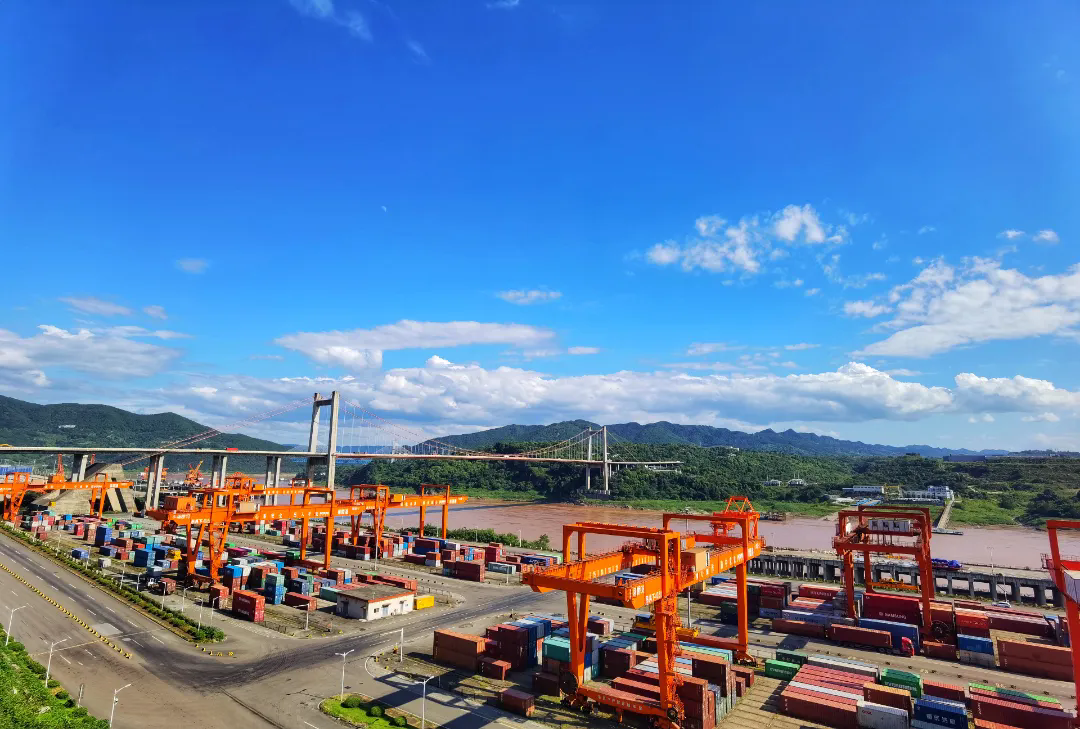
Guoyuan Port in Chongqing Liangjiang New Area. (Photo/Chongqing Lianglu Cuntan Free Trade Port Area)
Chongqing sits at the intersection of the Belt and Road Initiative and the Yangtze River Economic Belt, two major national development frameworks. The delegation said that the position gives the city an important role in China's regional development and opening-up, while also making it a suitable testing ground for new inland trade rules.
At the center of the suggestion is the United Nations Convention on Negotiable Cargo Documents, adopted at the 80th session of the UN General Assembly on Dec. 15, 2025. The delegation said the convention, for the first time at the international level, establishes a transferable cargo document regime covering multimodal and single-mode transport, granting rail and road waybills functions similar to maritime bills of lading and explicitly supporting electronic documents.
The delegation said the convention is designed to facilitate trade financing, cut inland trade costs and support digital trade. It described the treaty as the first international convention in transport rules to grow out of Chinese judicial practice and be led by China in its formulation. The convention has completed all UN approval procedures and is set to open for signature in the second half of 2026 in Accra, Ghana, and will take effect 180 days after the 10th country ratifies it.
Against this backdrop, Chongqing said national-level support is needed to translate the convention into workable domestic rules and practices. The delegation said parts of the convention still need alignment with Chinese law, while implementation will require stronger inter-agency coordination, more unified standards and clearer judicial guidance. It added that legal questions remain over whether rules traditionally applied to maritime bills of lading can extend to transferable cargo documents used in rail, road and multimodal transport.
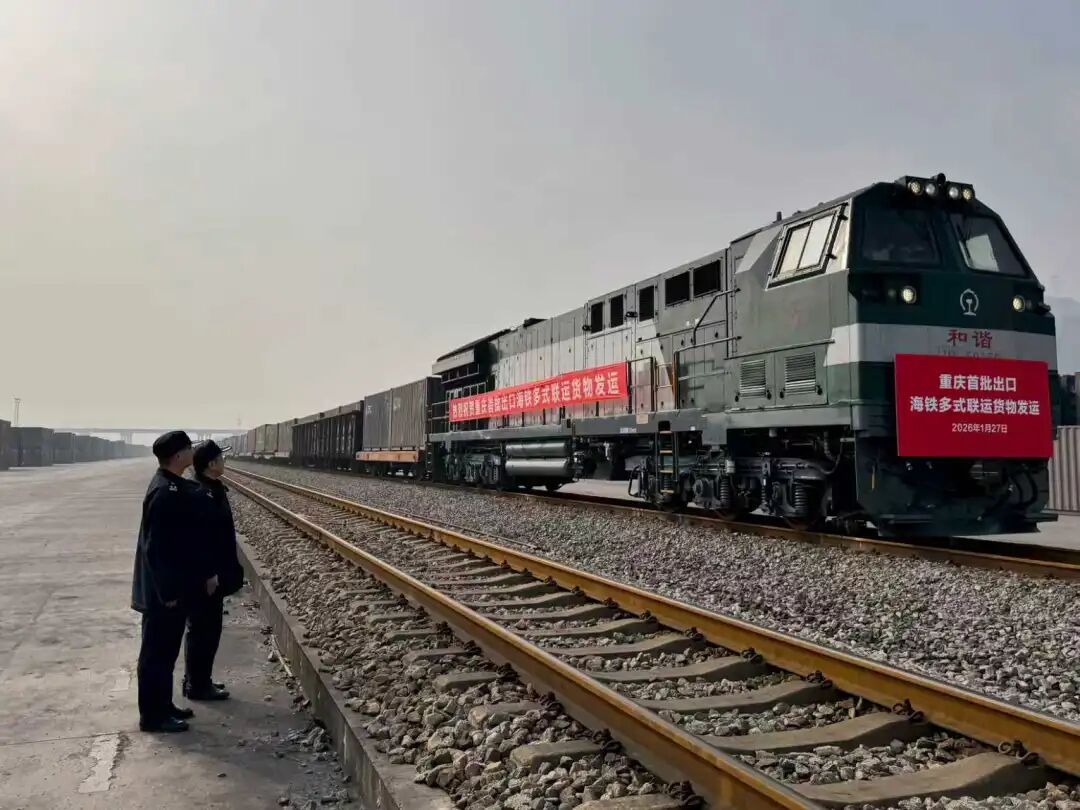
On January 27, 2026, officers from Chongqing Customs District conducted on-site supervision of the city's first export shipment transported via sea-rail intermodal transport in Chongqing. (Photo/Chongqing Customs District)
The suggestion says Chongqing has already built practical experience in this area. After the China-Europe freight train service began operating in the city in March 2011, Chongqing explored settlement using railway bills of lading under international letters of credit in automobile imports. That practice later expanded into multimodal "single-document" bills of lading, providing a practical basis for treating transport documents as documents of title in cross-border trade.
The city has also advanced institutional and judicial innovation. In June 2020, the Chongqing Free Trade Zone People's Court heard China's first property-rights dispute involving a railway bill of lading, helping shape judicial rules later reflected in the convention. By the end of 2025, Chongqing had issued more than 47,000 "single-document" bills of lading, including more than 13,000 digital bills. In January 2026, it issued 1,264 such bills, up 22.7% year on year.
To move further, the delegation called on the country's top legislature to accelerate domestic legislation after the convention is signed, while urging relevant agencies to improve policy coordination and the Supreme People's Court to issue guiding cases and judicial interpretations.
It also recommended that the People's Bank of China and the National Financial Regulatory Administration jointly study legal issues related to negotiable cargo documents in rail, road, and multimodal transport, provide institutional support for banks to recognize such documents as qualified collateral, and support financial institutions in developing trade settlement, pledge financing, and other document-based financial services.
The delegation said stronger national-level support would help turn the new rules into practical tools for higher-quality land trade and strengthen Chongqing's role as an inland gateway in China's broader opening-up.
By continuing to browse our site you agree to our use of cookies, revised Privacy Policy and Terms of Use. You can change your cookie settings through your browser.
For any inquiries, please email service@ichongqing.info