
Chongqing - Traffic management is a complex task for any megacity like Chongqing, where precision is vital. How can engineers ensure bridge stay cables remain secure, prevent tunnel collapses, and alert traffic police to accidents in seconds? Chinese engineering teams are pioneering solutions to tackle these challenges.
On March 16, a Bridging News reporter visited the Zengjiayan Bridge Science and Technology Exhibition Hall in Chongqing to explore the “hard-core” technologies shaping modern road infrastructure.
Utilizing big data and cloud platforms to manage urban traffic is no longer a novelty in China, yet some of the finer details remain impressive.
Zengjiayan Bridge in central Chongqing has become a key traffic hub by integrating a bridge, tunnel, and pedestrian system into one multi-level network. Spanning the Jialing River, it links the Yuzhong and Jiangbei districts, eases congestion, and improves connectivity in the dense megacity center.
Pedestrians are strictly prohibited from entering the Zengjiayan Bridge tunnel. At the bridge management center, the reporter observed a real-time monitoring system issue a yellow alert upon detecting a human figure inside the tunnel. Personnel then performed a manual check to confirm if it was a pedestrian or a motorcyclist before confirming or dismissing the alert—this human-machine interaction is a daily routine for the staff.
"Our task is to monitor the tunnel and bridge areas in real-time for traffic accidents, equipment failures, and other issues, and coordinate with relevant departments for resolution," a duty officer told the reporter.
On the high-tech monitoring screen, one can monitor carbon monoxide concentrations in the tunnel, the status of electrical equipment, and real-time traffic flow forecasts. Simply put, it integrates factors such as electromechanical maintenance and fire safety management into a single monitoring scope. While this involves coordination across many municipal departments, it is unified on this single screen.
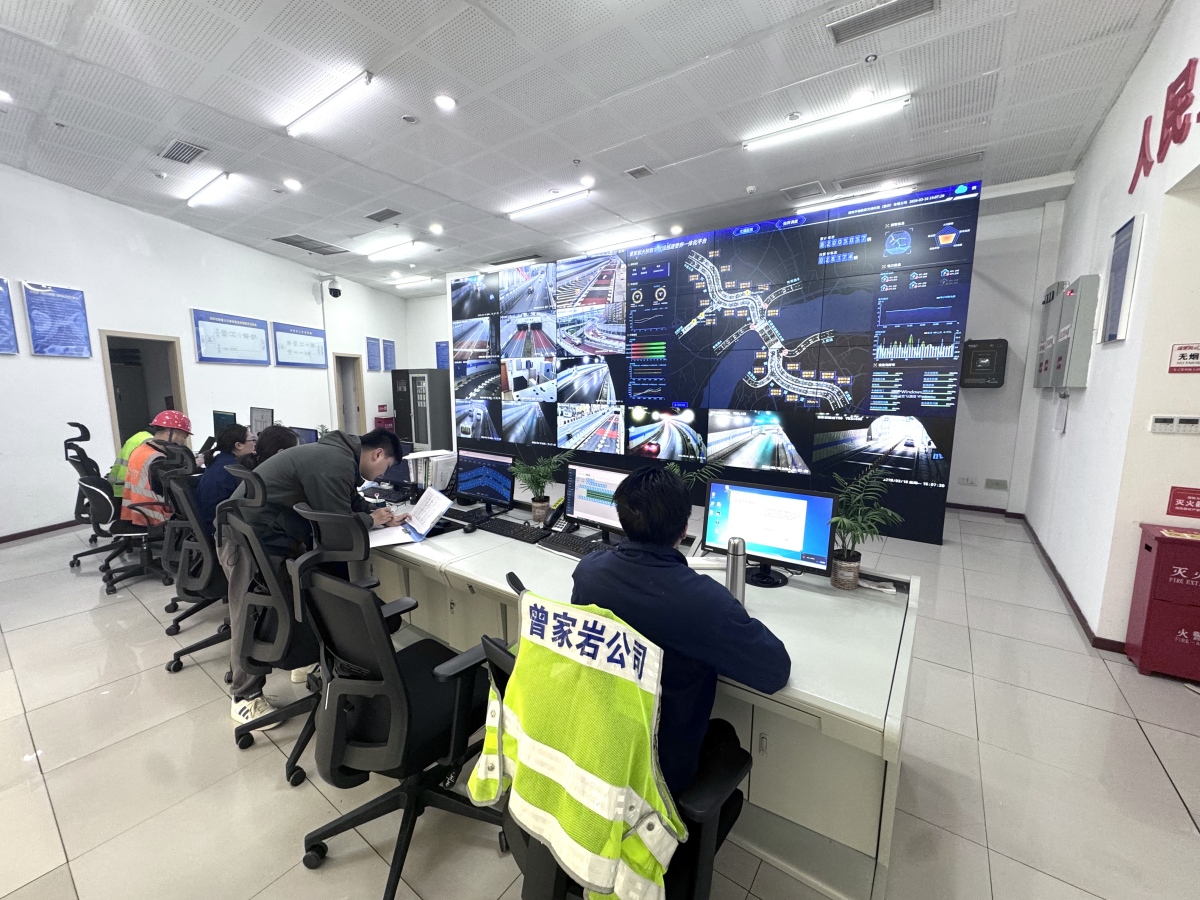
Staff members are monitoring real-time traffic data on a smart, large-scale screen. (Photo/Kenny Dong)
Once infrastructure is built, long-term maintenance becomes a new challenge. Pavement collapses, damaged tunnel structures, or cracks in bridge steel structures can all lead to serious traffic safety accidents. In the past, road infrastructure maintenance was primarily performed manually—a time-consuming and labor-intensive task.
Through collaboration with partner companies, the Zengjiayan Bridge construction team introduced inspection robots to assist with project maintenance. During the visit, the reporter viewed two primary types of robots: a tunnel inspection robot and a bridge bolt inspection robot.
A tunnel inspection robot, shaped like a train carriage, travels along tracks on tunnel walls to scan concrete structures and assess safety using image recognition, while a bridge bolt inspection robot operating on a rail system autonomously checks steel bolts and instantly alerts managers to any looseness or loss—marking a first-of-its-kind innovation in China.
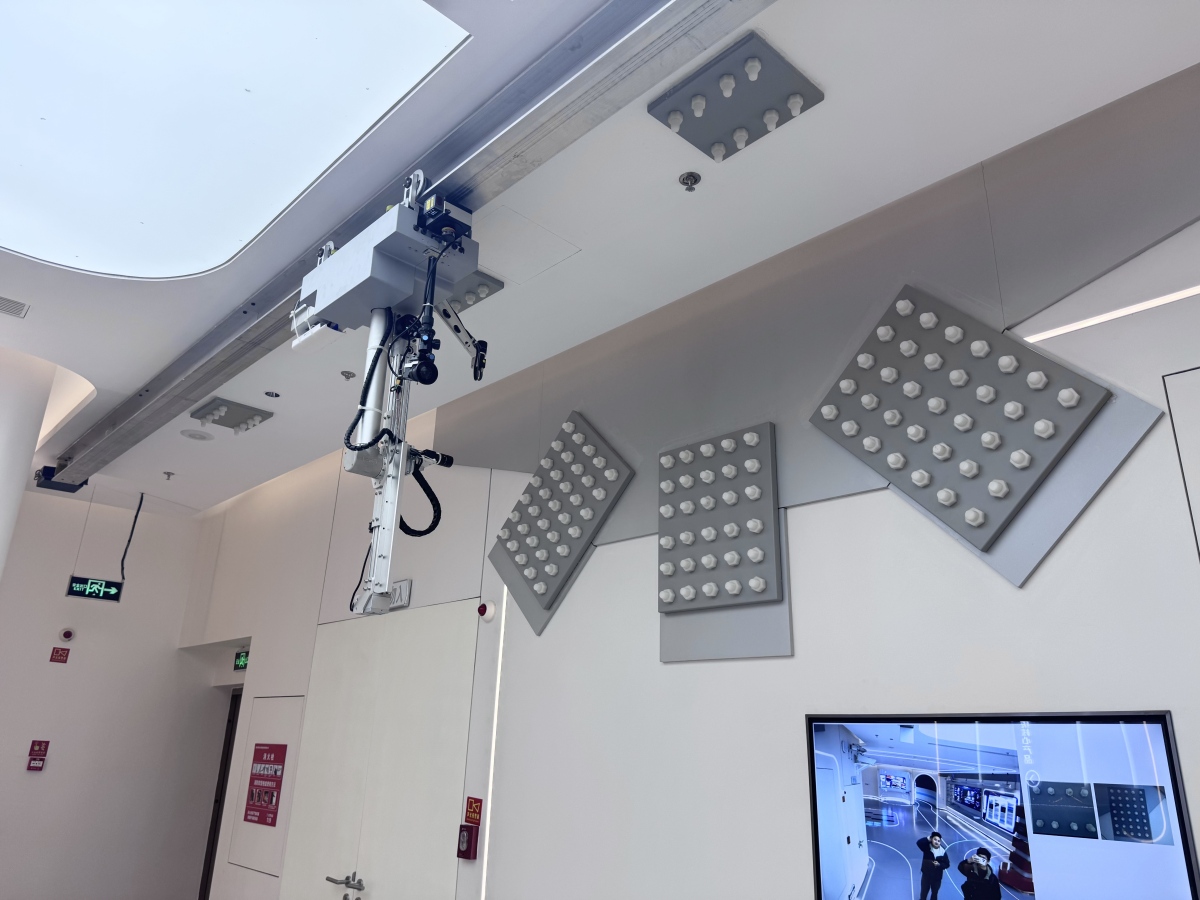
Inside the exhibition hall, a bridge inspection robot model demonstrates how to detect loose bolts. (Photo/Kenny Dong)
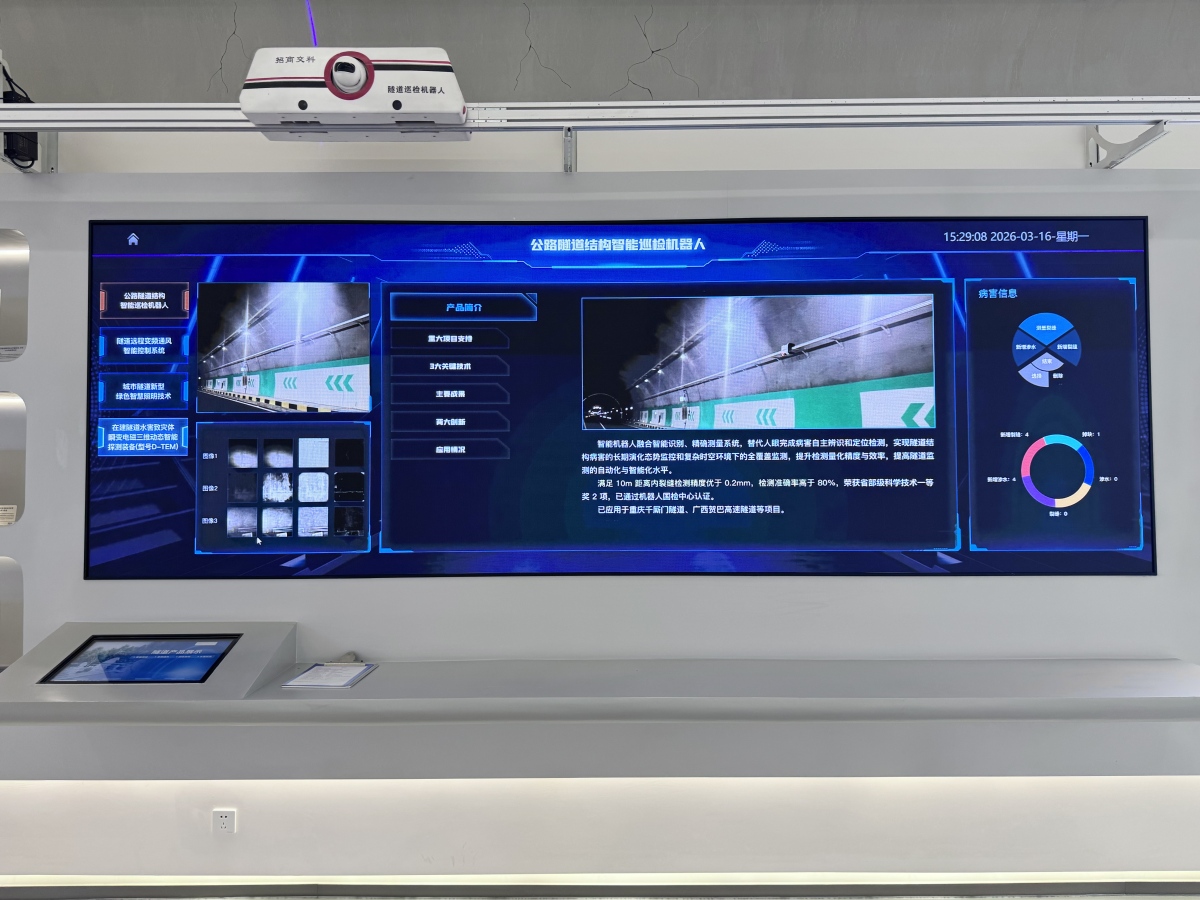
A tunnel inspection robot, shaped like a train carriage, demonstrates tunnel maintenance on a track model. (Photo/Kenny Dong)
"In the past, we relied entirely on manual inspections. Compared to robots, manual accuracy isn't necessarily as high," staff member Shang Chenghan told the reporter.
The company responsible for the construction and management of this bridge is Chongqing Zengjiayan Bridge Construction Management Co., Ltd., a subsidiary of China Merchants Group. Founded in the second half of the 19th century, China Merchants Group currently focuses its business on transportation and logistics, integrated finance, urban and industrial park development, and strategic emerging industries.
These inspection systems and big-data management models are no longer confined to this specific bridge and its surrounding tunnels; they can be seen in many cities across China.
As the era of large-scale construction for roads, bridges, and railways reaches a plateau, China's infrastructure development has entered a new phase of intelligent transformation. In recent years, the Ministry of Transport has consistently issued policies encouraging the construction of intelligent management, maintenance, and monitoring systems for transportation infrastructure.
By continuing to browse our site you agree to our use of cookies, revised Privacy Policy and Terms of Use. You can change your cookie settings through your browser.
For any inquiries, please email service@ichongqing.info