
Despite sustained airstrikes, leadership decapitation, and a growing military build-up, Washington remains caught between escalation and strategic ambiguity as the conflict with Iran expands across military, diplomatic, and economic fronts.
With no clearly defined strategy—beyond the political will of U.S. President Donald Trump and the strategic preferences of Tel Aviv—the United States continues its intense confrontation with Iran, now entering its fifth week. Washington is seeking a decisive victory that has yet to materialize despite continuous bombardment since February 28, raising fundamental questions about the limits of military power in achieving political objectives.
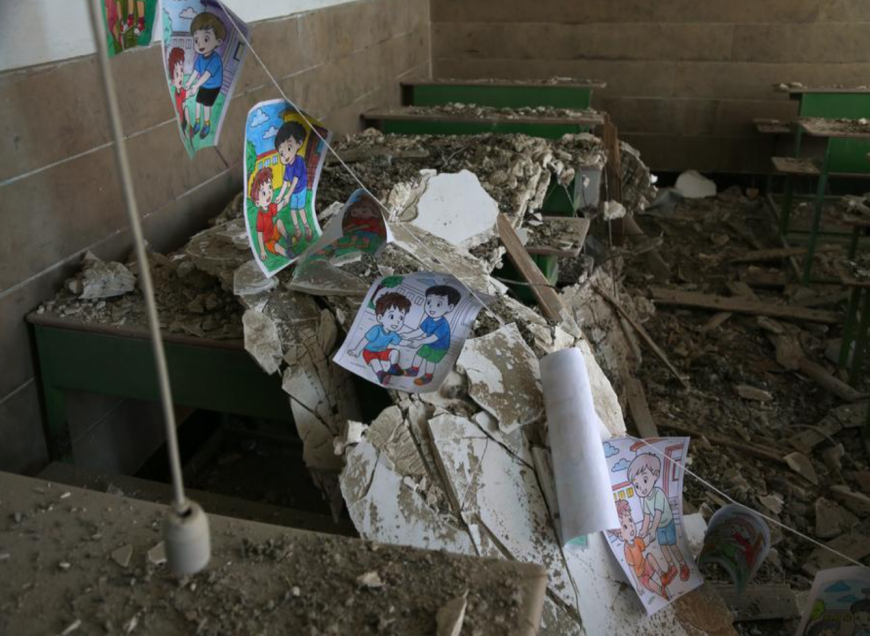
This photo taken on March 3, 2026 shows the debris inside a classroom of Shahid Mahallati School in Tehran, Iran. (Xinhua/Shadati)
Indeed, many—if not most—of Tehran’s prominent military leaders have been eliminated. Statements from U.S. Central Command (CENTCOM), alongside the president’s posts on Truth Social, continue to highlight ongoing Iranian losses. Yet, these developments have not translated into the outcome envisioned by the White House.
The sustained assassinations and airstrikes have neither forced the Iranian regime into surrender nor enabled Israeli intelligence services, including Mossad, to ignite an internal uprising. Instead, the campaign has driven Tehran to hold the United States—alongside its traditional adversary Israel—responsible for the destruction and losses. This dynamic reflects the regime’s capacity to absorb shocks and maintain internal cohesion despite unprecedented military pressure.
Across the Strait of Hormuz, losses are mounting in Gulf states. Iranian missiles continue to strike an expanding range of targets, no longer limited to U.S. military bases or Israeli interests, but extending to critical oil infrastructure. This escalation has increased pressure on Trump, who recently called on countries that refused to participate in the campaign to “go and take their oil themselves.”
Between both sides, mediation efforts continue in an attempt to rapidly end the crisis, restore regional stability, and prevent further damage to the global economy—at a time when fuel prices are rising worldwide.
Alongside the military dimension, diplomacy has emerged as an overlapping factor in strategic calculations. Ground maneuvers may serve as leverage in negotiations, yet continued airstrikes confirm Washington’s readiness to escalate if diplomacy fails, creating a complex interplay between military action and political pressure.
U.S. troop levels in the Middle East have surpassed 50,000, with the arrival of approximately 2,500 Marines and 2,500 additional naval personnel—an increase of roughly 10,000 above typical levels—according to The New York Times.
The newly deployed forces, including the 31st Marine Expeditionary Unit, arrived as part of an amphibious group led by the USS Tripoli (LHA-7)—a platform capable of conducting sea and air assault operations, including the deployment of F-35B aircraft.
U.S. sources indicate that these forces have not yet been assigned a specific mission. However, internal discussions within the Trump administration reportedly include scenarios such as seizing strategic islands or conducting limited ground operations to reopen navigation in the Strait of Hormuz, which has become nearly closed due to Iranian attacks on ships and maritime infrastructure, as reported by the Financial Times and Reuters.
The Pentagon has also deployed approximately 2,000 troops from the 82nd Airborne Division, a rapid-response force typically used in sensitive missions requiring swift deployment and control of key objectives. According to officials cited by The Washington Post and The New York Times, these forces could participate in operations such as securing Kharg Island.
On Tuesday, a U.S. official told The Wall Street Journal that the United States could soon have three aircraft carriers in the Middle East, following the deployment of the strike group led by the USS George H.W. Bush (CVN-77). This suggests it will not replace the USS Gerald R. Ford, which withdrew from the Red Sea to a Croatian port for maintenance after a fire, and is expected to rejoin Central Command soon.
Despite this build-up, military experts warn against overstating its significance. A force of 50,000 troops remains extremely limited compared to the requirements of any large-scale ground invasion. By comparison, the United States deployed approximately 250,000 troops during the 2003 invasion of Iraq, while Israel mobilized over 300,000 troops in Gaza operations since October 2023.
Iran, meanwhile, is a country of approximately 93 million people, with complex mountainous terrain and a multi-layered military structure that includes conventional forces, the Revolutionary Guard, and networks of militias and proxies—making any attempt at military control highly complex.
Iran holds significant strategic leverage over the global economy, most notably through the Strait of Hormuz. The Iranian parliament has approved legislation to impose transit fees for passage, similar to Egypt’s Suez Canal, in addition to its control over oil exports and its ability to rapidly replace leadership losses.
These factors render any U.S. move—despite Israeli pressure for escalation—highly risky, while also reflecting a degree of internal stability within the Iranian system under external pressure.
Amid U.S. reports that the deployment of thousands of troops—including Marines and paratroopers—is intended to prepare for limited tactical operations inside Iran, some American officials, including Secretary of State Marco Rubio, view ground preparations as leverage in negotiations to compel Tehran to retreat or reopen the Strait.
At the same time, continued airstrikes indicate Washington’s willingness to expand the war alongside Israel if diplomatic options fail. This reflects a dual-track strategy combining diplomatic pressure with military escalation, including potential operations to seize sensitive sites such as Kharg Island or destroy strategic missile facilities—demonstrating Pentagon planning for multiple scenarios without committing to full-scale occupation.
However, military assessments indicate that securing Kharg Island or similar strategic targets would be extremely difficult. Fierce resistance involving drones, missiles, and naval mines—combined with the logistical challenges of securing such positions—would make the operation highly risky and potentially lethal for U.S. forces.
This environment reportedly contributed to Israel targeting Iranian Revolutionary Guard Navy commander Ali Reza Tangsiri, who was directly overseeing defensive preparations for the island against a potential U.S. ground operation.
Reflecting these risks, The Wall Street Journal reported that Trump has told aides he is prepared to end the U.S. military campaign against Iran even if the Strait of Hormuz remains largely closed.
In recent days, Trump and his advisers have concluded that forcibly reopening the Strait would extend the conflict beyond the president’s projected four-to-six-week timeline. Instead, Washington aims to weaken Iran’s naval forces and missile stockpiles, reduce current hostilities, and apply diplomatic pressure to restore freedom of trade.
If these efforts fail, the United States may pressure its European and Gulf allies to take the lead in reopening the Strait. Officials also indicated that additional military options exist, though they are not immediate priorities.
According to The Telegraph, analysis of munitions used in the war compared to known stockpiles suggests the Pentagon is racing against time to conclude operations before critical weapons are depleted. The Royal United Services Institute estimates that shortages in advanced air defense missiles and precision-guided bombs could emerge within a month, following the use of 11,000 munitions costing $26 billion during the first 16 days of operations.
Days ago, Iran reportedly inflicted significant strategic losses on the United States in a single strike targeting Prince Sultan Air Base in Saudi Arabia, destroying an E-3 Sentry aircraft—one of the most critical assets in the U.S. arsenal, with no direct production replacement and an estimated cost of $700 million—along with damage to up to five aerial refueling aircraft.
Despite this, Trump stated Tuesday that he is not yet ready to abandon efforts to force Iran to reopen the Strait. In remarks to CBS News, he expressed frustration over the lack of allied participation while confirming that U.S. forces will remain engaged “for now”.
Russia’s ambassador to Tehran stated that Iran’s new Supreme Leader remains inside the country despite his absence from public view, citing security-related reasons. Russian President Vladimir Putin was among the first to express support for the new leadership, while Western reports had previously claimed he was transferred to Moscow for treatment following injuries sustained in U.S.-Israeli strikes.
Meanwhile, Trump indicated that the new leader is likely alive but in critical condition.
The conflict has exposed growing divisions among Western allies. Italy, led by Prime Minister Giorgia Meloni, refused to grant landing rights to U.S. warplanes, while France blocked weapons transfers through its airspace, prompting criticism from Washington.
President Emmanuel Macron responded by stating that France has not altered its policy since the beginning of the crisis. Spain has also restricted U.S. military use of its bases, with Prime Minister Pedro Sánchez warning that the conflict could exceed the масштаб of the 2003 Iraq War.
The International Monetary Fund has warned that the war has triggered severe disruptions across frontline economies and is casting a shadow over global recovery.
The conflict has produced a “highly uneven global shock,” tightening financial conditions while driving up energy and food prices. The closure of the Strait of Hormuz and damage to regional infrastructure have contributed to one of the largest disruptions in global oil markets in history.
Low-income countries face heightened risks to food security, while persistent inflation threatens to slow global growth. As the IMF noted, all trajectories point toward higher prices and weaker economic performance.
At its core, the conflict underscores a central strategic dilemma: the United States is applying sustained pressure without a clearly defined path to victory. Military escalation risks broadening the war, while diplomacy lacks sufficient leverage to force a decisive outcome.
As the fifth week unfolds, the war against Iran is increasingly defined not by what it has achieved—but by what it has yet to resolve.
By continuing to browse our site you agree to our use of cookies, revised Privacy Policy and Terms of Use. You can change your cookie settings through your browser.
For any inquiries, please email service@ichongqing.info