
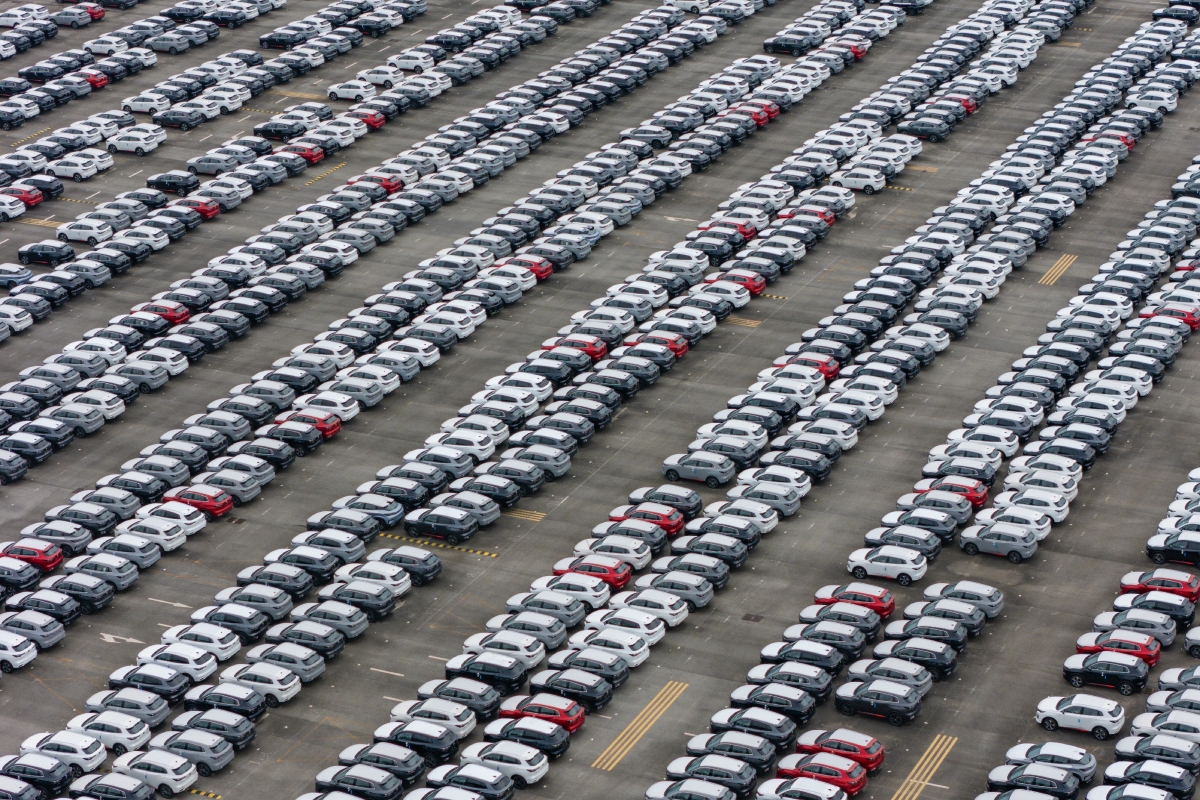
Changan vehicles await shipment at the port for overseas delivery. (Photo/Li Hongbo)
Chongqing - In Q1 2026, China’s auto market came under pressure from weakening domestic demand, but a surge in exports helped stabilize overall sales for major automakers.
Data from the China Passenger Car Association shows that cumulative retail sales of passenger vehicles nationwide in 2026 Q1 stood at 4.236 million, down 17% year-on-year. In March alone, retail sales reached 1.657 million. While this represents a 60% month-on-month increase—indicating a post-holiday recovery—it still marks a 15% decline.
In contrast to the domestic market, Chinese auto exports demonstrated robust growth. From January to February this year, national auto exports reached 1.55 million, a 61% YoY increase. New energy vehicles (NEVs) performed particularly well, with cumulative exports hitting 670,000, up 88% YoY, acting as the core driver for overseas expansion.
Statistics reveal that in 2026 Q1, China's top eight automakers, including Geely, BYD, Chery, Changan Automobile, Great Wall Motor, SAIC, Dongfeng, and GAC, exported a combined total of 1,721,830 vehicles, accounting for 36.49% of their total sales. The Chinese auto industry rapidly transitions to a "dual circulation" model, with exports emerging as a vital engine for sales growth.
Export performance varied among automakers. Chery reported cumulative Q1 sales of 601,712, with overseas sales reaching 393,311. This accounted for 65.37% of its total sales, reflecting a 53.9% growth. Currently, Chery has 19.12 million users worldwide, including over 6.23 million overseas users, positioning it at the forefront of the industry's globalization process.
Among private automakers, Geely and BYD vied for the Q1 total sales crown, recording 709,358 and 700,463 respectively, with Geely edging out BYD by just 8,895. However, in overseas markets, BYD exported 319,751 (45.65% of total sales), outpacing Geely's 203,024 (28.62% of total sales), indicating a faster pace of international expansion for BYD.
SAIC topped the list with total Q1 sales of 972,748, a slight increase of 2.95%. Its exports reached 324,899, surging 48.34% and accounting for 33.30% of total sales, demonstrating steady overseas operations.
Changan and GWM showed distinct performances in their respective segments. Changan's total Q1 sales stood at 557,501 (down 20.94%), but its overseas sales reached 212,585, making up 38.13% of the total, with its March exports hitting a record high. GWM recorded total Q1 sales of 269,104 (up 4.79%), with cumulative overseas sales of 130,095, accounting for 48.34% of its total volume.
Dongfeng and GAC reported relatively lower export ratios. Dongfeng sold 528,000 in Q1 (up 12.3%), with overseas sales at 96,000, accounting for 18.18%. GAC's cumulative Q1 sales neared 380,000 (up 2.38%), while overseas sales of its independent brands stood at 42,165, making up 11.10%. Their slower overseas progress is due to a strategic focus on domestic joint ventures, delayed establishment of overseas channels, and challenges with regional product adaptability.
Regarding the Q1 decline in domestic auto production and sales, the China Association of Automobile Manufacturers noted that it resulted from a combination of factors. On the policy front, phased adjustments to industry regulations led to an overdraw of purchasing demand.
Specifically, starting January 1, 2026, the NEV purchase tax policy shifted from a full exemption to a 50% reduction. This prompted many consumers to rush their purchases at the end of 2025, causing a sharp contraction in terminal demand at the beginning of 2026. Chinese auto "trade-in" subsidy policy transitioned from a fixed quota to a dynamic percentage based on the new car's price, leaving both the market and consumers in an adaptation period.
Holiday factors and industry cycles disrupted production and sales rhythms. The 2026 Spring Festival holiday was extended to nine days, leaving only 16 effective working days in the first quarter. This restricted corporate production schedules and terminal consumer activities. Coupled with the traditional year-end and early-year off-season for auto sales, these short-term seasonal fluctuations further exacerbated the downward pressure on the domestic market in Q1.
By continuing to browse our site you agree to our use of cookies, revised Privacy Policy and Terms of Use. You can change your cookie settings through your browser.
For any inquiries, please email service@ichongqing.info