
Chongqing - China's foreign trade expanded sharply in the first quarter of 2026, with inland regions emerging as a major growth engine, according to data released April 14 by China's State Council Information Office.
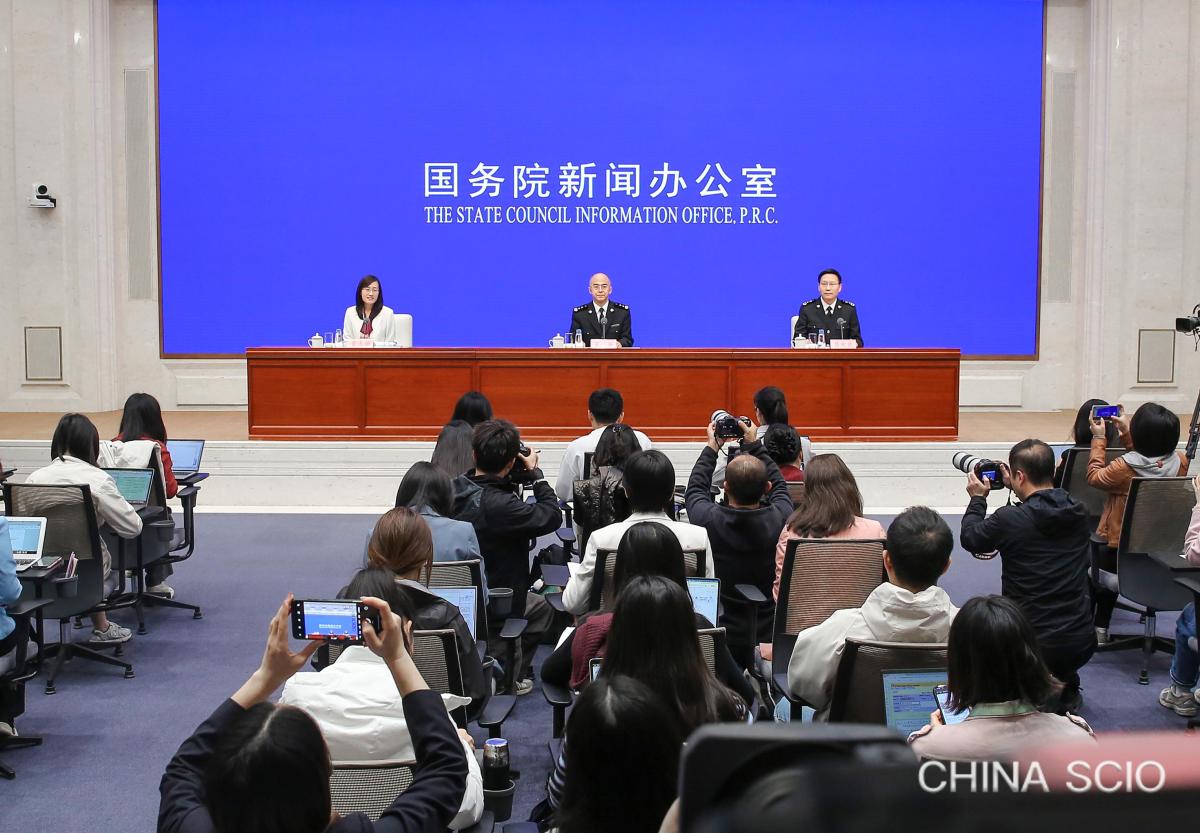
On April 14, 2026, the State Council Information Office held a press conference in Beijing on China's import and export in the first quarter of 2026. (Photo/China SCIO)
Total imports and exports of goods reached 11.84 trillion yuan (about 1.74 trillion U.S. dollars), surpassing 11 trillion yuan for the first time in the same period and rising 15% year-on-year. Central and western regions accounted for 2.21 trillion yuan of that total, up more than 20%, contributing 24% of the country's overall foreign trade growth.
At the recent press conference, Wang Jun, vice minister of the General Administration of Customs of China (GACC), highlighted a championship-winning motorcycle from Chongqing, known as ZXMOTO, as an example of the region's industrial momentum. "For every 10 internal combustion motorcycles China exports, four come from central and western regions," he said.
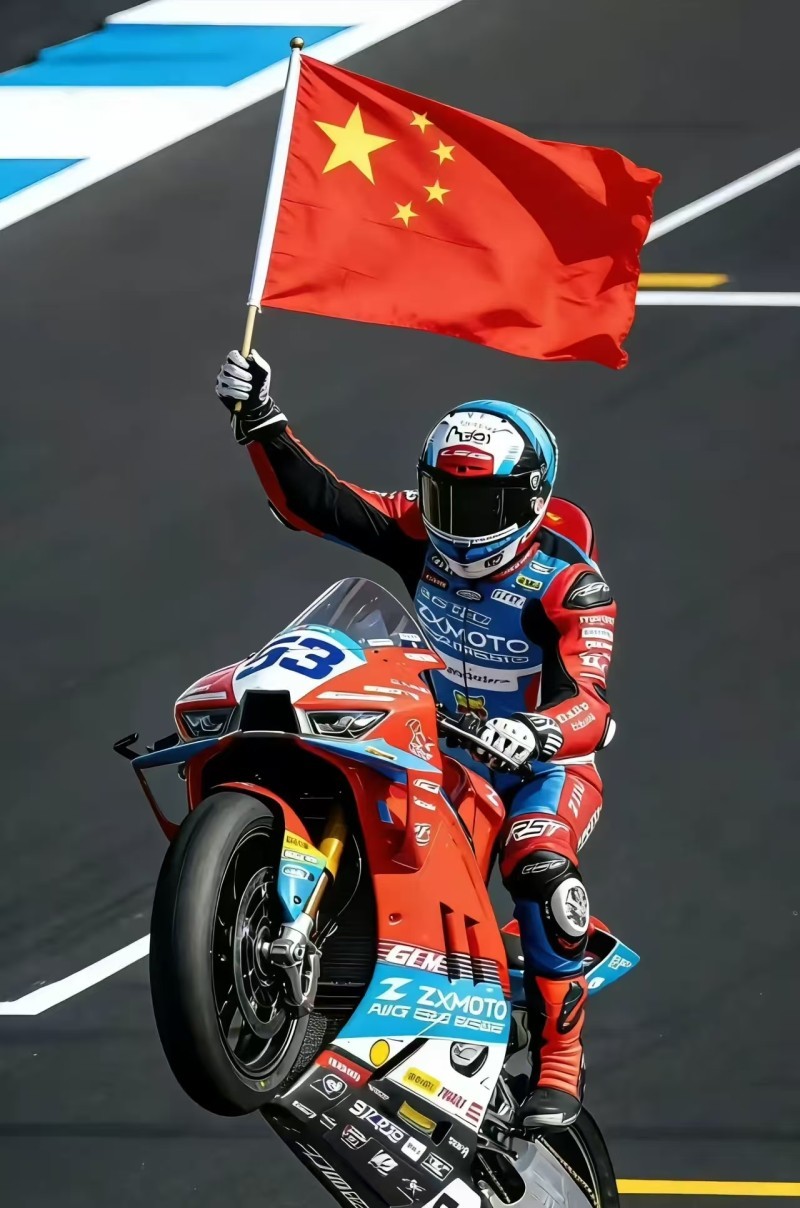
French rider Valentin Debise, riding ZXMOTO's 820RR-RS, wins the WSBK Portugal round and raises China's national flag after the race. (Photo/ZXMOTO)
Chongqing illustrates that strength in concrete terms. The inland city is home to 51 major motorcycle manufacturers and more than 410 parts suppliers, with local sourcing exceeding 80%. Its broader trade platform has also expanded rapidly: the city's seven comprehensive bonded zones recorded 87.07 billion yuan in trade in the first two months of the year, up 44.3% and accounting for 63.5% of Chongqing's total foreign trade.
Officials also pointed to the rapid rise of green industries. In China, the "new three" refers to electric vehicles, lithium batteries, and photovoltaic products. Wang said exports of these products from central and western regions grew 24.7 percentage points faster than the national average. Electric vehicles and photovoltaic products accounted for more than 40% and 30% of China's total exports in their respective categories.
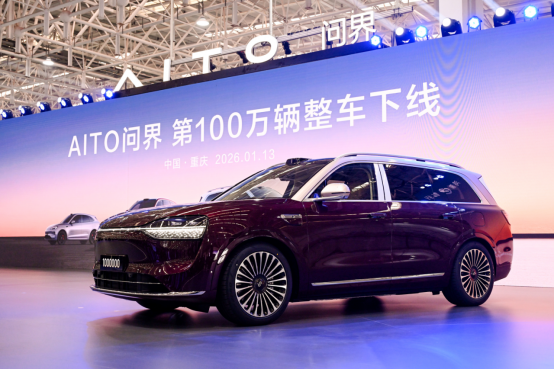
On January 13, 2026, AITO rolled off its one millionth vehicle at the Seres Super Factory in Chongqing. (Photo/Seres)
Chongqing's numbers reflect that trend. In the first two months of 2026, its total imports and exports reached 137.02 billion yuan, up 38.8% year-on-year. Automobile exports rose 89.3% to 8.89 billion yuan, while mobile phone exports increased 26.1% to 8.43 billion yuan. The city reflects a wider shift in western China from traditional manufacturing toward higher-value sectors such as new energy vehicles and electronics.
Improved logistics have also supported the growth. In the first quarter, imports and exports through the New International Land-Sea Trade Corridor rose 22.5%, while rail and air transport increased 21.5% and 23.9%, respectively.
Chongqing, the corridor's operational center, handled 28,700 twenty-foot equivalent units of cargo in January, up 56% year-on-year, while multimodal transport volume surged 76%. The network now covers 18 provincial-level regions, connects more than 120 countries, and includes more than 200 routes and 1,400 types of goods.
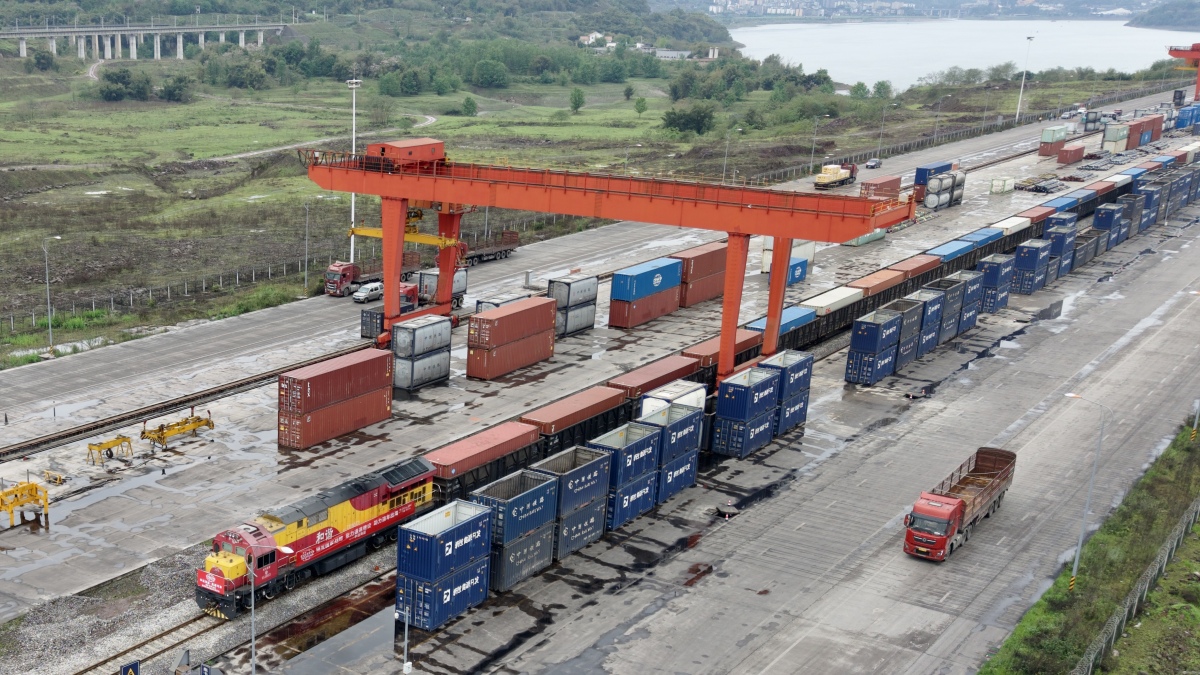
A freight train of the New International Land-Sea Trade Corridor, loaded with semi-knocked-down (SKD) automobile kits, departs from Fuling Longtou Port on March 31, 2026, marking the inaugural launch of the Fuling-to-North Africa route. (Photo/Chongqing Railway Logistics Center)
On March 31, a new freight train route was launched from Fuling in Chongqing to North Africa, carrying 150 sets of semi-knocked-down automobile kits worth about 10 million yuan. The shipment is expected to cut transport time by more than 10 days compared with traditional river-sea shipping. A representative from Chongqing Railway Logistics Center said the route demonstrates the corridor's ability to support the export of high-value-added products.
Policy support also expanded. In 2026, China widened its cross-border trade facilitation program to 45 cities, including 16 in central and western regions. Xi'an, Lanzhou, Kunming, and Yinchuan joined for the first time, piloting 29 measures in customs clearance, trade formats, logistics efficiency, and digital port operations.
China is also set to implement a zero-tariff policy for 53 African countries with diplomatic ties starting May 1, a move expected to boost trade flows further. Inland regions, which serve as key hubs in China's Belt and Road Initiative, are likely to benefit from increased connectivity with these markets.
"We have the confidence and capability to stabilize the scale of foreign trade and optimize its structure," Wang said. "Central and western regions are an important force in stabilizing foreign trade and expanding opening-up."
By continuing to browse our site you agree to our use of cookies, revised Privacy Policy and Terms of Use. You can change your cookie settings through your browser.
For any inquiries, please email service@ichongqing.info