
Chongqing — As water levels dropped this spring at Yutan Reservoir in Dazu District, a striking image surfaced along the receding shoreline: rows of stone-carved hands, layered one above another, appearing to rise from the water.
Captured by a passing photographer and widely shared online, the scene drew widespread attention and speculation. Some viewers wondered whether the sculpture was an ancient relic that had long been submerged. Others traveled to Panlong Village to witness what quickly became known as the “Thousand-Hand Guanyin” in the water.
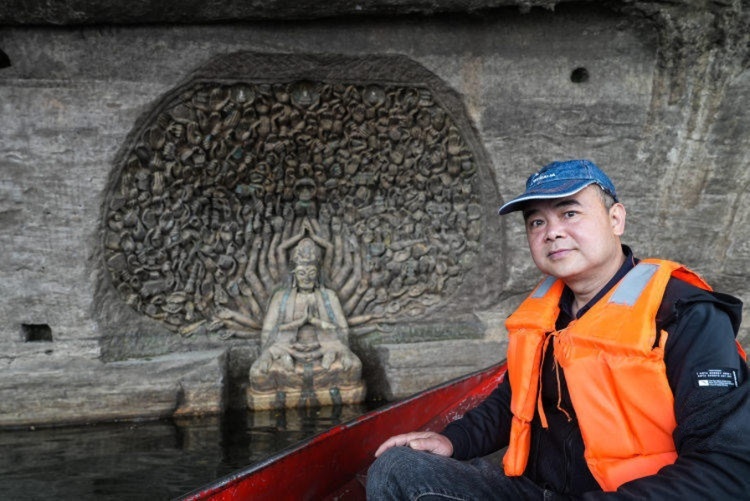
Shao Tianyun and his 30-year-old work. (Photo/Zou Fei)
In fact, the carving is not centuries old. It was created about 30 years ago by a local craftsman, Shao Tianyun.
Now in his 50s, Shao recently returned to the reservoir, where villagers immediately recognized him. Standing at the bow of a small boat, he watched as the hands he carved decades ago reappeared between rippling reflections of light.
“Being able to leave something behind is enough,” he said.
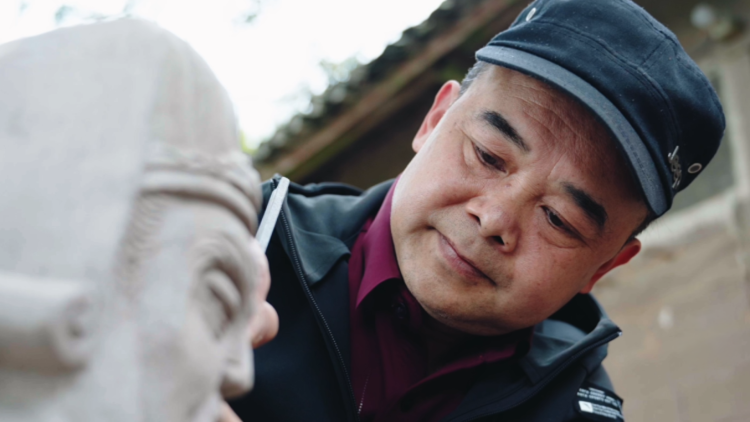
Shao Tianyun works on a sculpture. (Photo/Dazu Media Center)
Shao was born and raised in Dazu, home to the UNESCO-listed Dazu Rock Carvings, a complex of religious sculptures dating from the 9th to 13th centuries. As a child, he spent hours observing the intricate figures at Baodingshan, studying the folds of garments, the gestures of hands and the lifelike expressions carved into stone.
“At the time, I didn’t understand the techniques,” he said. “I just knew they were extraordinary.”
Without formal training, he began experimenting on his own, carving stones with simple tools and gradually learning to understand the material — its grain, density and natural fractures.
“You have to follow the stone,” he said.
In 1996, at age 25, Shao was commissioned by villagers in Panlong to create a cliffside sculpture near what would later become Yutan Reservoir. Armed with little more than a rough sketch and his memory of the Thousand-Hand Guanyin at Baodingshan, he worked largely alone, traveling long distances each day with his tools.
Using only hammer and chisel, he shaped each hand step by step — from rough outline to fine detail — in a repetitive, labor-intensive process that echoed through the valley.
His original plan was to carve 1,007 hands, in keeping with traditional depictions of the bodhisattva. Financial constraints limited the final work to 480.
Not long after, the area was flooded by the reservoir's construction, submerging the unfinished sculpture and gradually fading it from memory — even for Shao himself, who later left Dazu to pursue jade carving in southern China.
Three decades later, the artwork resurfaced unexpectedly as water levels receded. Shao first recognized it in a video circulating online.
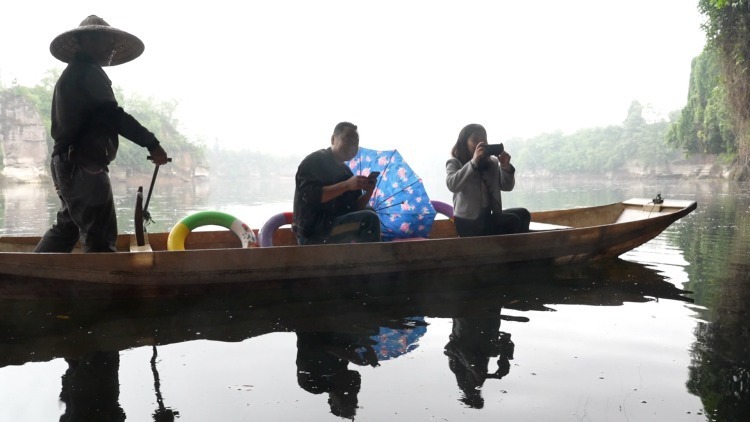
Visitors view the Thousand-Hand Guanyin. (Photo/Zou Fei)
Its partial completion, once a source of regret, now contributes to its visual impact. The upper portion of intricately carved hands contrasts with the untouched rock below, while reflections from the water create shifting patterns of light and shadow across the surface.
“Looking at it now, the unfinished part has become a highlight,” Shao said. “If it had been fully completed, it might not have this effect.”
In recent years, Shao has returned to Dazu, stepping away from higher-paying commissions to focus on teaching. He has trained more than 100 apprentices, emphasizing patience and attentiveness to the material.
“Many people learn quickly, but not everyone can stay focused,” he said.
His son, Shao Lei, has also taken up the craft, continuing a tradition that Shao believes should remain rooted in everyday life rather than confined to museums.
With renewed attention surrounding the resurfaced sculpture, Panlong Village has seen an increase in visitors. Local officials say the once-quiet reservoir area has grown livelier, as tourists and photographers arrive to view the carving.
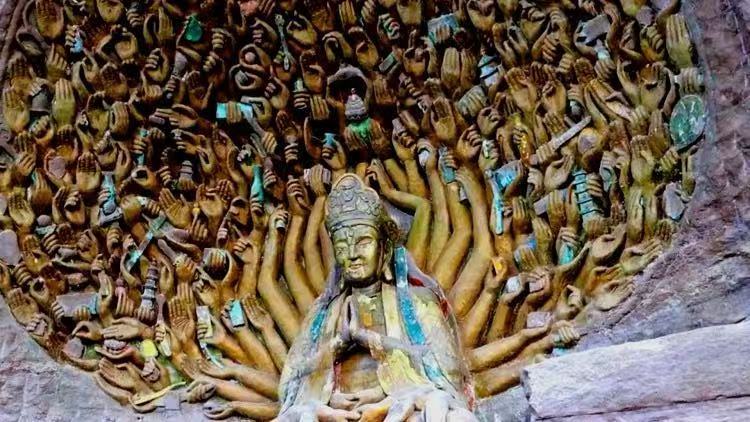
The Thousand-Hand Guanyin. (Photo/Zou Fei)
For Shao, however, the attention matters less than whether people take the time to look closely: at the hands, at the stone, and at the craftsmanship shaped by years of patient work.
Thirty years after it was left unfinished, the sculpture has returned to public view in an unexpected form — shaped not only by human hands, but also by time and nature.
(Zhang Xuege, as an intern, also contributed to this article.)
By continuing to browse our site you agree to our use of cookies, revised Privacy Policy and Terms of Use. You can change your cookie settings through your browser.
For any inquiries, please email service@ichongqing.info