

People try out a spicy soup base at a hot pot festival in Chongqing. (Photo/Xinhua)
Chongqing - Ever tried Chinese hotpot? Its soup bases can vary dramatically by region, from fiery spicy broths to rich and savory flavors. As hotpot expands into global markets, China has introduced its first national standard for hotpot soup bases, giving exporters and overseas buyers a clearer reference for quality and classification.
The voluntary GB/T standard, which took effect on June 1, 2026, aims to address long-standing differences in local and company standards as Chinese hotpot flavors expand into global markets.
Previously, hotpot soup bases followed different local or company standards, which sometimes created challenges for exporters in product classification at overseas customs.
Around 2006, Chongqing-based hotpot food company Zhoujunji had just built a modern production line, the first food-grade production line of its kind in Southwest China. Its food safety director, Liao Yuanguo, took samples to Europe and the U.S., where customs officials kept asking one question: Is this a seasoning or a stock? Liao could not give them a clear answer.
An early shipment to the U.S. was delayed for three weeks. Test reports had to be redone repeatedly while orders stalled. Foreign importers became reluctant to sign long-term contracts because no one knew what would happen to the next batch.
Ingredients created even bigger problems. Li Dejian, chairman of Chongqing hotpot brand DeZhuang, said beef-tallow soup base contains animal fat, which draws stricter import scrutiny despite being a signature ingredient in Chongqing hotpot. If a recipe contains other animal-derived ingredients, such as chicken powder, many countries may classify the product as prohibited. "Without a unified Chinese standard, we had no leverage in negotiations," Liao said.
Hotpot traditions from across China came together to draft the standard: Chongqing's numbing-spicy, rich beef-tallow broth, Sichuan's fresh and fragrant oil-based broth, and Inner Mongolia's clear soup. Each side wanted its own product characteristics reflected in the rules. "Arguments sometimes became heated enough for participants to pound the table, and meetings often ran deep into the night," Liao said. Dozens of panel discussions and more than a hundred surveys still could not settle the differences.
The deadlock broke when the group shifted its focus from creating a unified flavor formula to establishing common quality rules: no prescribed taste, no mandatory spice ratios, only safety baselines for the entire supply chain and common physical and chemical indicators.
The standard also expanded the recognized product forms, adding solid and liquid soup bases alongside the traditional semi-solid block. These formats include products suited to camping, single-serving instant meals and quick home cooking.
It also sets uniform requirements for indicators such as heavy metals, pesticide residues and acid value in key ingredients including chili, Sichuan pepper and beef tallow. The new safety guidelines require microbiological controls throughout production and mandatory testing of finished products, including routine factory inspections and type testing.
After the standard was published in May 2025, many companies began upgrading their operations before it took full effect. In the summer of 2025, DeZhuang shipped 20 tonnes of soup base to Europe, marking its first entry into that market. Zhoujunji has operated in South Korea for years; previously, every shipment meant re-explaining the product's classification and resubmitting test reports.
Now, foreign importers can verify products directly against the Chinese standard, whose food safety indicators already cover or exceed the entry requirements of several target markets. Some countries and regions have already adopted it as a quality certification reference for importing Chinese hotpot soup base.
At the Anuga food fair in Cologne in October 2025, a German buyer praised Zhoujunji's product as "distinctly Eastern in character yet in line with modern food standardization requirements." Zhoujunji's output value exceeded 200 million yuan (about 29.5 million U.S. dollars) in 2025, with overseas orders growing far faster than domestic ones. "The standard speaks for us. We no longer have to chase customers to prove our products are good," Liao said.
The new standard gives Chongqing, widely regarded as one of the birthplaces of Chinese hotpot, a new benchmark for expanding the industry internationally. Chongqing's hotpot industry generates about 330 billion yuan (about 48.7 billion U.S. dollars) annually across its full industry chain and employs nearly 900,000 people. The city is targeting 500 billion yuan in full-industry-chain output by 2027 and, under a 2024 municipal policy, aims to become a global hotpot-ingredient production and distribution center and a national center for hotpot standard-setting.
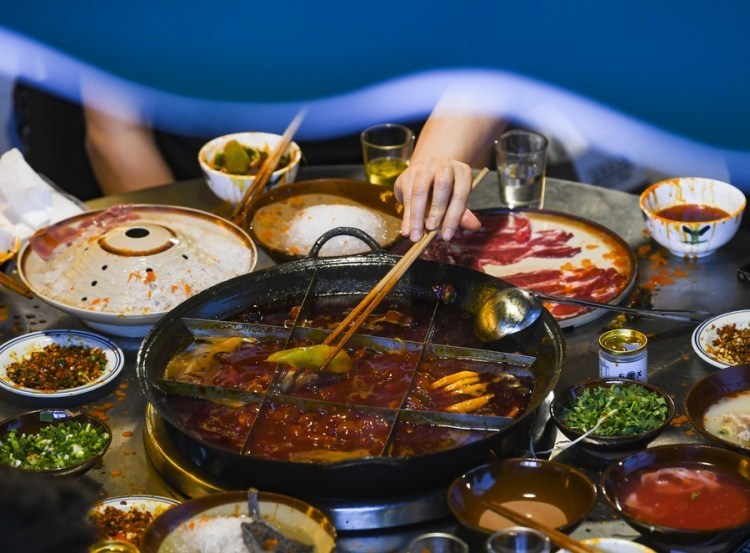
People enjoy a meal at a hotpot restaurant on a commercial street in southwest China's Chongqing Municipality. (Photo/Xinhua)
By continuing to browse our site you agree to our use of cookies, revised Privacy Policy and Terms of Use. You can change your cookie settings through your browser.
For any inquiries, please email service@ichongqing.info