
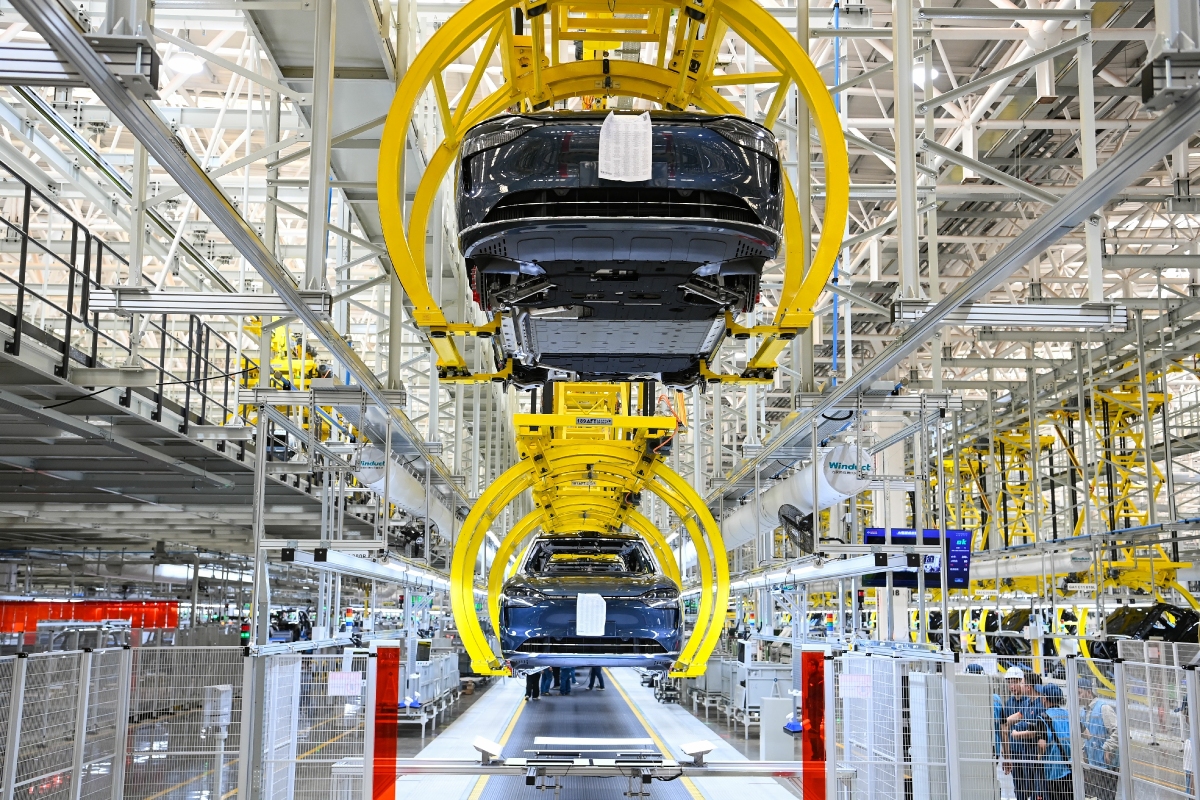
The assembly workshop of Seres' super factory, where robots are at work. (Photo/Wang Jiaxi)
Chongqing - China’s research and development spending reached 3.93 trillion yuan (approx. 589.36 billion U.S. dollars) in 2025, up 8.2% year on year. Businesses accounted for 3.04 trillion yuan, or 77.4% of the total, making them the main source of R&D investment.
As businesses become the main force behind China’s R&D investment, how they use it to drive growth matters to global technology, competition and collaboration. Private enterprises in Chongqing offer a concrete example of this shift.
The figures show that R&D spending rose even as the companies' combined revenue remained largely stable. For manufacturers facing intensifying competition and pressure to upgrade their products, expanding capacity, increasing output or cutting costs alone may not be enough to sustain a competitive edge. R&D can help companies improve products, boost efficiency, develop new businesses and explore new markets.
However, higher R&D spending does not mean that all companies have shifted to technology-driven growth. Chongqing's businesses are exploring different approaches.
In the new energy vehicle sector, Seres continues to invest in intelligent and electrification technologies. The company's R&D spending reached 12.51 billion yuan in 2025, up 77.4% year on year, while revenue grew 13.7%. The figures show that higher R&D spending coincided with business growth. For NEV manufacturers, R&D matters not only for developing new features, but also for improving vehicle technology, user experience, and product competitiveness.
Shineray Group has introduced intelligent connected technologies and remote management into its businesses, while expanding its product range to include commercial NEVs, motorcycles and intelligent lawn-mowing robots. Technological upgrades can improve existing operations while helping traditional manufacturers develop new products and enter new markets.
Sevnce Robotics focuses on high-risk industrial settings, including the petroleum and chemical sectors. It develops explosion-proof robots and related solutions for inspection and safety management. These products are designed to reduce the need for personnel to enter hazardous areas and support more efficient inspections and safety management. Their actual impact depends on the results achieved in specific applications.
R&D requires talent, funding, equipment and application scenarios. Access to these resources, along with the ability to share costs and risks, affects whether technologies can be put to practical use.
The list shows that 88 companies cooperate with universities. Companies on the list have also helped establish 116 innovation and R&D organizations, including industrial technology alliances, innovation consortia, joint laboratories and new-type research institutions.
Leading companies are also deepening industrial collaboration. Seres, for example, works with Huawei in the intelligent vehicle sector and has strengthened cooperation with CATL on battery safety and supply-chain coordination.
Companies are also seeking to improve operational efficiency through digitalization and greener practices. The list shows that 85 companies have formulated or begun developing strategic plans for digital transformation and AI applications, while 76 have actively pursued green and low-carbon transformation.
These efforts can improve efficiency and reduce energy consumption, potentially freeing up resources for sustained R&D investment. However, whether companies reinvest the saved resources in R&D requires further company-level evidence.
By continuing to browse our site you agree to our use of cookies, revised Privacy Policy and Terms of Use. You can change your cookie settings through your browser.
For any inquiries, please email service@ichongqing.info