
Chongqing - Chongqing has fully ended household waste landfilling, shifting entirely to waste-to-energy incineration after the Dazu District incineration power plant came online, marking a major change in urban waste management in one of China’s largest cities.
According to the Chongqing Municipal Urban Management Bureau, the move closes a chapter that began decades ago. In the late 1990s, when the city’s population and waste volumes were far smaller, sanitary landfilling was the dominant disposal method.
“At that time, Chongqing had sufficient space to build large-capacity landfills, and the approach aligned with the city’s level of economic development,” said Zhang Xianghe, head of the bureau’s Rural Environmental Sanitation Division.
Rapid urbanization, however, soon pushed the system to its limits. By 2001, daily waste generation in the urban core had climbed to 3,100 tons—nearly double the original capacity—while suitable landfill sites became increasingly scarce.
Environmental pressures also intensified. Odors and leachate from landfills heightened public concern over air, soil, and water pollution, turning waste disposal into a prominent urban issue. As waste incineration technologies matured globally in the early 2000s, Chongqing began to reassess its long-term approach.
“Compared with landfilling, incineration offers clear advantages in waste reduction and environmental safety,” said Jiao Binquan, a professor at the Chongqing University School of Resources and Safety Engineering. He noted that incineration significantly reduces land use and limits secondary pollution. Each ton of waste can generate more than 500 kilowatt-hours of electricity. Chongqing’s fourth incineration power plant alone produces around 600 million kilowatt-hours annually—enough to meet the daily electricity needs of roughly 300,000 households.
With national development funding approved in 1999, Chongqing Sanfeng Environment Group introduced German Martin waste incineration and flue-gas purification technology and adapted it for domestic application, laying the foundation for the city’s transition to waste-to-energy treatment.
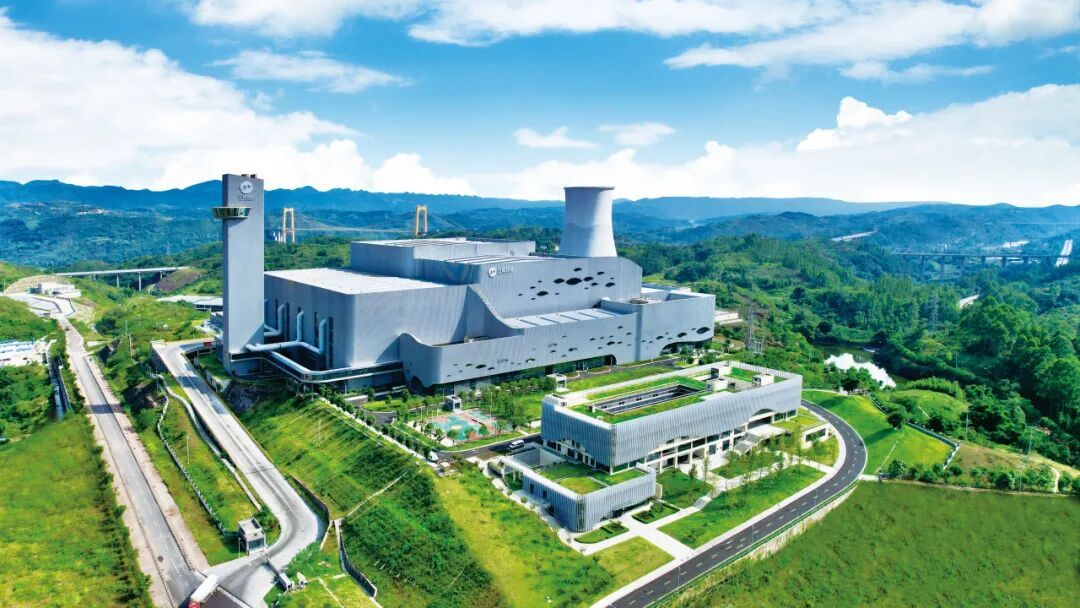
The Yulin Waste-to-Energy Plant, operated by Sanfeng Environment Group, processes up to 3,000 tons of household waste per day. (Photo/Sanfeng Environment)
Despite limited domestic experience and the absence of national standards at the time, Chongqing made the strategic decision to replace landfilling with waste incineration. In 2005, the Tongxing Waste-to-Energy Plant began operations, becoming the first facility in China built to international standards.
By 2012, the city’s second waste-to-energy plant had come online, with officials confirming that key equipment had been successfully localized. Addressing public concerns over emissions, plant operators explained that incinerators operate at temperatures of around 1,000 degrees Celsius—high enough to rapidly decompose dioxins. Additional design features and flue-gas treatment systems, including lime slurry injection and activated carbon adsorption, further reduce harmful substances, enabling emissions to meet European Union standards.
Expansion accelerated after 2018. Chongqing now operates 25 waste incineration facilities with a combined designed capacity of 23,000 tons per day, processing approximately 20,000 tons of household waste daily. Four plants serve the central urban area, significantly shortening transport distances and lowering logistics costs. Outside the urban core, districts have adopted more flexible approaches, including shared facilities between neighboring counties to avoid redundant investment.
Older landfill sites have not been abandoned, but sealed and retained as emergency backup facilities. “They can be activated immediately during maintenance or unexpected shutdowns at incineration plants,” officials said.
Artificial intelligence is increasingly embedded in daily operations. At the Sanfeng Yulin waste-to-energy plant, automated cranes, intelligent control systems, and AI-driven monitoring now manage processes once handled manually. Meanwhile, the Baiguoyuan plant’s intelligent incineration model has been cited by the Basel Convention Regional Centre for Asia and the Pacific as a reference case for “zero-waste city” development in the region.
By continuing to browse our site you agree to our use of cookies, revised Privacy Policy and Terms of Use. You can change your cookie settings through your browser.
For any inquiries, please email service@ichongqing.info