
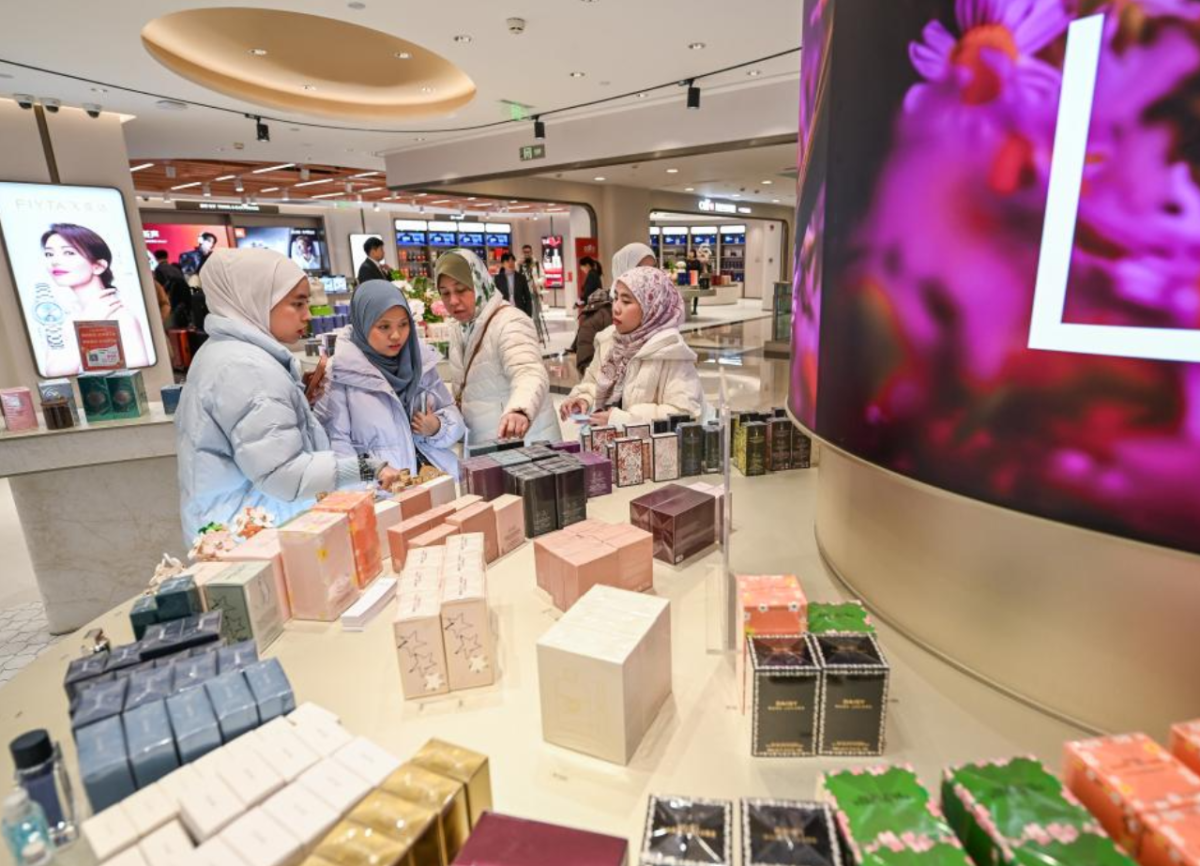
Malaysian tourists shopped for perfume at the duty-free store on November 26. (Photo/Zou Jingyi)
Chongqing - From January to November 2025, Chongqing’s duty-free sales topped 108 million yuan (about 15.41 million U.S. dollars), up 46.9% year on year and surpassing the 100 million yuan mark for the first time.
As China strives to boost consumption, Chongqing, the only municipality directly under the central government in the western region, actively works to establish itself as a global consumption hub. According to officials from Chongqing Customs District, the rapid growth in duty-free sales reflects the city’s potential in international consumption.
This surge in sales is closely tied to innovative initiatives by the duty-free stores, with onboard duty-free shopping a key focus. Compared to land-based duty-free stores, onboard shops create a new consumption scene within the limited space of a flight.
Chongqing Customs District noted that the number of flights offering onboard duty-free sales has increased this year. For instance, Hainan Airlines has added new routes of onboard duty-free stores including Madrid, Bangkok, and Brussels.
The expansion of routes has helped attract high-net-worth travelers on long-haul flights, significantly boosting sales. From January to November, onboard duty-free sales in Chongqing totaled 4.46 million yuan, marking a year-on-year growth of 106.05%.
Aviation industry analysts note that the unique environment of long-haul international flights triggers compensatory consumption and impulsive decision-making among passengers, filling gaps left by rushed shopping on the ground. Onboard duty-free shopping does not compete with or replace land-based duty-free stores; rather, it complements them.
Currently, Chongqing’s duty-free stores have developed a complete system. Land-based duty-free stores offer in-depth experiences and a wide range of products. Meanwhile, onboard duty-free stores capture impulse purchases and unmade decisions during travel, covering a wide range of consumption scenarios.
Innovations in shopping models have also improved the convenience of duty-free shopping, further driving growth. A new model of consumption allows both domestic and international travelers departing within 60 days to select items at city duty-free stores and pick them up at the airport when departing, creating a seamless link between city stores and airport departure points.
The shopping space now spans from airport security areas to urban commercial complexes. According to the Chongqing Customs District, this convenient shopping channel effectively attracts and retains consumer traffic.
The booming growth of duty-free consumption is closely linked to the rising popularity of international tourism in Chongqing. In April of this year, global video influencer iShowSpeed livestreamed his visit to Chongqing, showcasing the city’s nighttime scenery to an overseas audience. With the help of the internet and short video platforms, Chongqing’s international reputation has continued to rise, attracting a large number of foreign tourists.
The 240-hour visa-free transit policy has further facilitated inbound tourism, allowing foreign visitors to experience Chongqing in depth. Data shows that from January to November 2025, Chongqing received 67.6% more inbound tourists than the previous year. The number of inbound and outbound flights at the city’s aviation ports reached 17,384, with 2.095 million passengers, representing increases of 26.70% and 30.73%, respectively.
By continuing to browse our site you agree to our use of cookies, revised Privacy Policy and Terms of Use. You can change your cookie settings through your browser.
For any inquiries, please email service@ichongqing.info