
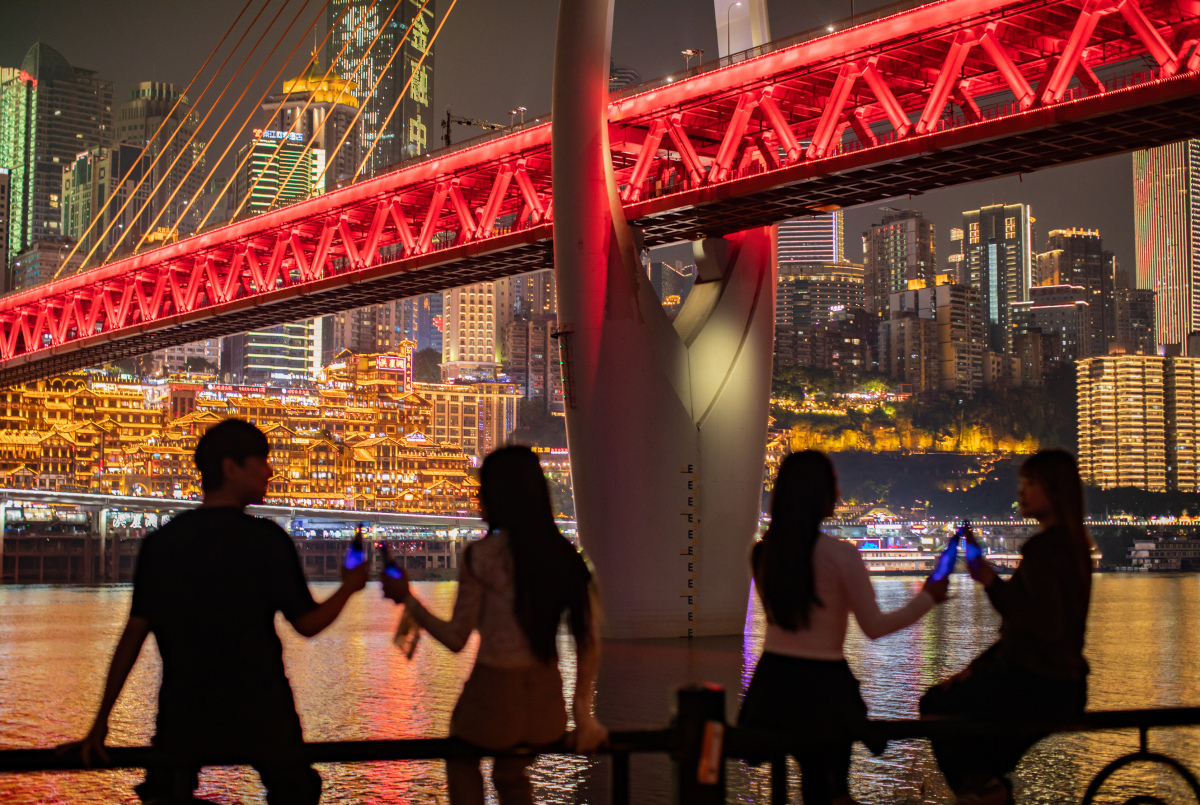
In Chongqing, tourists take photos with the city lights in the background. (Photo/Chongqing Daily)
Chongqing - Chongqing’s electricity use climbed to 153.3 billion kilowatt-hours in the first 11 months of this year, up 3.5 percent year on year, reflecting economic growth driven by advanced manufacturing, expanding services and more energy-efficient, low-carbon development.
Automated lines at carmakers such as Changan Automobile and Seres run at high loads with stable, continuous power demand. From January to November, value added in Chongqing’s auto industry rose 13.7% year on year, while vehicle output climbed 12.1%. Output of new energy vehicles (NEVs) surged 37.2%.
At Seres’ super factory in Liangjiang New Area, rooftop photovoltaic panels supply more than 30% of the site’s electricity. A plant executive said distributed PV stations have been built across the site, and total installed capacity is expected to rise to 173 megawatts, with annual generation reaching 170 million kWh, cutting carbon dioxide emissions by about 140,000 tonnes a year.
Electricity demand from data centers and 5G base stations is also rising. One example is the Chongqing Artificial Intelligence Innovation Center in Xiyong Micro-electronics Industrial Park, which began operations in July 2023. It has provided computing services to more than 200 companies and research institutes, with computing utilization exceeding 98%.
“The center has used more than 11 million kWh of electricity since it was established two and a half years ago, including 4.8 million kWh this year,” a representative from the center said.
From January to November, electricity use in the service sector and by households each rose by more than 5%. The increase is attributed to stronger cultural and tourism consumption and a growing shift to green mobility.
At Liziba station, Lü Xiaoxi, who runs a library nearby, said visitors stayed longer this summer. “In the past, most tourists came in a hurry, took a few photos, and moved on, but this summer was different,” Lü said, adding that the library installed several more air conditioners.
Zhang Weiling, a property management official for the building, said overall electricity consumption there rose about 20% year on year this summer, mainly because shops extended business hours and added facilities such as lighting and entertainment equipment for tourists.
On the residential side, Shao Lin, a resident in Liangjiang New Area, said he used to spend more than 1,000 yuan (about 142 U.S. dollars) a month on fuel, and holiday road trips could push the bill to 1,800 yuan. After receiving a government trade-in subsidy earlier this year, he replaced his old car with an NEV. “After more than nine months, I’ve spent just over 1,500 yuan on charging electricity, on average, a little more than 100 yuan a month,” Shao said.
A representative of State Grid Chongqing Electric Power Company said electricity used for NEV charging and battery swapping has continued to rise, as fuel consumption at gas stations is being converted into grid electricity demand.
The Chongqing Municipal Energy Bureau said electricity supply was sufficient during this year’s summer peak season, and renewable energy accounted for 45.6% of installed capacity, a record high.
Chongqing is strengthening imported power supplies while expanding investment in solar, wind, and energy storage. The grid is supported by both the Sichuan–Chongqing 1,000 kV ultra-high-voltage (UHV) alternating-current project and the Hami-Chongqing ±800 kilovolt ultra-high voltage direct current (UHV DC) power transmission project.
In Wushan County, eight turbines at China Three Gorges Renewables' 60-megawatt Dafengkou Wind Farm Project generate 110 million kWh a year. “The electricity can meet the annual clean power demand of about 60,000 households,” the project head said, adding that the project saves 45,000 tonnes of standard coal and cuts carbon dioxide emissions by 86,000 tonnes a year, equivalent to planting 450 hectares of forest.
Chongqing has also launched a one-million-kilowatt rooftop distributed PV initiative, tapping more than 200 million square meters of urban and rural rooftops and raising annual PV generation to 1.13 billion kWh, officials said.
In the energy storage sector, companies including HiTHIUM and Jiangsu Horizon New Energy Technology have launched projects in Chongqing. Chongqing plans to achieve a cumulative installed new energy storage capacity of 2.2 million kilowatts by 2027, alongside the goal of establishing an industrial cluster valued at approximately 200 billion yuan.
By continuing to browse our site you agree to our use of cookies, revised Privacy Policy and Terms of Use. You can change your cookie settings through your browser.
For any inquiries, please email service@ichongqing.info