
Chongqing - Embodied artificial intelligence, which combines AI with physical machines such as robots, is gaining momentum in Chongqing as the southwestern Chinese municipality steps up efforts to integrate emerging technologies into manufacturing and urban development.
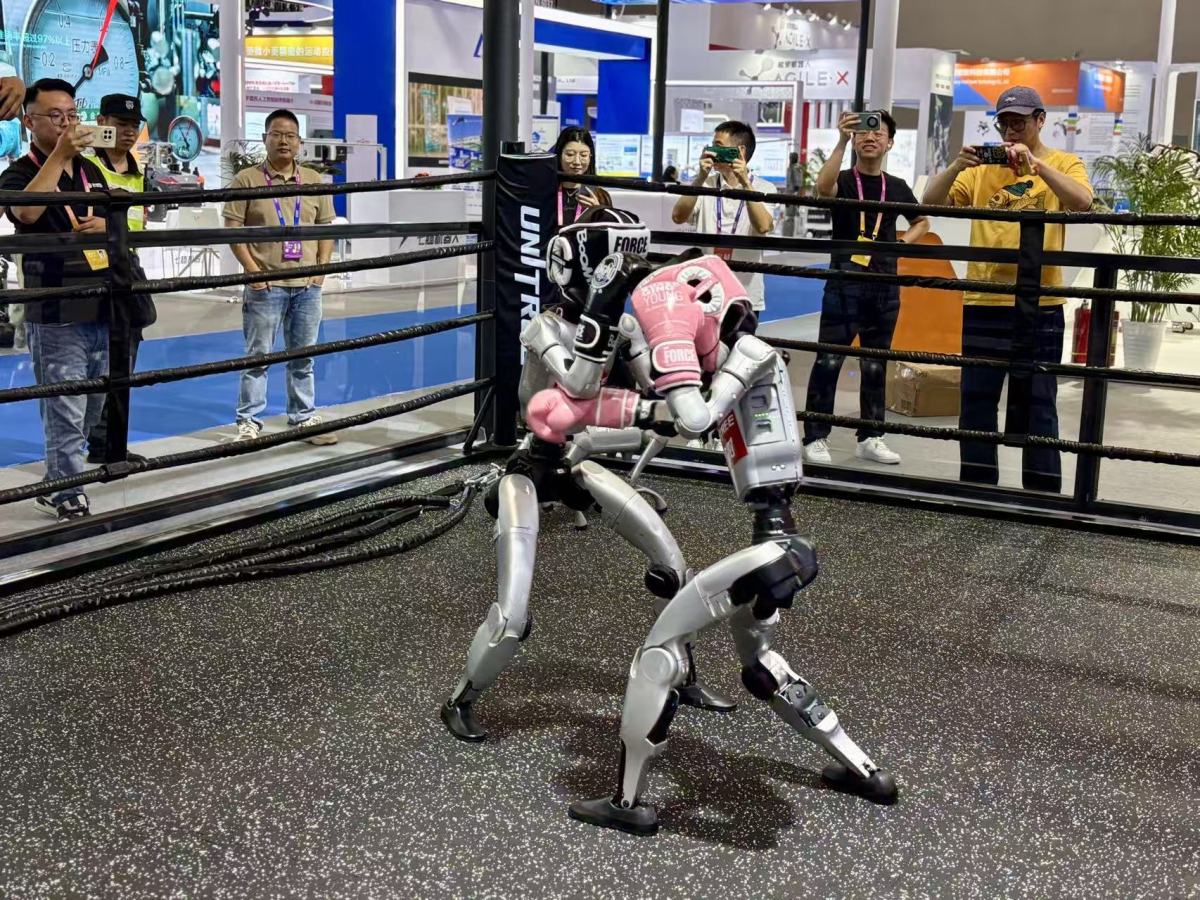
Two robots compete in a combat match on Unitree Robotics' arena at the 2025 World Smart Industry Expo. (Photo/Zheng Ran)
Chongqing has recently started building an “AI Bay” as part of efforts to expand its artificial intelligence sector and support the city’s manufacturing base. Local authorities said the initiative aims to promote industrial upgrading and improve urban governance through wider AI applications.
Many AI industrial parks rely mainly on land offers and subsidies to attract firms, but companies often arrive and then face gaps in talent, technology and real application scenarios, leaving some parks underused.
Chongqing’s “AI Bay” is trying a different model built around “one bay plus two institutes.” The platform serves as a hub connecting government policy and capital with universities and company demand, so research can be applied more quickly. For example, the Chongqing General AI Institute can link its models to local automakers’ intelligent driving needs, while students from the Chongqing AI Institute can bring projects directly into company internships, and investors can better track clear paths to commercialization.
Leading robotics companies, including Unitree Robotics and Galbot, have announced new investments or operations in Chongqing. The Chongqing Municipal Commission of Economy and Information Technology has also released a notice seeking demands for a third batch of projects in embodied intelligence- a policy mechanism in which the government publishes concrete technical or application needs and invites firms to compete to meet them.
These developments suggest a move beyond early-stage concept building toward real-world deployment. Across China, embodied intelligence is increasingly measured by commercialization and delivery capacity. Companies such as UBTECH Robotics and Unitree reported orders of more than 1,000 units and revenues above 100 million yuan in 2025, indicating rising demand for deployable products.
Embodied intelligence depends on hardware such as sensors, motors, batteries, joint modules and control systems. As one of China’s major industrial hubs, Chongqing covers all 31 major manufacturing categories and has deep experience in equipment manufacturing and automotive supply chains.
Chongqing’s progress in related sectors also supports this push. The city is among the first in China to pilot Level 3 autonomous driving, which shares core technologies with embodied intelligence, including perception systems, control algorithms and real-world data collection. It has also advanced its “33618” modern manufacturing cluster system and introduced targeted policies for robotics, helping local supply chains adapt to new technology demands.
Application scenarios are another focus. Through its "Digital Chongqing" initiative, the city has generated urban management data and operational settings that could serve as testing environments for embodied intelligence. Service-sector use cases are also under discussion. With a relatively high aging population, officials and industry participants have explored the potential for eldercare robots, linking technology development with public services.
At the national level, policy coordination is advancing. In December, the Ministry of Industry and Information Technology established a standardization committee for humanoid robots and embodied intelligence to accelerate the development of technical standards and interfaces. Chongqing has indicated it will align with this direction by supporting industry alliances, data sharing, and cooperative innovation.
Officials and industry observers note that embodied intelligence remains a developing field, requiring steady investment and staged validation. For Chongqing, the approach has been to build on its industrial base, expand application scenarios, and allow technology and markets to evolve together, laying groundwork for the sector's gradual integration into manufacturing and urban life.
By continuing to browse our site you agree to our use of cookies, revised Privacy Policy and Terms of Use. You can change your cookie settings through your browser.
For any inquiries, please email service@ichongqing.info