
Chongqing — When frost still covered the fields in Sailong Village in Chongqing this winter, villager Zhou Minggui stood at the village entrance watching an excavator lower a new ductile iron pipe into the ground.
For more than a decade, the village’s aging water lines had been patched again and again. This winter, they were finally replaced.
"These old pipes were repaired for years. Now we have a real upgrade," Zhou said, smiling.
Nearby, Wang Jie, Party branch secretary of Sailong Village, checked pipeline drawings.
"This new line will connect nine village groups and serve 1,536 people," Wang said. "Every household will finally have stable water pressure."
Scenes like this are now common across rural Chongqing, where a citywide push to build a smart, integrated water network is dramatically improving water security. According to municipal data, during the 2025 summer drought, the rural population facing temporary water shortages fell to 44,000—a drop of 167,000 from 2024 and the lowest figure in nearly 15 years.
The shift goes beyond just laying pipes. In Yongchuan District, a smart water plant under construction represents the new approach. "In the past, our goal was simply to ensure people had water," said Yao Chunmei of the district's Water Resources Bureau. "Now we focus on water quality, reliability, and intelligent management."

A smart water plant with a total investment of more than 1 billion yuan is under construction in Yongchuan District, Chongqing. (Photo/Yongchuan District Water Resources Bureau)
To address seasonal fluctuations in Yathe ngtze River source water, the plant is adopting a full-process purification system, including ultrafiltration membrane technology. The digital platform integrates real-time data from sensors, pipelines and treatment units, enabling engineers to monitor pressure, detect abnormal flows, and predict potential failures before disruptions occur.
"In the past, pipes burst and only then would people be notified," said Wang Gang (pseudonym), a resident of Laiyinyan Village, Chenshi Subdistrict, in Yongchuan. "Sometimes repairs took one or two days."
Now, with pressure sensors distributed throughout the network and algorithm-based analysis, the system can identify risks early, shifting from reactive emergency repairs to proactive protection, Yao said.
In 2025, Chongqing connected 1,096 monitoring devices to its municipal smart management platform. Officials say the on-time resolution rate for rural water problems reached 93 percent, while user satisfaction climbed to 97 percent, both up more than three percentage points from the previous year.
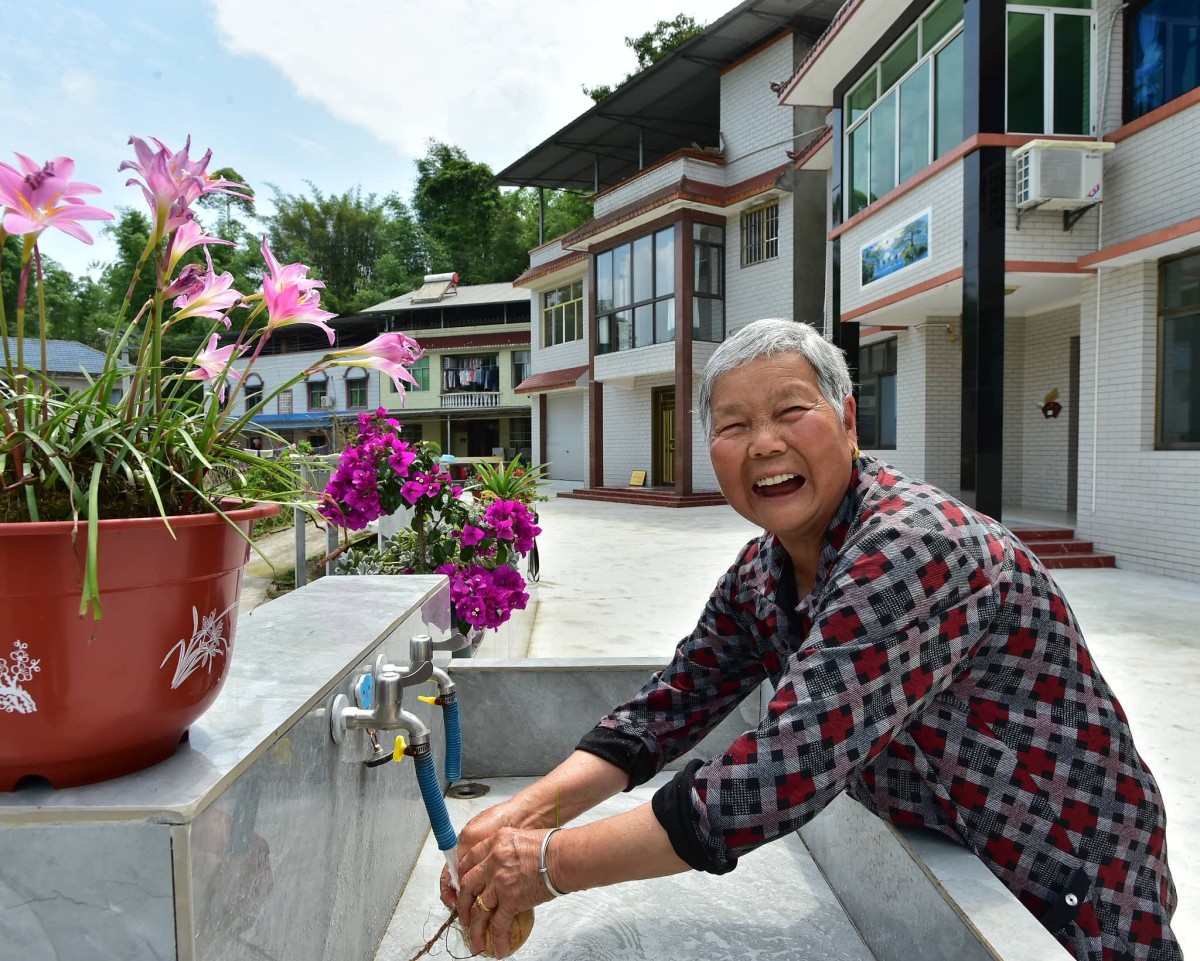
A large-scale rural water supply expansion project has improved drinking water security for more than 180,000 residents in Tongliang District, Chongqing. (Photo/Yu Dingguo)
In Panshi Village, Gaolou Town, Tongliang District, villager Fan Chaobi turned on her washing machine and water heater at the same time.
"Ten years ago, I carried water for more than a kilometer every day," she said. "One bucket had to last two days."
In 2025, Tongliang launched a rural water expansion project with a total investment of 247 million yuan. Covering 15 towns and subdistricts, the project involves replacing aging pipelines and building new ones. So far, 4,915 kilometers of pipes have been laid or upgraded, benefiting more than 180,000 residents, with 72 percent of the project now completed.
"This is not a simple replacement," said Liu Yan, director of the Gaolou Town Industrial Services Center. "These ductile iron pipes are more resistant to corrosion and have a much longer service life."
Before the upgrade, Gaolou Town’s water loss rate was nearly 30 percent. After the reconstruction, it is expected to fall to below 8 percent, Liu said.
Across Chongqing, similar projects have transformed the rural network. In 2025, the city extended or upgraded 5,384 kilometers of rural pipelines. At the same time, Chongqing promoted county-level unified management and a "one household, one meter" system, helping resolve long-standing issues of unclear responsibility for maintenance. The county-level unified management rate has risen to 76.3 percent.
Safety and preparedness are also key. Ahead of the Spring Festival, technicians from the Liangping District Center for Disease Control and Prevention tested water samples at the centralized supply station in Jincheng Village, Jindai Subdistrict.
The screen showed: "Residual chlorine: 0.39 milligrams per liter — qualified."
Across the district’s 33 towns and subdistricts, 113 samples were collected and tested for microbial safety, chemical indicators and sensory quality.
"We used to judge water by sight and experience," said Liu Yonghong, head of public health at the Liangping CDC. "Now we rely on data."
Liangping has also strengthened emergency safeguards. Chongqing has established a three-tier rural water emergency response system at the municipal, district, and township levels. In 2025, the city completed 71 drought emergency water projects and 165 water source protection projects in drought-prone areas, removing high-risk water shortages for 225,000 residents.
From smart monitoring platforms in Yongchuan to newly laid pipelines in Tongliang and water quality checkpoints in Liangping, Chongqing is reshaping rural water security through a coordinated system covering water sources, treatment plants, pipelines, water quality, digital management, operations and emergency response.
As the summer drought season approaches, officials say the city’s rural water network is better prepared than ever.
"When drought comes now, we are no longer afraid,“ said an elderly farmer in Tongliang. "The water still flows."
By continuing to browse our site you agree to our use of cookies, revised Privacy Policy and Terms of Use. You can change your cookie settings through your browser.
For any inquiries, please email service@ichongqing.info