
Chongqing - Recently, China's Foreign Ministry spokesperson Mao Ning shared a video of a striking new landmark with audiences worldwide: the Shennü (Goddess) Escalator in Wushan County. Stretching nearly a kilometer up the mountainside, the project quickly drew attention as a fresh symbol of Chongqing's urban renewal.
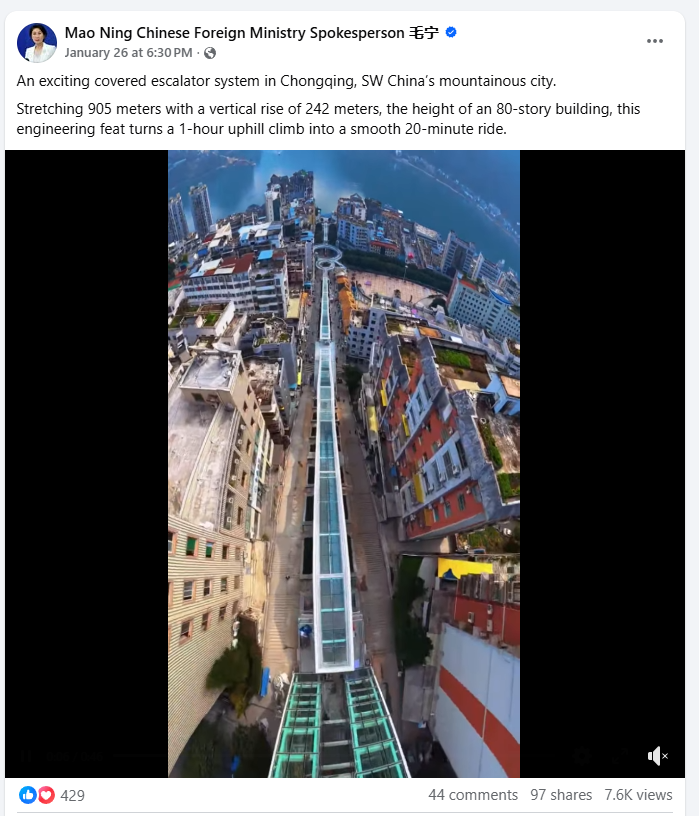
Screenshot of a Facebook post by China's Foreign Ministry spokesperson Mao Ning, sharing the 905-meter-long Shennü Escalator in Wushan, Chongqing.
Built as a vertical transit corridor made up of a series of linked escalators, the Shennü Escalator stretches about 905 meters in total—longer than the well-known Crown Grand Escalator in downtown Chongqing—and rises more than 240 meters, roughly the height of an 80-storey building. The system is currently undergoing final operational and digital testing and is expected to open before the Spring Festival.
Behind the engineering feat is a design team from China Railway Eryuan Engineering Group. Huang Wei, the project’s chief designer, said the concept of a vertical transit solution for Wushan dates back to 2002, when the county’s new urban area was completed but its steep terrain continued to hinder daily travel. At the time, limited funding and technological constraints led to the proposal being shelved.
The project was revived in 2022 as rising mobility demands and congestion pressures prompted local authorities to revisit the idea. “The key question was what kind of transport system best suits a mountainous city like Wushan,” Huang said. Options including cable cars, sightseeing trains and rail transit were evaluated. After weighing factors such as capacity, safety, lifecycle costs, adaptability to steep slopes and visual impact, the team ultimately chose a multi-level escalator system.
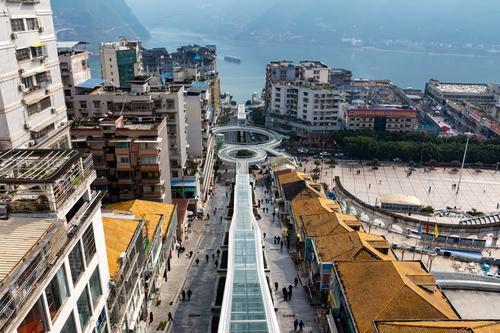
The Shennü Escalator basking in sunlight, January 22, 2026, Wushan County. (Photo/Yin Shiyu)
According to Huang, the modular design allows the escalators to be combined "like building blocks," fitting flexibly into Wushan’s fragmented terrain and integrating with existing roads and buildings. The result is a continuous, high-capacity, and all-weather vertical link that eases pressure on surface traffic.
Engineering challenges were significant. The route runs alongside dense residential buildings and through an area packed with underground pipelines. Geological conditions are equally demanding, with karst formations and an average slope of 35 percent, reaching nearly 60 percent at the steepest points. To cope with these constraints, designers adopted a “three-dimensional stitching” strategy, lifting much of the structure into the air through lightweight elevated corridors to conserve ground space.
Transparent glass façades were used to reduce the visual bulk of the structure while opening panoramic views of the surrounding mountains and river. Along the 905-meter route, three viewing platforms were added, including elevated “sky balconies” and a 360-degree lookout offering sweeping vistas of the Yangtze River and the county town below.
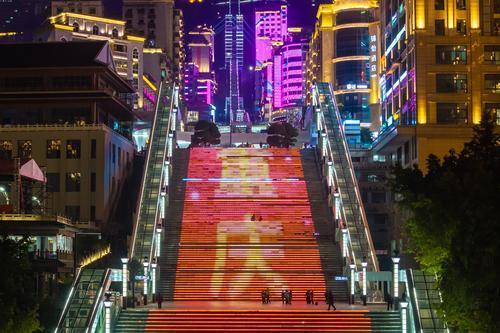
The Shennü Escalator illuminated at night, shimmering alongside Wuxia Gorge and the Yangtze River. (Photo/Yin Shiyu)
From the outset, tourism was embedded in the project’s design. Lighting installations at key nodes link the escalator to Wushan’s broader nightscape program, transforming the structure after dark into a ribbon of light winding through the hills and helping to activate evening leisure and consumption.
“Our goal was for infrastructure itself to become a destination,” Huang said. “It’s not just a way to get from point A to point B, but part of the city’s experience.”
Local housing and urban development officials say the Shennü Escalator is a flagship project in Wushan’s efforts to enhance urban quality and position itself as a gateway destination along the Three Gorges. City authorities add that it also reflects Chongqing’s broader approach to urban renewal—advancing neighborhood-, street- and district-level upgrades through careful, people-centered design. In this sense, the “sky ladder” serves both as a practical solution to daily mobility challenges and as a new calling card for the mountain city.
By continuing to browse our site you agree to our use of cookies, revised Privacy Policy and Terms of Use. You can change your cookie settings through your browser.
For any inquiries, please email service@ichongqing.info