
Chongqing – Having posted a resilient 5.3% GDP growth in 2025 on the back of a manufacturing revival and export resilience, China’s strategic western municipality of Chongqing has outlined a 2026 work plan that seeks to consolidate recent gains while pushing aggressively into new technological frontiers. In his annual government work report delivered to the municipal legislature, Mayor Hu Henghua set the GDP growth target at over 5% and detailed a series of tasks in 2026.
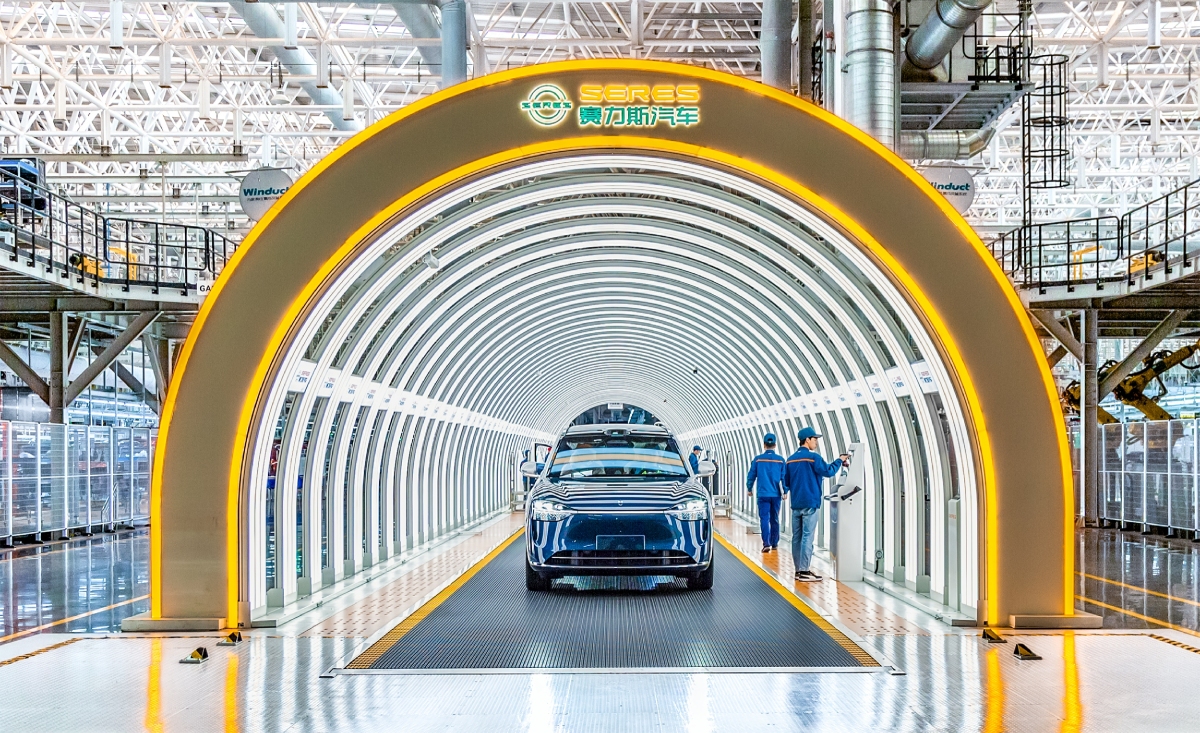
The Aito model, a car brand co-developed by Chongqing automaker Seres and Huawei, rolls off the production line. (Photo/Yan Yili)
In 2025, Chongqing’s regional GDP reached RMB 3.38 trillion, with standout results in industrial upgrading. New energy vehicle (NEV) output soared to 1.296 million units, cementing its status as a national NEV powerhouse. The value of technology contracts signed in the city exceeded RMB 114 billion.
The New International Land-Sea Trade Corridor, a logistics network originating in Chongqing, saw freight value triple over the past five years, demonstrating growing export competitiveness despite external pressures.
These achievements were supported by substantial progress in the Digital Chongqing initiative, with more than 210,000 government data categories aggregated on a shared platform, and by stabilizing the property market through targeted urban renewal.
The 2026 government work plan, structured around 11 key areas, marks the start of the 15th Five-Year Plan of the city.
Leveraging the 2025 NEV production surge and the establishment of the China Changan Automobile Group headquarters, Chongqing will “comprehensively advance the construction of the Capital of Intelligent and Connected NEVs” in 2026. This involves supporting leading automakers such as Changan, Seres (Aito), and Great Wall in scaling up production, while accelerating breakthroughs in key components, including intelligent cockpits and automotive-grade chips. The city will also pilot integrated vehicle-road-cloud autonomous driving systems.
In 2026, Chongqing will see a major push into the low-altitude economy. The city plans to establish an intelligent low-altitude management system, upgrade low-altitude networking, and expand commercial applications in tourism and logistics, aiming to become a “national innovation powerhouse in the low-altitude economy.”New tracks like bio-manufacturing and brain-computer interfaces will also be explored.
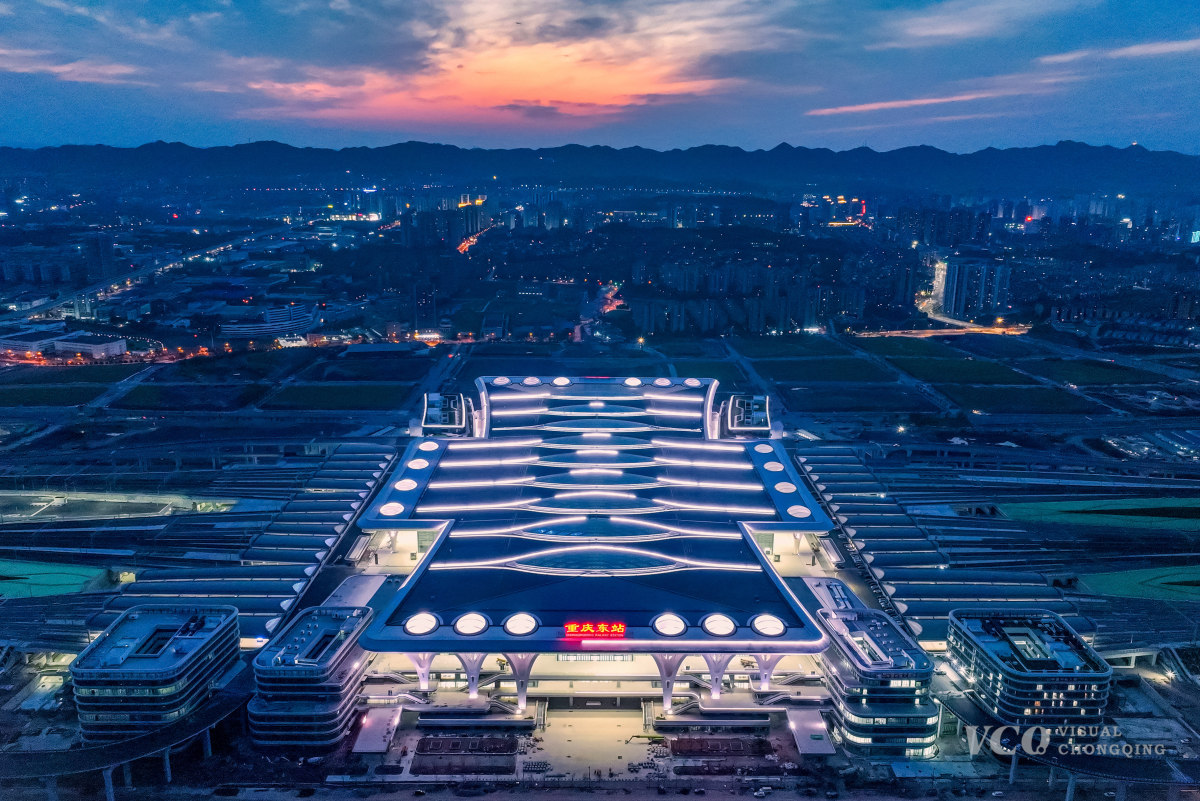
Chongqing East Railway Station.
Following 2025’s completion of 340 key municipal projects, including Chongqing East Railway Station, the fixed-asset investment will target a 3% growth in 2026. The focus is on advanced manufacturing, with plans to advance more than 600 industrial projects, each valued at over RMB 100 million, and to undertake more than 1,500 technological transformation projects, the report explained.
The AI+ Initiative will be expanded, evolving from 2025’s data platform construction to include fostering high-quality industry datasets and reducing computing costs for SMEs through a regional computing power dispatching platform. The goal is to create an AI application highland.
Capitalizing on the 2025 growth in ILSTC freight value and the launch of financial services for the corridor, 2026 work will strengthen Chongqing’s role as the corridor’s operational organizer. Efforts will focus on improving multimodal transport efficiency and developing hub-economy industries around key logistics parks.
Building on 2025’s success in growing trade with ASEAN and other emerging markets, 2026 will see upgraded efforts to attract foreign investment and support local firms in going global.
The Digital Chongqing framework, whose core capabilities were established in 2025, will see deeper application in 2026. Priority will be given to building AI+ comprehensive scenarios for emergency management and enterprise services.
In urban renewal, following the 2025 launch of a three-year action plan, 2026 will focus on completing key projects, such as Metro Line 15 (Phase I), and addressing 60 traffic congestion points.
On green development, after achieving excellent water quality in the Yangtze’s Chongqing section for nine consecutive years through 2025, 2026 will implement a dual-control system for carbon emissions and accelerate the build-out of the new power system.
The report acknowledges ongoing challenges, including the need for more diversified industrial pillars and weak market expectations—issues the 2026 plan explicitly aims to address through its focused tasks. As Chongqing embarks on the first year of its 15th Five-Year Plan, its agenda reflects a deliberate strategy to build on the momentum of a resilient 2025 and lay the foundation for longer-term, innovation-driven growth.
By continuing to browse our site you agree to our use of cookies, revised Privacy Policy and Terms of Use. You can change your cookie settings through your browser.
For any inquiries, please email service@ichongqing.info