
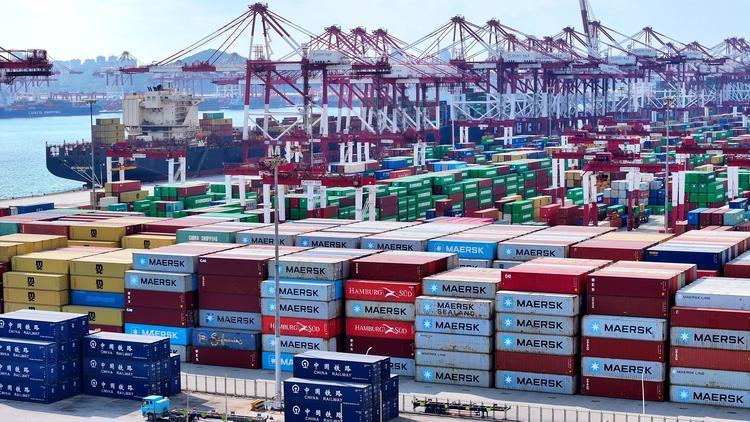
A drone photo shows a view of Qingdao Port in Qingdao, east China's Shandong Province, Oct. 29, 2025. (Xinhua/Li Ziheng)
Beijing - China's economy remained robust despite headwinds last year, achieving stable year-on-year GDP growth of 5 percent and making new and higher-quality progress across economic and social sectors. This further solidifies its role as a key contributor and stabilizer for the global economy.
The newly released data by the National Bureau of Statistics (NBS) captures the remarkable trajectory of China's economic development over the past year, said Sheng Laiyun, deputy head of the NBS, noting that the data presents a panoramic picture of China's economy, characterized by stable performance, progressive momentum and strong resilience.
The figures highlight China's growing national strength and rising global influence. The country's economic aggregate continued to scale new heights in 2025, exceeding 140 trillion yuan (about 20.22 trillion U.S. dollars) for the first time, and achieving the development goal for the 14th Five-Year Plan period (2021-2025).
In 2025, China's per capita GDP reached 99,665 yuan, or 13,953 U.S. dollars at the average annual exchange rate, staying above 13,000 U.S. dollars for three consecutive years. Driven by scientific and technological innovation, labor productivity rose by 6.1 percent year on year in 2025, 1.1 percentage points higher than GDP growth.
With 5-percent GDP growth and contributing around 30 percent of global economic expansion, China remains the foremost driver and stabilizer of the world economy, Sheng noted. As the world's second-largest import market for 17 consecutive years and with steady outbound investment, China has shared its development dividends with the rest of the world and fulfilled its responsibility in global development.
Last year, China cultivated new growth drivers and shaped new advantages in the process of upgrading and transforming toward new and higher-quality development to drive economic growth, the data reveals. In 2025, total investment in research and development increased by 8.1 percent year on year, while the ratio to GDP reached 2.8 percent, exceeding the average level of members of the Organization for Economic Co-operation and Development for the first time.
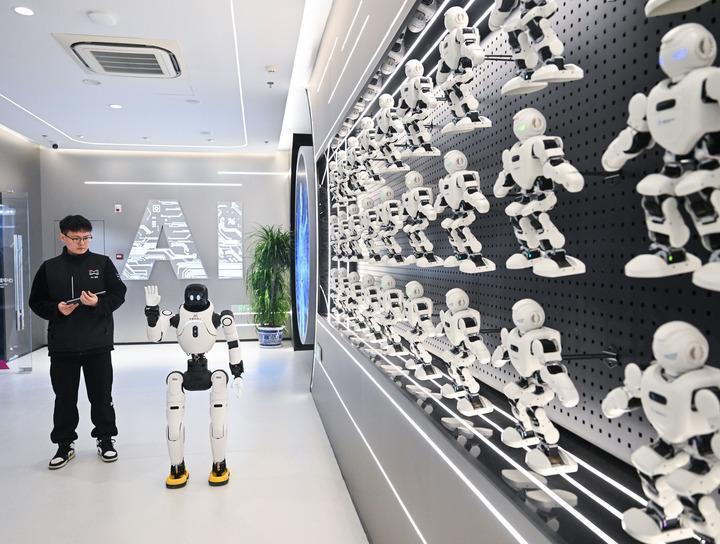
A humanoid robot greets people at an AI industry center in Nanjing, east China's Jiangsu Province, Dec. 4, 2025. (Xinhua/Ji Chunpeng)
China has also seen continued improvement in the quality and efficiency of its green and low-carbon transformation. The construction of a new energy system is accelerating, while the proportion of clean energy consumption in total energy consumption has risen to 30.4 percent. Output of green products such as new energy vehicles, charging piles and solar cells is also growing rapidly in China.
Amid a volatile global environment, China has deepened its integration into the international division of labor, steadily expanded institutional opening-up, and promoted high-quality interaction between domestic and international economic flows.
In 2025, China's goods trade value exceeded 45 trillion yuan for the first time, up 3.8 percent year on year. It is expected to rank as the world's largest goods trader for nine consecutive years, serving as a key link in stabilizing global industrial and supply chains, said Sheng.
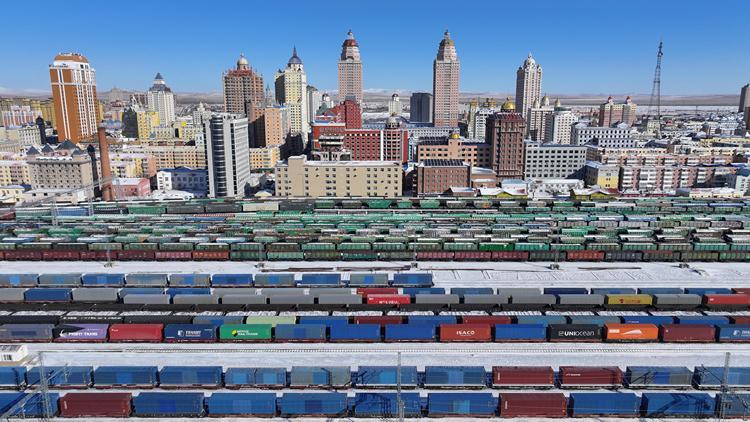
An aerial drone photo taken on Feb. 26, 2026 shows the China-Europe freight trains waiting for outbound departure at Manzhouli Railway Station in Manzhouli City, north China's Inner Mongolia Autonomous Region. (Photo by Huang Xu/Xinhua)
Reform across China has deepened steadily, with progress made in key areas such as fiscal and taxation reform. Efforts have also been intensified to improve the business environment and address involution-style competition, according to the NBS.
Key outcomes include an average of 26,000 new enterprises established per day in 2025. Preferential tax and fee policies supporting technological innovation and manufacturing sectors, meanwhile, have reduced corporate burdens by 2.9 trillion yuan, the data reveals.
With a slew of policies supporting key livelihood areas including employment, China created 12.67 million new urban jobs in 2025. Residents' per capita disposable income rose by 5 percent in real terms last year, keeping pace with economic growth. Driven by consumption-boosting policies such as trade-in programs, service consumption accounted for 46.1 percent of residents' total per capita consumption expenditure in 2025.
China's social security system was further expanded last year. By the end of 2025, 1.08 billion people were covered by basic pension insurance and 1.33 billion by basic medical insurance. Last year, a total of 1.21 million units of government-subsidized housing were started or secured as part of broader efforts to improve social services, the NBS noted.
By continuing to browse our site you agree to our use of cookies, revised Privacy Policy and Terms of Use. You can change your cookie settings through your browser.
For any inquiries, please email service@ichongqing.info