
Chongqing - On March 4, China's Chongqing delegation to the National People's Congress (NPC) submitted a group suggestion urging greater national-level support to accelerate the construction of the Chongqing logistics hub economic zone. The submission was made during the fourth session of the 14th NPC, the country's national legislature.
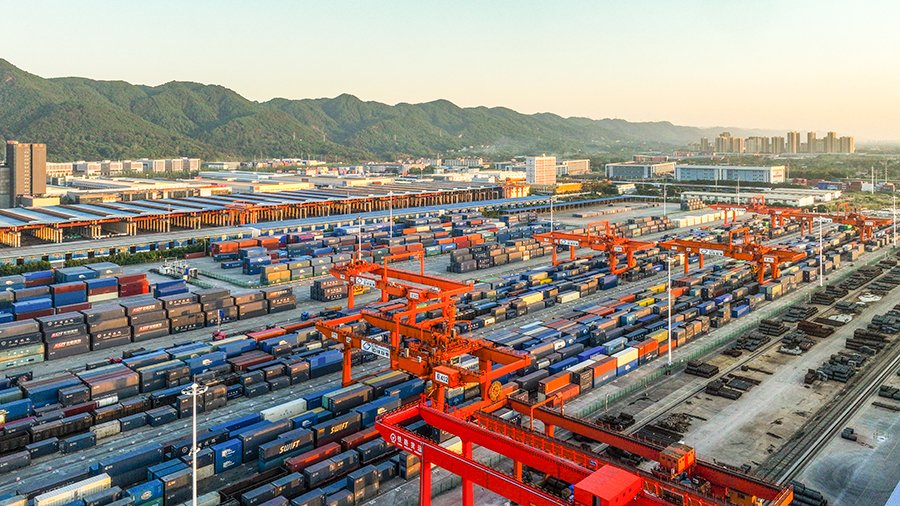
Chongqing Tuanjiecun Railway Station is the starting hub of China-Europe freight trains and a key origin point of the New International Land-Sea Trade Corridor. (Photo/Chongqing International Logistics Hub Park)
The group suggestion is framed as part of Chongqing's efforts to implement instructions issued during Chinese President Xi Jinping's inspection of the municipality in April 2024, when he assigned Chongqing two strategic roles: serving as a key strategic support point for China's Western Development strategy and functioning as a comprehensive inland hub for opening up.
According to the group suggestion, Chongqing is China's first and only "five-type national logistics hub city," referring to five categories: port-type, land-port-type, airport-type, production-service-type, and trade-service-type.
Chongqing is also described as the only city in western China with rail, road, river, and air multimodal transport conditions. It has formed 10 specialized open-port functions, including those for automobiles, pharmaceuticals, and meat products.
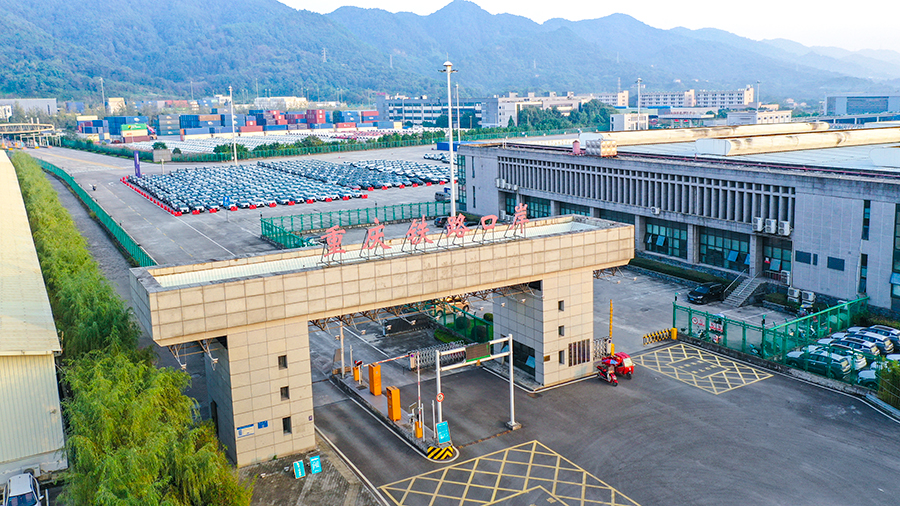
Chongqing Railway Port, China's first Class I railway port located in an inland region. (Photo/Chongqing International Logistics Hub Park)
In 2025, Chongqing's "five-type" national logistics hubs handled 120 million tons of cargo, up 13% year-on-year. Multimodal transport volumes reached 173,000 TEUs, up 20%, while logistics-related revenue totaled 36.8 billion yuan (about 5.34 billion U.S. dollars), rising 6.7%. The suggestion says the city's hub scale and network reach rank among China's leading areas.
Chongqing's logistics network is tied to the New International Land-Sea Trade Corridor (ILSTC), a transport route linking western China with Southeast Asia via rail and sea connections. Using the corridor as a backbone, Chongqing has built a multidirectional system connecting east, west, south and north through integrated rail, road, water and air transport.
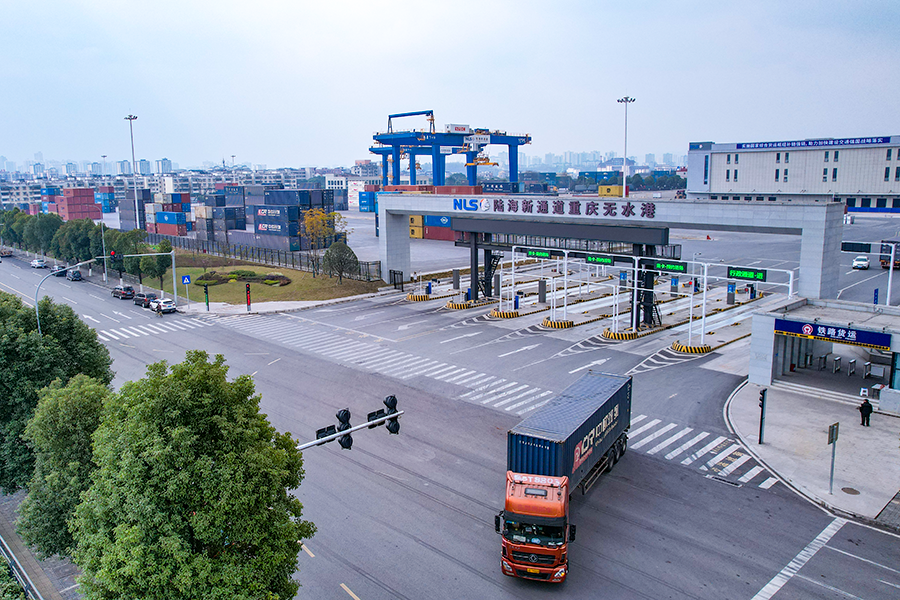
Chongqing Dry Port on the New International Land-Sea Trade Corridor. (Photo/Chongqing International Logistics Hub Park)
West- and northbound routes include an "ASEAN Express" service that links Southeast Asia with European markets through Chongqing. Freight trains from Chongqing to Europe and Central Asia have achieved stable operation at one train per week.
Southbound routes include a scheduled rail service linking China, Laos, and Thailand. In 2025, both cargo volume and cargo value transported on that service recorded year-on-year growth of more than 100%, according to the submission. Eastbound, Chongqing relies on the Yangtze River to support river-rail-sea transport links with coastal ports.
The submission also cites a hydrogen-powered logistics corridor jointly advanced by Chongqing, Guizhou and Guangxi along the ILSTC. The corridor spans more than 1,000 kilometers and provides an application scenario for scaling hydrogen energy use in freight transport.
The group suggestion indicates that Chongqing's manufacturing system, covering all 31 categories of China's manufacturing industry, supports logistics-driven trade and industrial upgrading. It also references the "33618" modern manufacturing cluster system and highlights industries including intelligent connected new energy vehicles, electronics and equipment manufacturing as sources of import-export demand.
Chongqing also outlines digital trade measures, including a January 2025 launch of an international trade digital platform integrating trade matching, logistics coordination, financing, and professional services. It says corridor-related systems have collected more than 400 million customs and logistics data records, and blockchain-based documentation has processed more than 800,000 electronic documents serving more than 5,000 companies.
While outlining existing foundations, the Chongqing delegation said that building the logistics hub economic zone requires additional national support to speed construction of the logistics hub economic zone.
It urged the National Development and Reform Commission (NDRC) to strengthen the ILSTC's pulling effect and reinforce the "hub + industry + network" linkage to raise regional logistics efficiency and lower overall costs; it called on the NDRC, the Ministry of Foreign Affairs and the Ministry of Commerce to support "multi-country, multi-park" industrial cooperation to diversify supply-chain risks and sought inclusion of the initiative in the Lancang-Mekong Cooperation framework.
Meanwhile, it requested finance-related reform pilots, including cross-border mutual recognition and use of a "single-document" multimodal transport bill of lading on routes such as China-Europe freight trains and the ILSTC and expanded financing scenarios tied to that document; and it asked for institutional opening-up pilots that leverage platforms such as the Free Trade Pilot Zone and Comprehensive Bonded Zone to align with high-standard trade rules, including the China–ASEAN Free Trade Area and the Comprehensive and Progressive Agreement for Trans-Pacific Partnership, alongside a blockchain-based joint oversight mechanism to verify the authenticity of offshore trade.
By continuing to browse our site you agree to our use of cookies, revised Privacy Policy and Terms of Use. You can change your cookie settings through your browser.
For any inquiries, please email service@ichongqing.info