
Chongqing - China is installing artificial fish nests along the Yangtze River in 2026 to restore spawning habitats for endangered endemic species.
According to the Chongqing Forestry Bureau, roughly 20,000 square meters of artificial nests will be built and deployed across key habitats in Chongqing this year, providing safe and suitable grounds for spawning, hatching, and early development for multiple Yangtze species that lay adhesive eggs.
Artificial fish nests are man-made spawning habitats that offer fish a safer environment to spawn, hatch, and survive when natural habitats are compromised. In China, they have been deployed at scale in areas such as the upper Yangtze following the construction of the Three Gorges Dam. Broader conservation efforts have also included the reconstruction of spawning grounds to support natural reproduction.
Funded through ecological restoration programs and compensation payments, the project has financed the construction of more than 4,000 square meters of fish nests. Research teams from Southwest University and Chongqing University of Arts and Sciences provided technical support throughout the process, including site selection, construction oversight, and outcome monitoring.
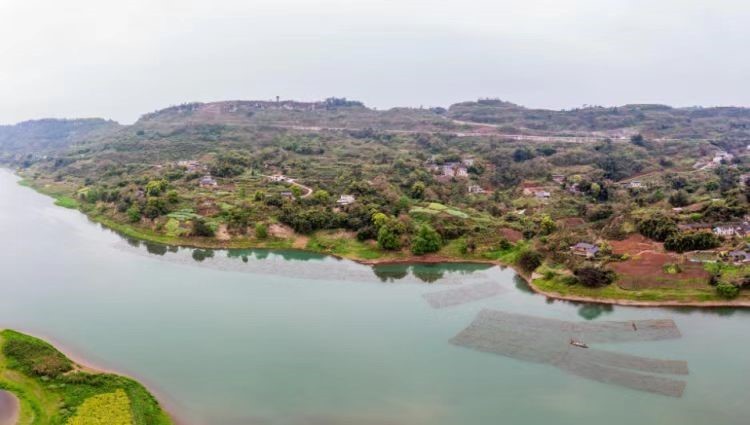
Artificial fish nests at the Dingjiatuo spawning ground in the reserve. (Photo/Chongqing Forestry Bureau)
With no unified national standard yet in place for artificial fish nest construction, the reserve said it has refined this year’s approach by adopting a “bamboo frame plus ecological substrate” design. The framework is made from hard-headed yellow bamboo, selected for its strong buoyancy, durability, and non-polluting properties. Natural attachment materials, such as aquatic grasses and cypress branches, are added to better mimic natural spawning habitats.
Each nest unit is built to standardized dimensions, with bamboo poles linked into rectangular grid formations that are sturdy, current-resistant, and easy to maintain. Every deployment site is staffed by at least two patrol workers on 24-hour duty, who continuously monitor water temperature, egg attachment, and the structural condition of the nests.
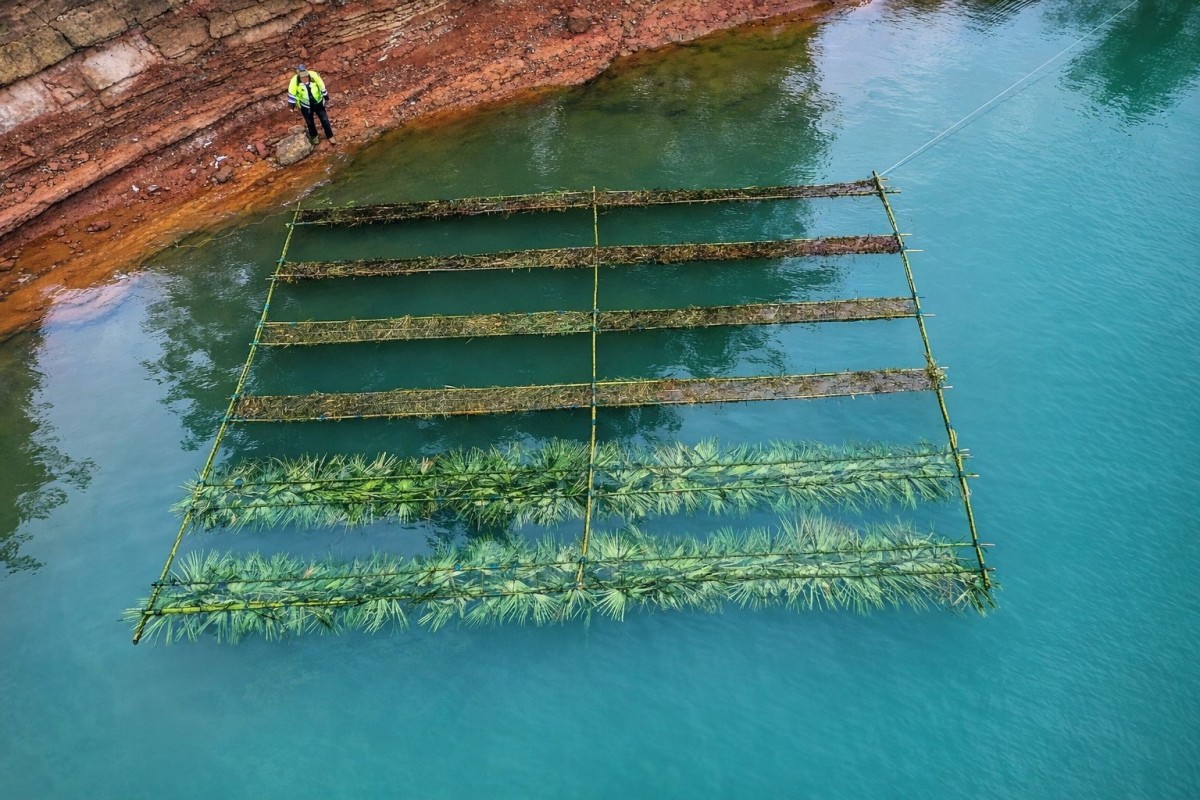
Artificial fish nests using different substrates as part of a controlled comparison experiment. (Photo/Chongqing Forestry Bureau)
This year also marks the first time the reserve has launched a comparative experiment on different attachment substrates. Within the same construction area, experimental nests have been set up in parallel using native plants as the primary substrate. By tracking key indicators such as egg attachment rates, hatching success, and early larval survival, researchers aim to evaluate the suitability of each material and build a scientific basis for improving future fish nest construction and ecological restoration outcomes.
So far, the artificial nests have already attracted large numbers of fish to spawn in clusters, with newly hatched fry observed. Monitoring data show that each square meter of fish nest can hold more than 10,000 eggs, and officials estimate that tens of millions of eggs could hatch safely this year, providing a significant boost to the recovery of the Yangtze fish resources.
Looking ahead, reserve authorities said they will continue to advance habitat rehabilitation measures, including the routine deployment of artificial fish nests, deepen cross-sector cooperation, and refine technical approaches to protecting aquatic biodiversity in the Yangtze River — all to safeguard the upper Yangtze’s fish gene pool.
(Luo Yilin, an intern, also contributed to this article.)
By continuing to browse our site you agree to our use of cookies, revised Privacy Policy and Terms of Use. You can change your cookie settings through your browser.
For any inquiries, please email service@ichongqing.info