
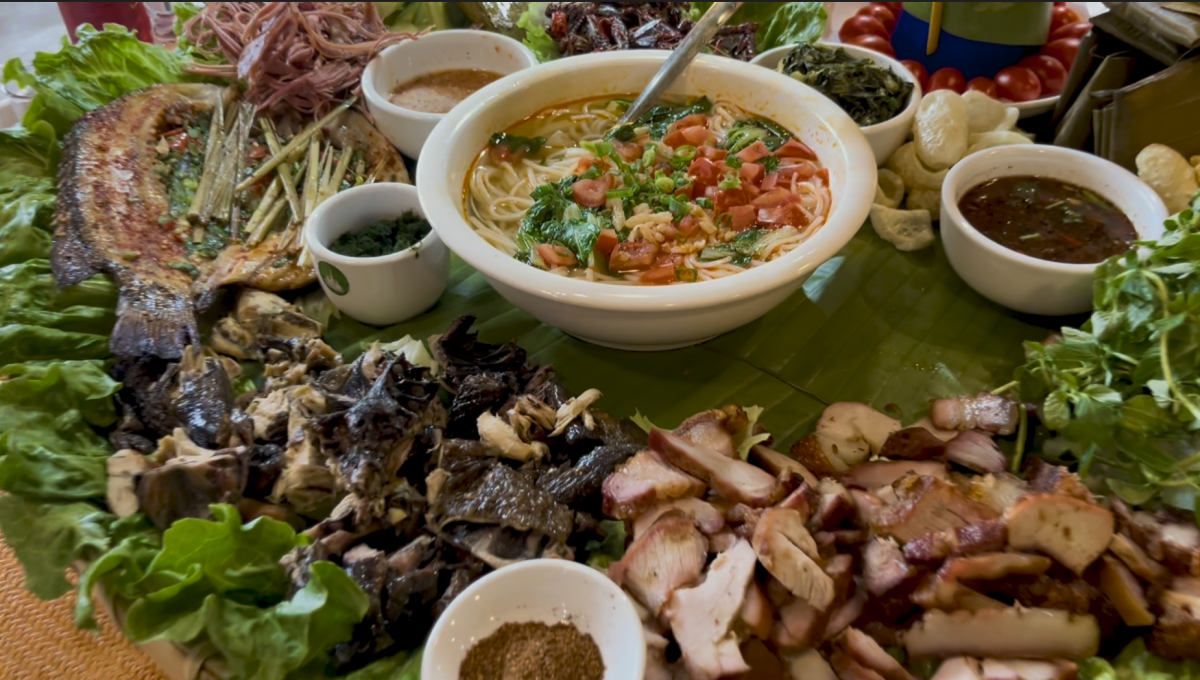
At a Dai village in Jinghong, visitors were welcomed with a traditional dinner. (Photo/Xudong Yang)
Jinghong - “Happy New Year of 1388!” according to the Dai calendar, which dates back to 638 CE—an occasion that culminates in the better-known Water-Sprinkling Festival.
So my third New Year celebration in 2026 took place in Jinghong, the capital of Xishuangbanna prefecture of Yunnan Province. Thousands gathered in the city square. The people all around were awash, with water and joy. They raised water guns and hands high, shouting "Shui! Shui!"
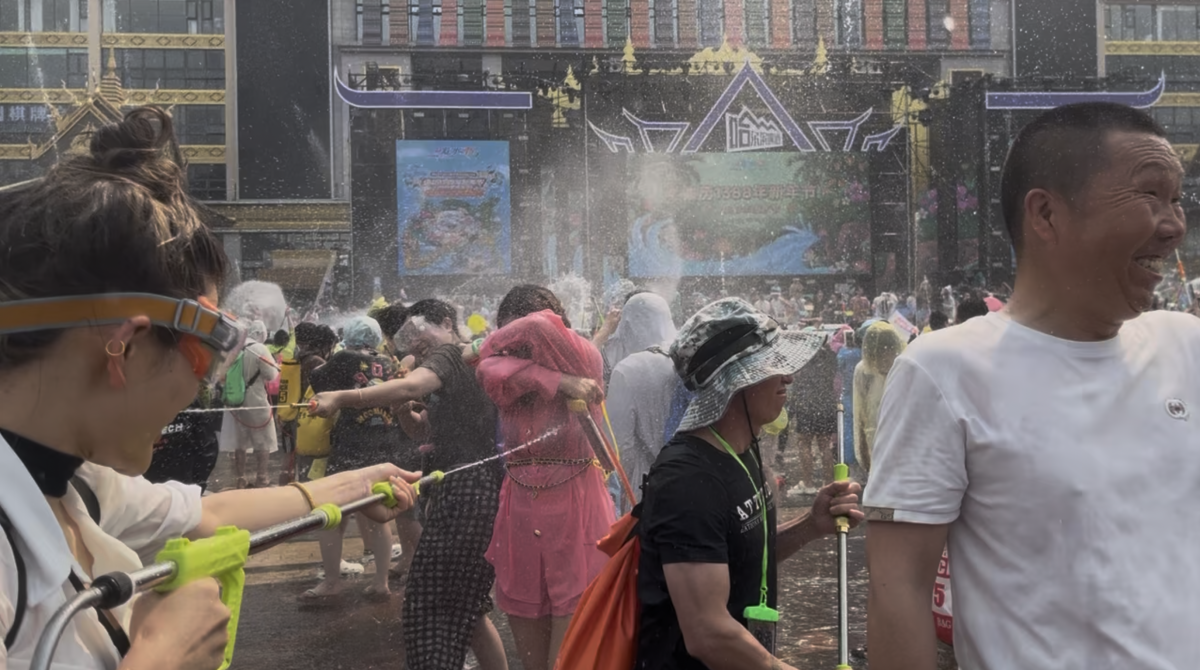
During the festival, everyone takes part in the splashing, both as givers and receivers. (Photo/Xudong Yang)
Water is sacred here and to be drenched is to be blessed.
The blessing was needed. A day prior, I had crossed the Tropic of Cancer into this valley tucked in the southwest of China. The weather forecast read 38 degrees Celsius.
I arrived with other reporters as part of a program covering the China–Laos Railway. This high-speed service connects the provincial capital Kunming, where I had boarded less than three hours earlier, and runs all the way to Vientiane, the Lao capital.
Before 2023, this line didn't carry passengers at all. And rewind just a little further: before late 2021, the line was nonexistent.
Now there are four international passenger services a day along the 1,035-kilometer line from Kunming to Vientiane, with stops at Pu'er, Xishuangbanna, Mohan, Boten, Muang Xai, Luang Prabang, and Vang Vieng. In just the first three months of this year, the China–Laos Railway moved over 110,000 cross-border travelers.
Whether stopping over or transiting, they had all passed through Jinghong. Of course, this town had always been defined by its promise of connections. The hub sits only kilometers from Myanmar, Thailand, Laos, or Vietnam.
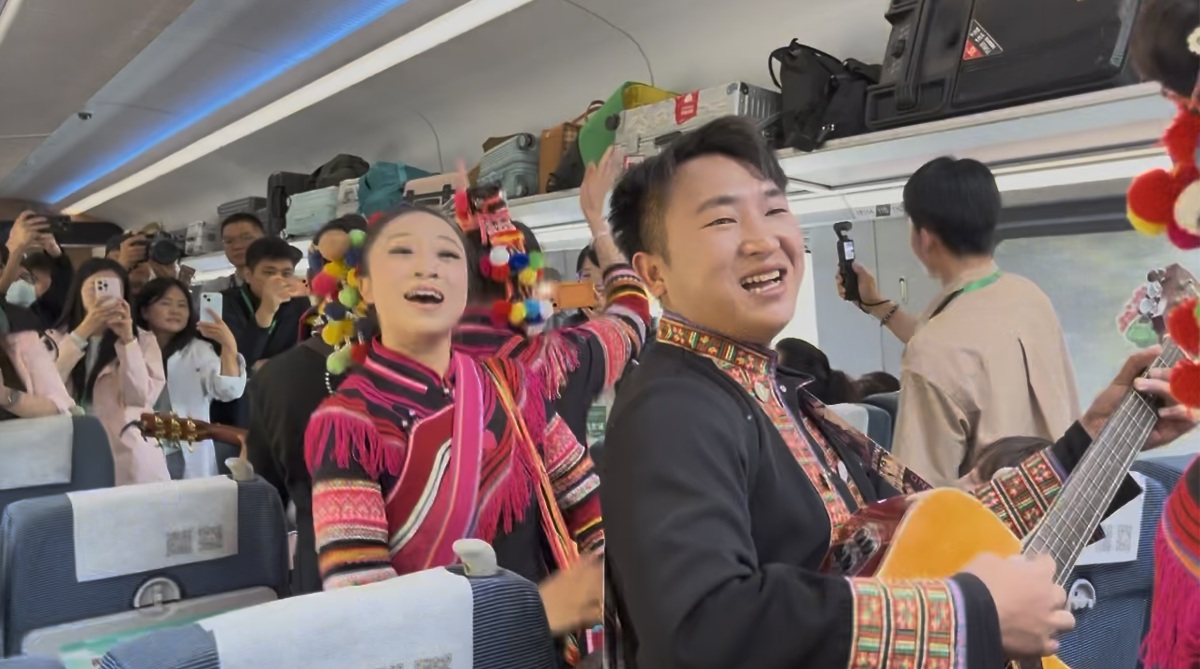
On the train from Kunming to Jinghong, folk song groups from the Yi, Dai, and Hani ethnic groups held a singing showdown. (Photo/Xudong Yang)
Jinghong offered her own set of welcomes. Circular Dai script claimed signs and notice boards. The platform ran trilingual announcements: Mandarin, Lao, and English.
This crossroad town was indeed many things: the prefectural seat, a multiethnic home to the peoples of Dai, Hani, Yi, and Han, and an up-and-coming destination for seasonal travelers. I saw young couples and groups everywhere, in minty Dai attire for the summer and on electric scooters. I asked my taxi driver how many here were seasonal residents. "About one in four" he asserted, "and we are busy with travelers all year here."
For a town of its size, the population density manifested in the thick traffic and the skyscrapers dotted with huge patios and warm lights.
Yet, beneath this skyline in its soft yellow glow, at four in the afternoon, the breeze was pleasantly dry enough to keep the windows down, regardless of what weather forecast said. Towering palms and bayans canopied the avenues, casting pools of shade where fruit and coffee vendors chatted carelessly. I understood why retirees and digital nomads alike chose this place.
By the official count: in 2025 alone, over 860,000 people from other Chinese provinces arrived to live in Xishuangbanna for extended stays, second only to Kunming.
Receiving us at the station earlier, more than one official had emphasized that until the passenger railway opened, the only route into this part of the world was by air into the dated airstrip or by long-distance coach. Eight to ten hours on the road from Kunming. A senior official complained how the latter was notoriously punishing on one's lower body.
Now even transnational groceries enjoy AC. Temperature-controlled containers began moving vegetables south and tropical fruit north in a little more than a full day. In Vientiane markets, Yunnan broccoli and Thai durian breathe with longer shelf lives.
Of course, humans can feel the railway more affectively, and economically.
Over the past three years, more than 800,000 cross-border travelers have passed through on this line. One of them, a British landscape photographer named Thomas Heaton, ended up making a whole documentary about it, now streaming on Disney+.
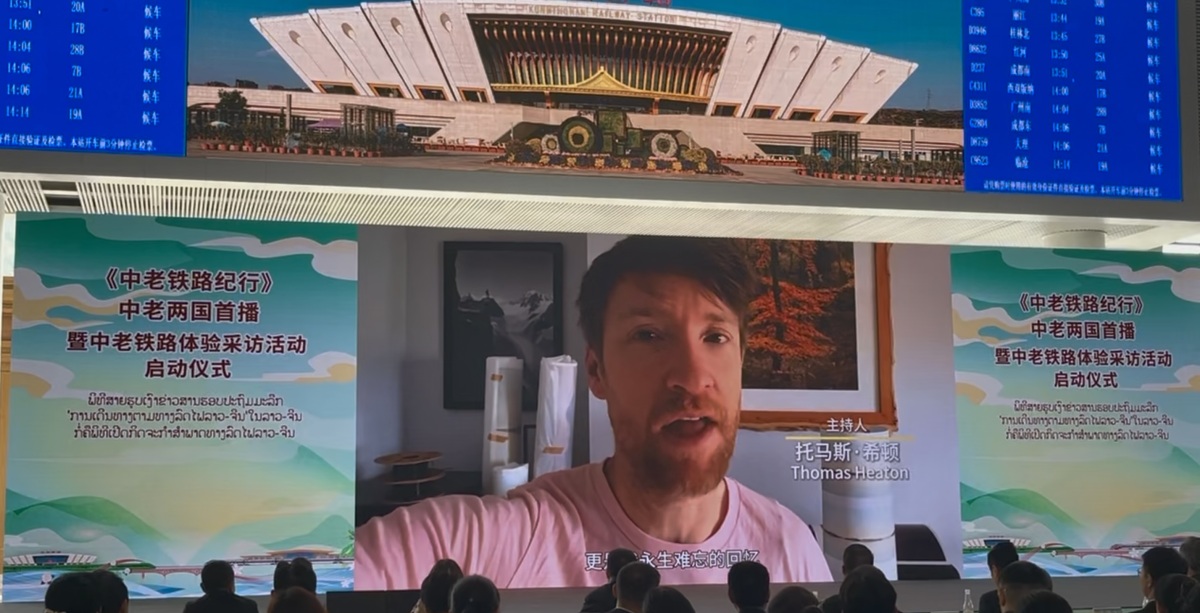
Thomas Heaton, a British landscape photographer and YouTuber, sent a congratulatory video for the launch event of his documentary at Kunming South Railway Station.(Photo/Xudong Yang)
Not all of us carry tripods. Border statistics show that business travel consistently ranks among the top three reasons for entry, alongside tourism and family visits. Down at the Mohan crossing, the China–Laos Mohan–Boten Economic Cooperation Zone (ECZ), China's second such national-level cross-border ECZ with a neighbor, continues to expand in both acreage and the number of registered businesses.
Soaked and trying to imitate Dai New Year greetings in different dialects, I could hardly think of any numbers at the time. It was only later—after drying my clothes and gathering my luggage and thoughts—that the big number, Year 1388, and its historical weight reentered my notebook.
Anthropologist James C. Scott popularized the geographical term Zomia to describe the massif spanning from Southeast China all the way to the Andaman coast. These heights and biomes had always sustained their own routes, exchanges, and local ways of belonging.
Now, tunnels and bridges in these southern reaches of the Hengduan Mountains offer a newer connection: a novel way of navigating the mosaic at a different speed.
Zooming out on the route from Kunming to Vientiane, the line hints at a future still in becoming.
My brief New Year excursion, and this meandering, must be cut short. I must to leave early for my flight back to Chongqing.
How I wish I could take a train.
By continuing to browse our site you agree to our use of cookies, revised Privacy Policy and Terms of Use. You can change your cookie settings through your browser.
For any inquiries, please email service@ichongqing.info