
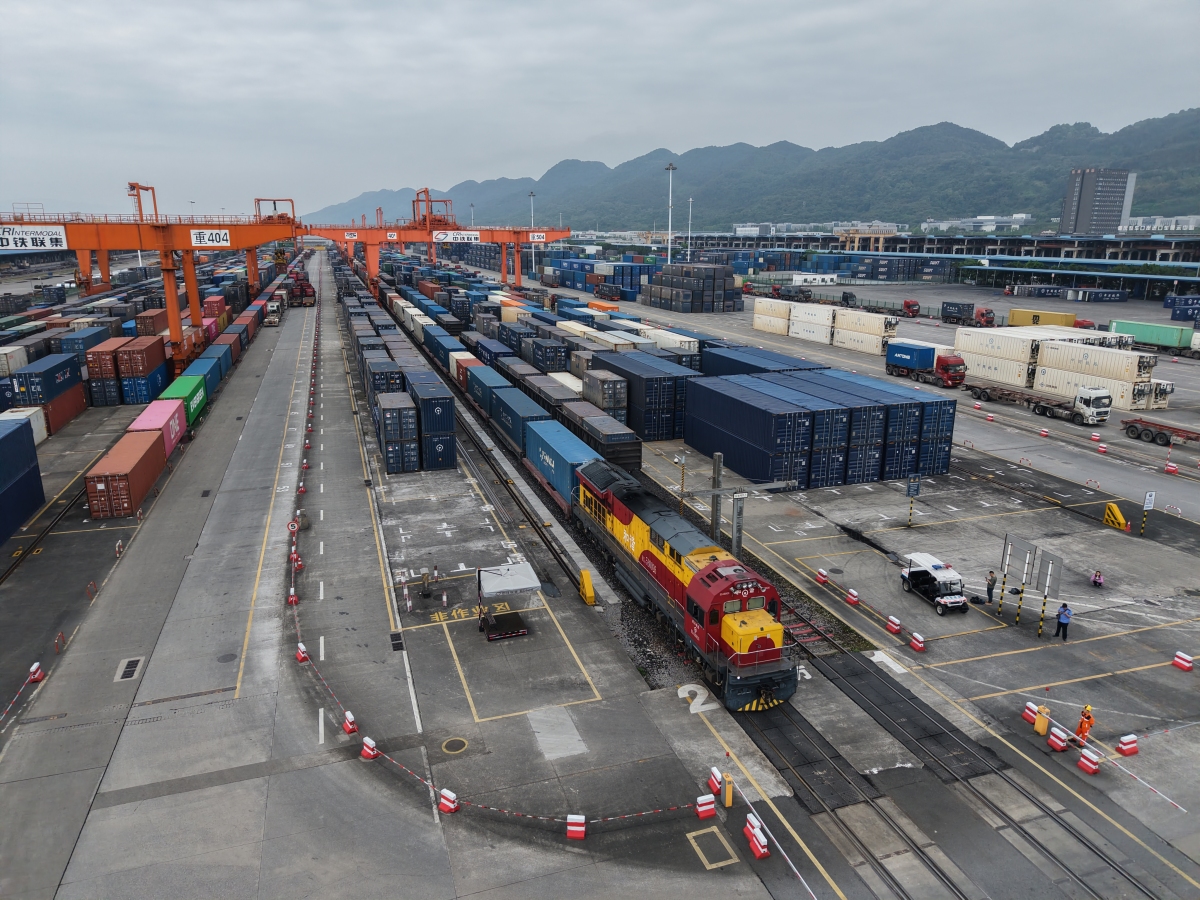
A Chongqing-made EV can reach Vientiane, Laos’ capital, in just five days via the China–Laos Railway. (Photo/Chongqing Daily)
Chongqing - On April 15, a China-Laos freight train carrying Chongqing-made new energy vehicles departed from Tuanjiecun Station and arrived in Vientiane via Yunnan’s Mohan port in just five days, marking the regular operation of the “Chongqing Cars Go Global” service under the New International Land-Sea Trade Corridor (ILSTC).
Lu Ling, an economist at the Tuanjiecun, offered a comparison: "Previously, automakers exporting to Southeast Asia primarily relied on an intermodal river to sea transport, which took 20 to 30 days for the entire journey. Now, via the China-Laos Railway, goods reach Vientiane in just five days and are then distributed by road to neighboring countries such as Thailand, Vietnam, and Cambodia, effectively lowering logistics costs for enterprises."
A flagship Belt and Road project, the 1,035-kilometer China-Laos Railway links Kunming with Vientiane and marked its fourth year of operation on December 3, 2025.
Over these four years, its freight capacity has continued to expand: the number of cross-border freight trains has increased from two per day to a peak of 23 per day, train hauling capacity has risen from 2,000 tonnes to 2,800 tonnes, and customs clearance time at Mohan has been reduced from 40 hours to under five hours.
As a result, freight costs from Kunming via Laos to Thailand have fallen by 30 to 50 percent.
As of April 2026, the China-Laos Railway has transported over 81.5 million tonnes of cargo. The range of cross-border goods has expanded from just over 10 categories at the beginning to over 3,800, covering 31 provinces, autonomous regions, and municipalities across China, as well as 19 countries in the ASEAN region. Exports of China's "new three," NEVs, photovoltaic products, and lithium-ion batteries, have grown rapidly.
To accommodate the stringent safety requirements for battery transport and the larger dimensions of NEVs, the Chongqing Railway developed specialized loading solutions and established a fast-track priority booking, loading, and dispatch process for cars and parts. Additionally, coordination was set up among customs authorities, manufacturers, and logistics operators to ensure empty containers are delivered to factories in advance.
The China-Laos Railway has fundamentally transformed the transport landscape of Laos, ASEAN's only landlocked country. NEVs arriving in Vientiane can be rapidly distributed to other countries across the Indochinese Peninsula. With Thailand, Indonesia, and Malaysia having already introduced policies to promote electric vehicle adoption, this rail link is emerging as a green corridor for Chinese NEVs into the ASEAN market.
In the first two months of 2026, Chongqing's automotive exports reached 8.89 billion yuan (about 1.3 billion U.S. dollars), marking an 89.3 percent year-on-year increase. Going forward, the ILSTC will introduce additional tailored services, including dedicated block trains for complete vehicles and express lines for auto parts.
By continuing to browse our site you agree to our use of cookies, revised Privacy Policy and Terms of Use. You can change your cookie settings through your browser.
For any inquiries, please email service@ichongqing.info