
Chongqing - Chongqing has recently unveiled an action plan to accelerate the real-world application of emerging technologies, aiming to fast-track the large-scale rollout of new products, services and business models by 2028 as China pushes to strengthen innovation-driven growth.

A humanoid robot developed by Landai Technology. (Photo/Zheng Ran)
In China's policy context, "scenarios" refer to real-world environments in which new technologies and products can be tested, refined, and adapted before a wider market rollout.
Zhu Jiang, deputy director of the Chongqing Municipal Development and Reform Commission, pointed to autonomous driving as an example of Chongqing’s push for emerging technologies, noting that Changan Automobile recently gained approval for Level 4 robotaxi road testing in designated areas to help accelerate commercialization.
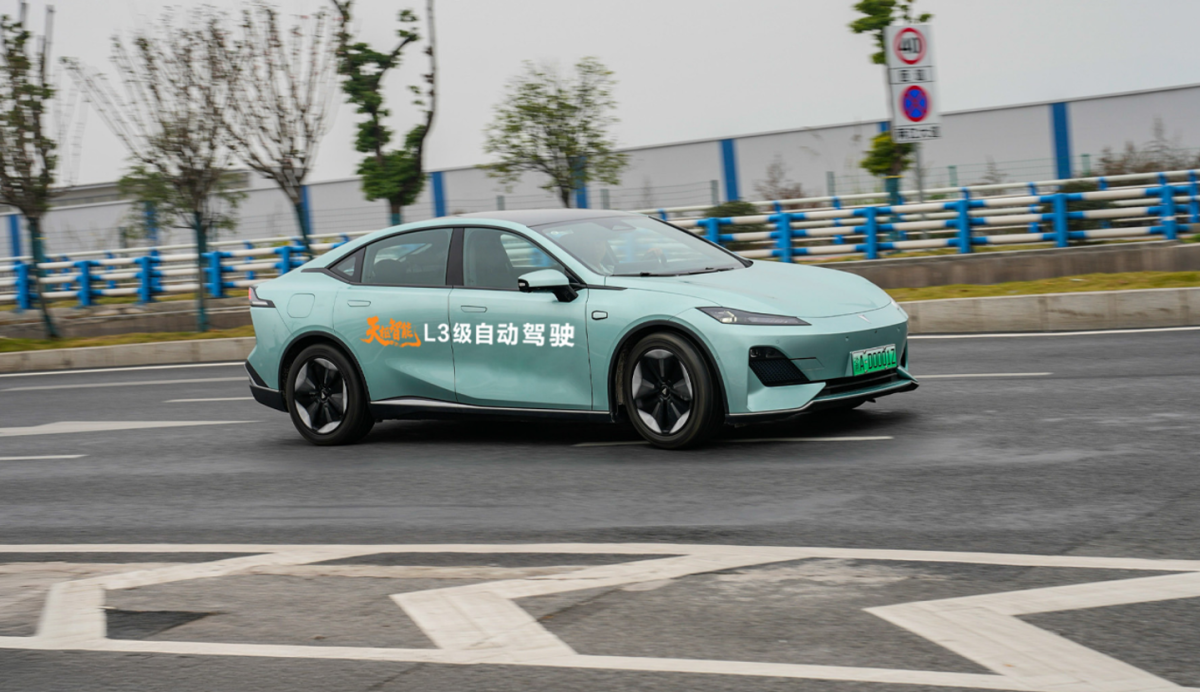
The Deepal SL03, one of China's road-legal L3 autonomous driving models, speeds down the road. (Photo/Deepal)
The plan identifies 21 priority fields across five major areas. Each year, Chongqing plans to develop 20 major integrated scenarios with local characteristics, hold more than 200 matchmaking events linking scenario providers and technology users, and release more than 2,000 effective scenario opportunities.
Several initiatives are tied to Chongqing's role in national and regional development strategies. The plan calls for upgrades to application scenarios linked to the New International Land-Sea Trade Corridor (ILSTC). It also supports smart rail-sea intermodal transport and "smart Yangtze River" applications.
In the low-altitude economy, the plan promotes the use of commercial drones in production, transport, public administration, and consumer services. It also calls for applications integrating China's BeiDou satellite navigation system with satellite internet services.
To lower barriers for companies, the action plan introduces financial and regulatory support. In government-invested projects, no less than 5% of the budget should be reserved for new scenario construction, Zhu said. Authorities will also encourage banks and insurers to develop specialized products such as "scenario loans" and "scenario insurance," while supporting participation from state-backed funds and private capital.
The plan also addresses access to key production factors. Beyond land, data, and talent, Chongqing will explore smoother circulation of newer strategic resources, including aerospace-related assets and spectrum-orbit resources, with the goal of supporting technology trials and industrial growth.

Engineers repair an aircraft engine at the Chongqing facility of Ruihang (Chongqing) Aero Engine Maintenance. (Photo/Zheng Ran)
The action plan also focuses on public services. It calls for wider use of remote medical services based on "distributed examination and centralized diagnosis," as well as smart nursing homes, smart housekeeping services, and integrated childcare scenarios. In transportation, Chongqing plans to deepen intelligent traffic management through adaptive traffic signals, traffic monitoring, and bus-priority dispatching.
Zhong Xi, deputy director of the Chongqing Municipal Commission of Economy and Information Technology, said scenario development has already supported local industries. He cited a BeiDou-enabled underground navigation project in Yuzhong district, saying it helped verify the technology, contributed to a 19% increase in Chongqing's BeiDou industry scale last year, and became a recognizable urban application.
Zhong said the city has also released an initial batch of 30 industrial artificial intelligence agents and is expanding into robotics scenarios, including vehicle assembly, flexible manufacturing, emergency response, elder care, and medical services.
He added that since the end of last year, leading companies, including Unitree, AgiBot, and Galbot, have established operations in Chongqing, while the city's service robot output rose 18% in the first quarter of this year.

A Unitree humanoid robot works at a checkout counter inside the company's western China innovation and operations center in Dadukou District, Chongqing. (Photo/Zheng Ran)
Officials said the next phase will include project lists for application scenarios, a lifecycle management system, and a platform to match supply and demand.
By continuing to browse our site you agree to our use of cookies, revised Privacy Policy and Terms of Use. You can change your cookie settings through your browser.
For any inquiries, please email service@ichongqing.info