
Chongqing - Energy officials, United Nations representatives and industry executives meeting in Chongqing called for stronger cooperation on green technology transfer, including the wider adoption of renewable energy technologies, supported by better regional power connectivity, workforce training and practical financing.
The 2026 International Forum on Regional Cooperation for Sustainable Development of Green Mountains was held in Chengdu and Chongqing, with the main forum taking place in Chongqing on July 12.
The event brought together 52 representatives from international organizations and overseas institutions to discuss renewable energy, clean technology cooperation, green finance, and cross-border projects.

The 2026 International Forum on Regional Cooperation for the Sustainable Development of Green Mountains was held in Chongqing on July 12, 2026. (Photo/Zheng Ran)
Shi Yubo, chairman of the China Energy Research Society, said solutions should reflect differences in natural resources and economic development rather than reproduce models designed for developed or lowland areas. He called for technologies that are affordable, accessible and adapted to the practical needs of mountain communities.
That approach was also central to remarks by Yang Lin, deputy executive secretary of the United Nations Economic and Social Commission for Asia and the Pacific (UNESCAP).

Yang Lin, deputy executive secretary of the United Nations Economic and Social Commission for Asia and the Pacific. (Photo/Zheng Ran)
Mountain regions face high infrastructure costs, climate-related damage and limited access to reliable electricity, Yang said. In many remote areas, extending a conventional national grid is neither technically practical nor cost-effective, making decentralized systems based on local solar, wind and other renewable resources an important alternative.
Yang pointed to UNESCAP's Sustainable Development Goal 7 road maps for countries including Nepal, Bhutan, Pakistan, Georgia, Kyrgyzstan and Tajikistan. SDG 7 is the United Nations goal of ensuring access to affordable, reliable, sustainable and modern energy.
"The clean energy transition is not just a technological transformation. It is a massive labor market transformation," Yang said.
She said renewable projects are increasingly constrained by shortages of qualified planners, engineers, technicians and regulators, particularly in mountain communities that are often among the last to receive new technologies and employment opportunities.
Yang proposed training programs tailored to local conditions, greater opportunities for women and young people, and shared certification systems that would allow skills to be recognized across borders. Infrastructure financing, she added, should also cover the people responsible for building, operating and maintaining energy systems.
"What we need now is collective action," she said. "The benefits of the energy transition must reach even the most remote and vulnerable communities."
Huang Jin, an energy expert with UNESCAP, said regional energy cooperation should not be measured only in generating capacity or transmission lines.
"It is also about structural resilience, investment confidence, regional trust and inclusive development," Huang said.
She identified geopolitical disruptions, climate volatility and financial pressure as interconnected risks. Hydropower-rich countries can experience electricity surpluses during wet seasons but reduced output during dry periods, while countries with expanding industries may face growing demand and dependence on imported fuels.
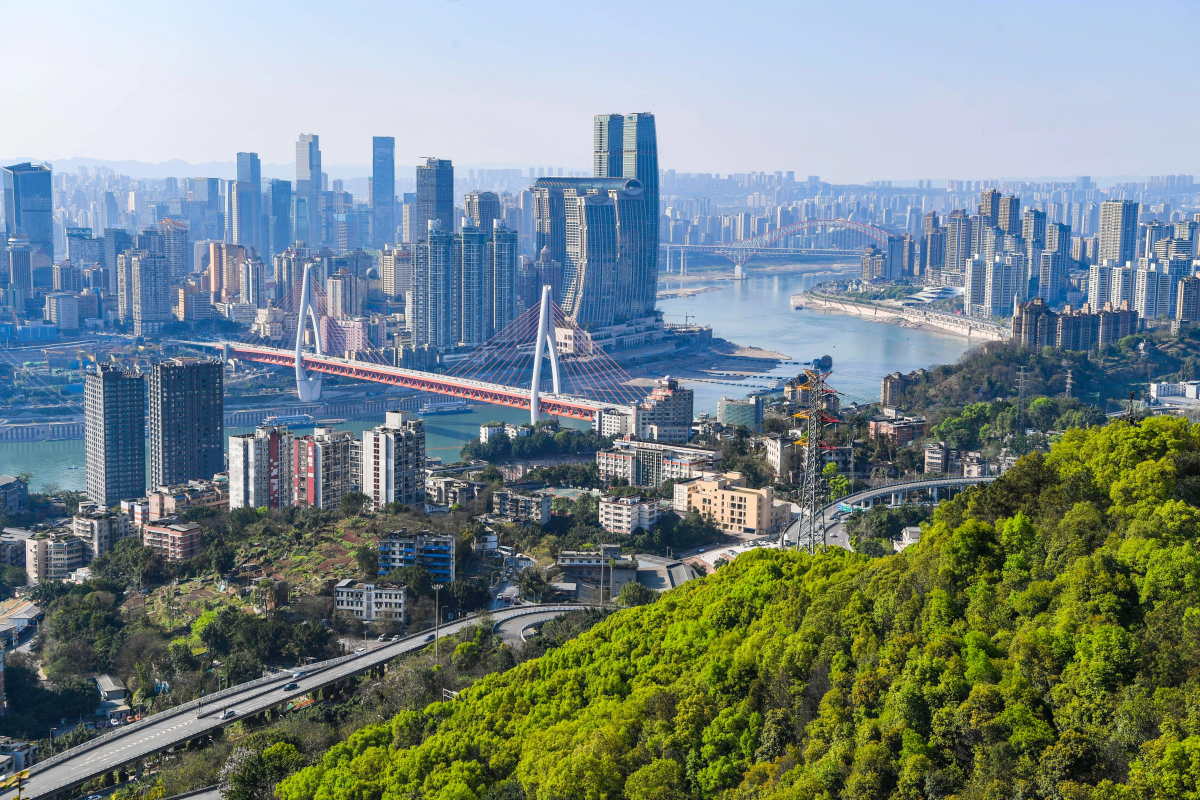
The landscape of Chongqing. (Photo/Chongqing Nan'an District)
The central mismatch, Huang said, is that rivers, climate risks and energy prices cross borders, while tariffs, market rules and technical standards remain largely national. She called for investment in cross-border transmission, storage, smart grids, forecasting, and common market arrangements, alongside measures to ensure that women, small businesses, and local workers benefit from projects.
Vladislav Zavadskiy, a senior energy expert with the UNEP Copenhagen Climate Center, also examined the grid challenge. His presentation showed sharply different power systems across Central Asia and Mongolia. Tajikistan and Kyrgyzstan rely heavily on hydropower, while Mongolia's electricity supply remains dominated by coal and Turkmenistan's by natural gas.

Vladislav Zavadskiy, a senior energy expert with the UNEP Copenhagen Climate Center. (Photo/Zheng Ran)
Zavadskiy's data showed Kazakhstan had 2,810 megawatts of hydropower, 1,520 megawatts of wind and 1,222 megawatts of solar capacity in 2024. Uzbekistan had 2,391 megawatts of hydropower, 501 megawatts of wind and 2,275 megawatts of solar. His presentation emphasized that variable wind and solar output requires grids to continuously balance electricity production and consumption, increasing the importance of storage, flexible generation and interconnections between national systems.
Thailand presented a policy-based approach to expanding solar power. Munlika Sompranon, director of the Solar Energy Development Division at Thailand's Ministry of Energy, said renewable sources accounted for 15.09% of the country's total final energy consumption in 2025.

Munlika Sompranon, director of the Solar Energy Development Division at Thailand's Ministry of Energy. (Photo/Zheng Ran)
Thailand's grid-connected solar capacity reached 12,754 megawatts by mid-2025. Its draft Alternative Energy Development Plan targets a 37% share of renewables by 2037 and more than 41,000 megawatts of solar capacity.
Households installing systems of up to 10 kilowatts can receive income tax rebates of up to 200,000 baht. Another program allows households to sell surplus rooftop solar electricity to the grid at 2.20 baht per kilowatt-hour under 10-year contracts. This payment mechanism is known as a feed-in tariff, a fixed price paid by utilities for renewable electricity. Thailand also said recent reforms had reduced some commercial solar approval periods from 75 days to between seven and 30 working days.
The forum also highlighted the role of companies in translating policy into operating projects. Xie Qing, general manager of Chongqing New Century Electrical, said mountainous countries could combine valley hydropower, mountain-pass wind projects and high-altitude solar systems while sharing substations, transmission lines and storage facilities.
Founded in 1992, the Chongqing company provides automation systems and engineering, procurement, and construction (EPC) services for hydropower and other electricity projects. Its examples included Vietnam's 63-megawatt Se San 4A Hydropower Plant and Pakistan's 40.8-megawatt Koto Hydropower Plant. The company has also supplied systems for projects in Peru, Afghanistan and Uzbekistan.
Xie said remote centralized control, digital monitoring and artificial intelligence-based scheduling could address the difficulty of managing multiple small power stations scattered across mountainous areas. The company proposed cooperation on equipment projects, local technical training, and shared regional operations and maintenance platforms.
Chongqing officials presented the municipality as both a mountain-city test site and an industrial partner. Liu Chenglong, vice chairman of the Chongqing Association for Science and Technology, said the city's energy consumption grew by an annual average of 2.2% while its economy expanded by 5.6%. In 2025, energy use per unit of economic output fell 8.3%, while value added by major industrial enterprises rose about 5.9%.
Liu said Chongqing would continue to develop renewable energy, energy storage, advanced materials, electric vehicles, and smart energy systems, while supporting international research, technology transfer, and industrial partnerships.
By continuing to browse our site you agree to our use of cookies, revised Privacy Policy and Terms of Use. You can change your cookie settings through your browser.
For any inquiries, please email service@ichongqing.info