
Chongqing - Chongqing has unveiled a new policy blueprint to accelerate innovation-led growth by strengthening links between scientific research, advanced manufacturing and artificial intelligence, following the Ninth Plenary Session of the Sixth Chongqing Municipal Committee of the Communist Party of China (CPC) held on July 13.
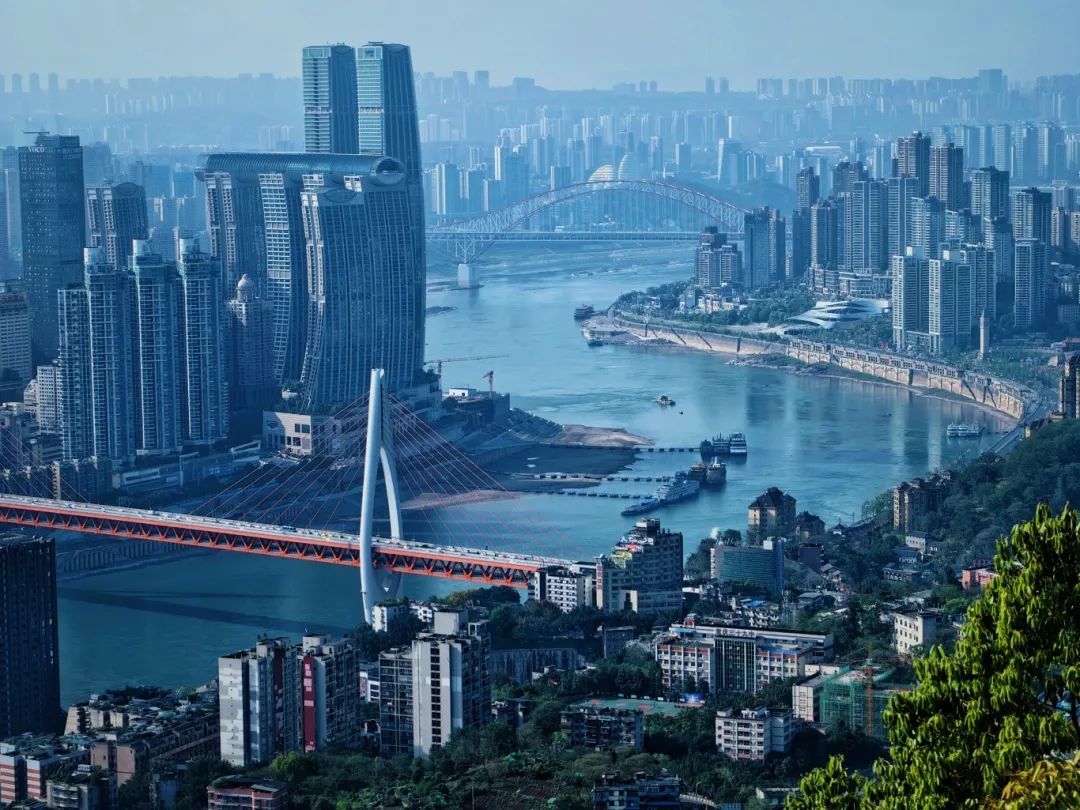
A view of Chongqing's urban landscape. (Photo/Chen Xin)
Officials approved a policy document outlining the city's priorities and major tasks for building a stronger, innovation-driven economy. It also marked a pivotal moment as the city prepares for the first year of China's 15th Five-Year Plan (2026–2030) and the 30th anniversary of its designation as a municipality directly under the central government.
By 2030, Chongqing aims to become a science and technology innovation center for western China, a nationally influential source of modern industrial innovation, a globally connected center for open innovation cooperation and a leading city for AI applications.

Two humanoid robots compete in a boxing match at Unitree Robotics' Western China Innovation and Operations Center in Chongqing's Dadukou District. (Photo/Zheng Ran)
The plan also calls for a "tropical rainforest-style" innovation ecosystem, referring to a diverse environment in which universities, laboratories, companies, investors and technology service providers support different stages of innovation.
At the July 14 news conference explaining the plenary session, Fang Lei, party secretary of the Chongqing Municipal Science and Technology Bureau, detailed the newly introduced "203060" framework.
The system calls for more than 20 strategic innovation platforms, over 30 priority technology breakthrough areas and at least 60 major outcomes that can be applied or commercialized.
"The '20+' strategic innovation platforms are the foundation, bringing together innovation resources," Fang said. "The '30+' key breakthrough directions are the targets, while the '60+' landmark achievements are the results and the practical application points for industrial development."
The platforms will be supported through customized policies covering project approvals, talent recruitment, funding and resource allocation. Chongqing plans to strengthen an innovation network centered on four major laboratories, with support from universities, research institutes and leading companies.

A laboratory at Chongqing Pharscin Pharmaceutical Co., Ltd. (Photo/Pharscin Pharmaceutical)
For priority technologies, Fang said the city would use a model in which "industry sets the questions and science and technology provide the answers." The approach is intended to align research programs with specific problems facing industrial supply chains.
Jiang Hui, member of the Standing Committee of the CPC Chongqing Municipal Committee and head of its Publicity Department, said Chongqing's total research and development spending in 2025 was 48.2% higher than at the beginning of the 14th Five-Year Plan period.
R&D spending rose from 2.11% to 2.65% of the city's economic output, while the number of nationally recognized high-level professionals increased by more than 60%, Jiang said. Chongqing had 10,400 high-tech enterprises and 76,900 science and technology companies, with both totals doubling during the period.
The policy also links the "203060" system with Chongqing's "33618" manufacturing framework. The numerical title refers to three leading industries, three pillar industries, six industries with distinctive local strengths and 18 emerging sectors.
Wang Zhijie, director of the Chongqing Municipal Commission of Economy and Information Technology, said the city plans to push its three leading industries - intelligent connected new energy vehicles, next-generation electronic information manufacturing and advanced materials - toward an output of 1 trillion yuan (about 147 billion U.S. dollars) each.
Chongqing also aims to expand intelligent manufacturing and equipment, food and agricultural processing, and software and information services. The software sector is targeted to approach 800 billion yuan in scale.
In its locally competitive industries, the city plans to promote premium, electric and intelligent motorcycles while strengthening the "one-hour motorcycle industrial circle," meaning a supply chain in which key components and services can be sourced within roughly one hour.

A range of premium motorcycles manufactured by Chongqing-based Shineray. (Photo/Zheng Ran)
Chongqing is targeting industrial clusters worth 200 billion yuan each in premium motorcycles, new energy equipment and textiles, as well as 100 billion yuan clusters in AI, specialized integrated circuits and biomedicine.
Artificial intelligence will be another central part of the plan. Gao Jian, director of the Chongqing Municipal Development and Reform Commission, said the city would focus on research, talent development, industrial incubation and real-world applications.
Plans include developing AI systems for intelligent vehicles, embodied intelligence and low-altitude aviation. Chongqing will also develop industrial drones for geographic surveying and urban inspection, improve low-altitude traffic management infrastructure, and expand AI applications across manufacturing and public services.
By continuing to browse our site you agree to our use of cookies, revised Privacy Policy and Terms of Use. You can change your cookie settings through your browser.
For any inquiries, please email service@ichongqing.info