
Chongqing - For many local Chongqing residents, Yangren Jie, literally "Foreigners' Street", is far from a new name. It brings back memories of weekends, family outings, and a once-popular local amusement destination. On Oct. 1, the name will return in a very different form.
With the Mid-Autumn Festival and National Day holidays approaching, the return of Yangren Jie is only one of several reasons to explore Chongqing. This guide brings together new attractions, festival events, cultural experiences, and early-autumn outings across the city.

Visitors stroll along a riverside walkway framed by autumn foliage. (Photo/Chongqing Daily)
The new Yangren Jie project by Mexin Group will open its first phase in Jieshi, Banan District, on China's National Day. Unlike its predecessor, the new attraction is being developed inside the company's intelligent manufacturing park. The idea is to turn part of an operating industrial site into a visitor experience, with "factories you can visit and workshops you can play in".
For international visitors unfamiliar with the original Yangren Jie, the appeal goes beyond the reopening of an old attraction. The more interesting story is how a place closely tied to local memory has been reimagined around a functioning manufacturing base. Visitors will be able to watch production processes, ride a steam train, walk along an artificial canal, and explore family attractions, all in a setting where factory floors and leisure spaces exist side by side.
And that is only one way to spend the holiday in Chongqing this year.
From a riverside hotpot carnival with hundreds of tables to pottery and traditional crafts in Rongchang, handwritten letters in a museum, early autumn walks and a hotpot dinner on Nanshan Mountain, the holiday offers a mix of new events and familiar Chongqing experiences worth slowing down for.
The first phase of the new Yangren Jie will open on Oct. 1, covering about 20 percent of the planned project.
What sets the new project apart is that manufacturing itself becomes part of the visitor experience.
Production lines for doors, windows, and home furnishings will remain in operation, with parts of the manufacturing process visible through transparent factory spaces. Around them, the park will add a multi-level play area inspired by the tiered geometry of traditional Chinese display shelves and Chongqing's famously layered urban landscape, along with a steam train, an artificial canal, family attractions, nighttime activities, cultural and educational programs, and dining options.

The factory-themed park takes shape as construction continues. (Photo/Mexin Group)
That makes the new Yangren Jie different from a conventional theme park. The factory is not hidden behind the attraction. It is part of the attraction.
The project will also introduce hotpot dining within the factory setting while keeping the relatively affordable, everyday character associated with the original Yangren Jie.
For locals, the reopening may feel like a return to a piece of shared city memory. For first-time visitors, the appeal lies in the unusual mix of working factory spaces and leisure attractions.
Ticketing and reservation details have not yet been announced. Visitors should check the latest official information before heading out.
If Yangren Jie is one of the holiday's newest attractions, the hotpot carnival in Dadukou District offers something much closer to the image many travelers already have of Chongqing, such as lively crowds, animated conversation and pots of red, bubbling broth.
The 18th China (Chongqing) Hotpot Food and Culture Carnival will run from Sep. 29 to Oct. 5 in Dadukou District.

Rendering of a riverside hotpot dining area planned for the Chongqing Hotpot Food and Culture Carnival. (Photo provided by the organizer)
This year's event will feature a themed "Chongqing Hotpot Harbor", with more than 270 hotpot tables and a lineup of well-known local brands.
The venue brings together river, cliffside, street, and garden settings in one large dining and entertainment area. Beyond sitting down for hotpot, visitors can explore camping-style spaces, markets, hotpot served inside an air-raid shelter, and interactive performances and games.
There will also be barbecue, coffee, Chongqing-style Jianghu cuisine, cultural products inspired by intangible cultural heritage, and other local goods.

Rendering of the dining and leisure area at the Chongqing Hotpot Food and Culture Carnival. (Photo provided by the event organizer)
The main draw, however, may be the setting itself. Hundreds of hotpot tables will fire up at once, surrounded by the river, the lights of the mountain city, and the bustle of the holiday crowd.
The event will also partner with DiDi to provide dedicated ride services for the carnival.
For travelers looking beyond downtown Chongqing, Rongchang District is worth setting aside a day or even two.
Events held under the theme of the 2026 Rongchang History and Culture Week run from September into November, covering both the Mid-Autumn Festival and National Day holiday period.

Visitors view Rongchang pottery on display during a previous edition of Rongchang History and Culture Week. (Photo/Rongchang District)
Here, traditional culture is not limited to something displayed behind glass. Much of it can be experienced firsthand.
At Antao Town, the home of Rongchang Pottery, visitors can move from viewing finished pieces to trying pottery making themselves. The new Anfu Market brings pottery, an intangible cultural heritage parade, local food, and hands-on craft activities into one space. Holiday markets will also feature regional specialties, such as Rongchang pork and Rongchang braised goose.
Beyond Antao Town, Wanling Ancient Town offers a riverside old town atmosphere, while Xiabu Town focuses more closely on Rongchang Ramie Cloth and the traditional weaving techniques behind it.
For a rainy day, or simply a slower afternoon, the Chongqing China Three Gorges Museum offers an easy indoor option. Three temporary exhibitions will be on view during the holiday.
Letters Across Time: Handwritten Correspondence by Notable Figures of the Ming and Qing Dynasties runs through Oct. 11.

A handwritten letter by Lin Zexu from the collection of the Chongqing China Three Gorges Museum. (Photo/Chongqing China Three Gorges Museum)
The exhibition brings together more than 210 handwritten letters connected to over 80 prominent figures from the Ming (1368 - 1644) and Qing dynasties (1644 - 1912). Their subjects range from scholarly discussions and exchanges between friends to everyday matters and reflections on the affairs of their time.
Most of the letters come from the collections of the Chongqing China Three Gorges Museum, Xiushan Museum, and other institutions. They are being systematically presented and publicly exhibited for the first time.
The figures range from artists and calligraphers such as Tang Yin, Wen Zhengming, and Zhu Yunming to prominent officials and statesmen including Lin Zexu, Zeng Guofan, and Li Hongzhang, as well as scholar and calligrapher Zhao Xi.

A handwritten letter by Zeng Guofan from the collection of the Xiushan Museum. (Photo/Chongqing China Three Gorges Museum)
Rather than viewing the works only as calligraphy, visitors can also read them as fragments of private communication preserved across centuries. Changes in pressure, corrections in the margins, and even ordinary remarks about daily life bring their writers closer to the present.
Admission to the exhibition is free.
Two other temporary exhibitions at the museum also run through the holiday.
Monsters and Wonders: An Imaginary Journey Among Fantastical Creatures runs through Oct. 18, bringing together mythical beings from Chinese and Western traditions. Standard admission is 49 yuan, with discounted and group ticket options also available.
Reflections Through Time: Bronze Mirrors of the Song and Jin Dynasties runs through Nov. 1. Co-organized by the Chongqing China Three Gorges Museum and Heilongjiang Provincial Museum, the exhibition features 87 bronze mirrors and sets of mirrors from the Song (960 - 1279) and Jin (1115 - 1234) dynasties. Admission is free.
The Chongqing China Three Gorges Museum is open from 9 a.m. to 5 p.m., with last admission at 4 p.m. Visitors are asked to leave the galleries from 4:45 p.m. The museum is normally closed on Mondays, except on national public holidays.
If the weather cooperates, there is no need to spend the entire holiday moving from one major event to another.
Around the Mid-Autumn Festival and National Day, Chongqing begins to move into early autumn. Temperatures generally start to ease from the summer highs, while the city's vegetation gradually changes with the season.
It is still early for the broad swaths of golden ginkgo leaves and red foliage seen later in the season. Early autumn is better suited to walking, climbing to a viewpoint and, with some luck, catching the scent of osmanthus in bloom.
Hong'en Temple Forest Park is an easy option within the urban area.

Hong'en Temple Forest Park lights up after dark, highlighting its traditional architecture against the night sky. (Photo/iChongqing)
Osmanthus generally flowers in early autumn, and Hong'en Temple Forest Park is one of Chongqing's better-known places to enjoy it. The exact timing, however, depends on temperature, rainfall, and other seasonal conditions, so peak bloom during the holiday cannot be guaranteed.
Even without the flowers, its hillside paths and elevated city views make the park an easy half-day outing.
Another option is to give an entire afternoon and evening to Nanshan Mountain.
Start with a walk through Nanshan Botanical Garden. Rather than planning a visit around a flower show that has yet to be announced, think of it as a place to enjoy seasonal plants and the landscape of Nanshan Mountain.
Nanshan Botanical Garden is open year-round from 9 a.m. to 5:30 p.m., with last admission at 5 p.m. Bus No. 384 serves the area. Parking is available.
Pets are not permitted inside the garden.
Toward dusk, head to one of Nanshan Mountain's viewpoints and watch Chongqing change as daylight fades.
As the city and the banks of the Yangtze and Jialing rivers begin to light up below, the view makes Chongqing's dramatic changes in elevation much easier to understand. It also shows why the city is so often described as having a distinctly three-dimensional urban form.
Then stay on the mountain for dinner.
Nanshan Mountain is home to a cluster of hotpot restaurants, but Pipayuan Hotpot Nanshan head store (Loquat Park Hot Pot) stands out for its scale and setting. Hundreds of tables spread across the hillside. After dark, rows of lights turn the slope itself into part of the dining experience.
It is a very different setting from a typical street-level hotpot restaurant.
A single afternoon and evening can move from the botanical garden to a mountain view of the city after dark, and finally to hotpot on the hillside. The route brings together several distinctly Chongqing experiences without trying to cover too much ground.
The "Majestic Landscape, Dynamic Chongqing" drone light show will hold special performances over the downtown riverfront during the Mid-Autumn Festival. The National Day schedule will be announced later.
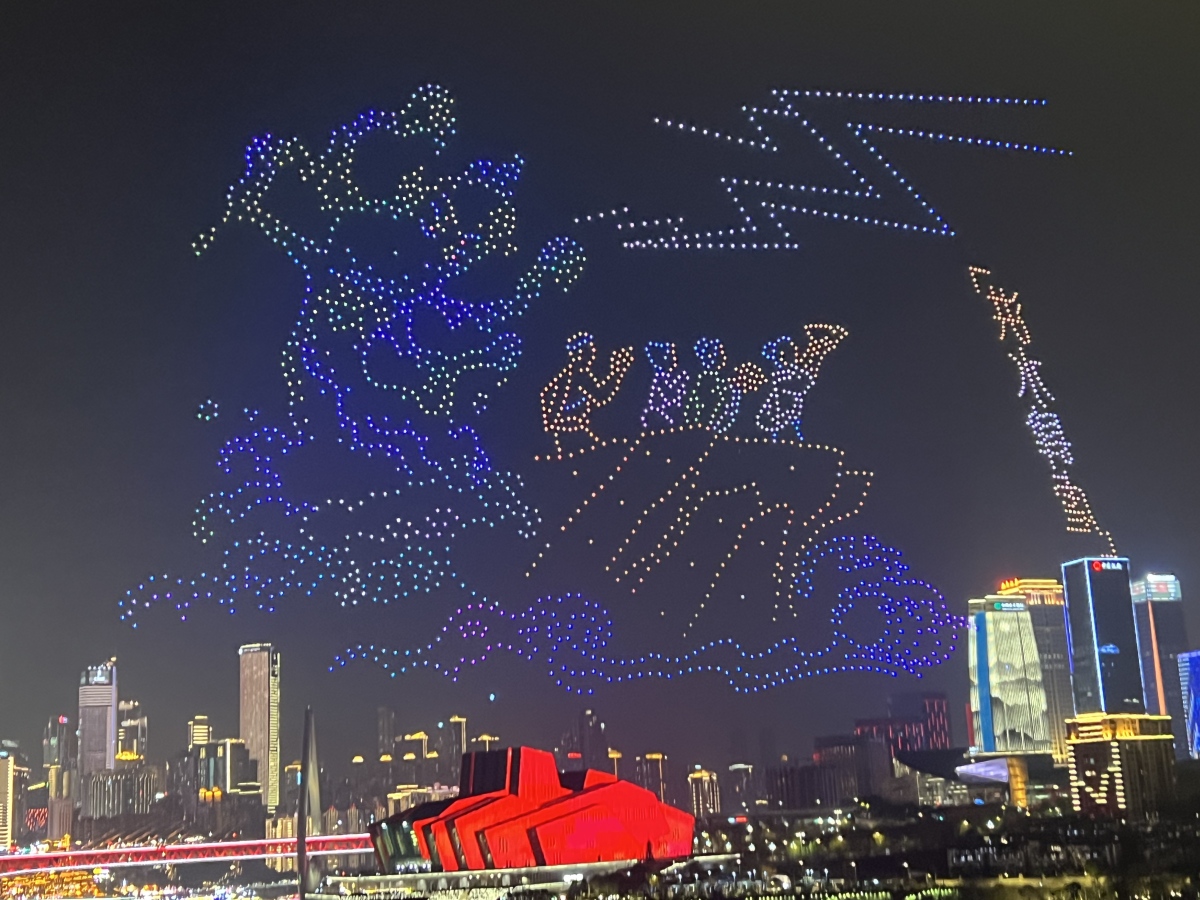
A drone light show illuminates Chongqing's night sky. (Photo/ Vivian Yan)
New intercity coach services from Chongqing to Mianyang and Neijiang will begin ahead of the holiday. Direct coach connections are also available to destinations including Dujiangyan and Jiuzhaigou. Travelers continuing beyond Chongqing can check the schedules before departure.
Autumn weather can vary considerably between downtown Chongqing and higher-altitude areas. Anyone heading into the mountains should check the latest forecast and attraction notices, and pack for possible temperature drops or rain.
Major events, museums and tourist attractions may introduce reservations, visitor limits or temporary traffic controls during the holiday. Check the latest official notices before setting out.
There is no need to fit every Chongqing attraction into a single holiday.
You might see how a place remembered by generations of locals has been reinvented, join hundreds of diners around a bubbling hotpot, shape a piece of clay in Rongchang or read a letter written centuries ago. Or you can skip the big events altogether, walk through the hills in the early autumn air, wait for the city lights to come on, and settle down beside a steaming pot of hotpot.
That may be one of the better ways to experience Chongqing. The city is not something to simply look at. It reveals itself in the time spent walking its hills, sharing a meal, visiting an exhibition, and watching an ordinary evening unfold.
By continuing to browse our site you agree to our use of cookies, revised Privacy Policy and Terms of Use. You can change your cookie settings through your browser.
For any inquiries, please email service@ichongqing.info