
Chongqing - Earlier warnings can give people more time to prepare for disasters. A digital meteorological system developed in Chongqing, southwest China, is attracting international attention for its approach to getting those warnings to the public and improving preparedness.
Florian Pappenberger, director of the European Centre for Medium-Range Weather Forecasts (ECMWF), visited Chongqing on November 24 to examine the city's implementation of the United Nations' "Early Warnings for All" initiative, which aims to ensure everyone worldwide is protected by early warning systems by 2027.

Florian Pappenberger, director of the European Centre for Medium-Range Weather Forecasts, visits the Chongqing Meteorological Bureau on November 24, 2026. (Photo/Chongqing Meteorological Bureau)
To address challenges posed by its complex mountainous terrain and frequent weather hazards, Chongqing has developed a digital meteorological system known as "Sitian." It consists of four components covering intelligent observation, forecasting, public services, and disaster prevention.
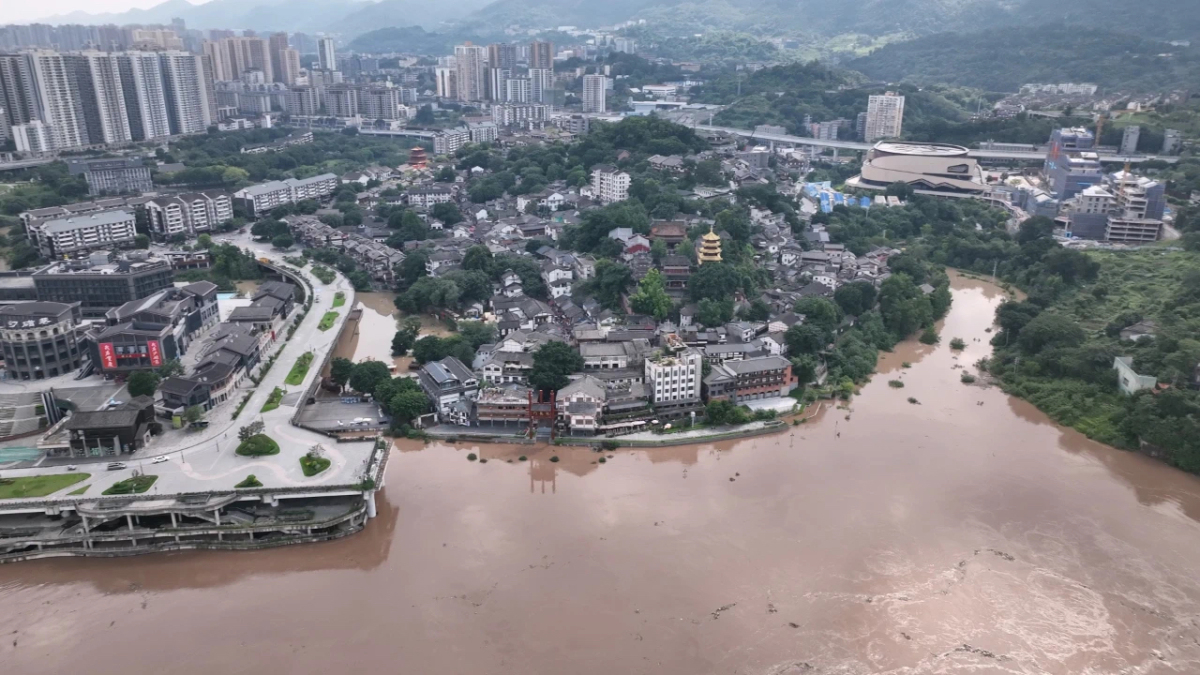
At 16:00 on July 12, 2024, floodwaters from the Jialing River surged through the Shapingba district of Chongqing, inundating the low-lying areas of the Ciqikou ancient town. (Photo/Fan Yuen)

The Zhitian Intelligent Service System. (Graphic/Chongqing Meteorological Bureau)
The system integrates meteorological observations, numerical forecast products, public service information, and data from other sectors through a cloud-based big data platform. It supports a progressive forecasting and warning framework covering 24 hours, 12 hours, six hours, two hours and real-time conditions, with warnings refined to the township and subdistrict level.
Warning messages are distributed through multiple channels, including public loudspeakers, text messages and WeChat, a widely used Chinese social media and messaging platform.
Pappenberger described the system as a potential model for other regions.
"I think you've developed an absolutely impressive forecasting system," he said, citing its coverage of hazards ranging from heavy rainfall and flooding to drought and wildfires.
He added that Chongqing's combination of forecasting capabilities and public communication channels could provide a useful blueprint for other regions seeking to expand early warning coverage.
The system's practical value was demonstrated during a heavy rainfall event on June 18, 2025. The platform automatically identified an area at risk at 1:50 p.m. Forecasters then used electronic geofencing technology to send targeted warnings to people in the affected area by 1:57 p.m., completing the process from detection to public notification in seven minutes.

Schematic of Chongqing Meteorological Bureau's alert workflow for excessive heavy rainfall thresholds. (Graphic/Chongqing Meteorological Bureau)
Artificial intelligence is also being applied in specific forecasting operations in Chongqing. Working with Huawei, Chongqing Meteorological Bureau developed an AI forecasting model for the Chengdu-Chongqing region based on the Pangu global weather model, supporting heavy rainfall warnings up to six hours in advance. The city also uses the China Meteorological Administration's Fenglei model to issue two-hour warnings for intense rainfall.
Pappenberger said AI has significantly improved forecasting accuracy and accelerated technological progress.
"AI has allowed us to make in two years the progress that previously would have needed 10 to 20 years," he said. He added that AI could also improve warning distribution, communication and the generation of public warning messages.
He also discussed the ongoing El Niño event, noting that its effects vary significantly across regions. ECMWF uses the Copernicus Climate Change Service, which brings together 11 seasonal forecasting systems, including one operated by the China Meteorological Administration, to assess climate trends and support further analysis of potential impacts.
International cooperation and access to technology will be essential to expanding early warning capabilities. Pappenberger said AI forecasting could become a global public good if data and models were openly and freely available, allowing countries worldwide to use the technology.
He also highlighted ECMWF's existing cooperation with Chinese meteorological institutions, saying the center benefits from China's data, knowledge and experience.
ECMWF aims to provide forecasting data, technology and software that national meteorological agencies can use to improve their own services and support public decision-making, he said.
The visit highlighted opportunities for further cooperation between ECMWF and Chinese institutions in weather forecasting, disaster preparedness and the application of meteorological information to public services.
By continuing to browse our site you agree to our use of cookies, revised Privacy Policy and Terms of Use. You can change your cookie settings through your browser.
For any inquiries, please email service@ichongqing.info